 Carlson BCM
Read as text
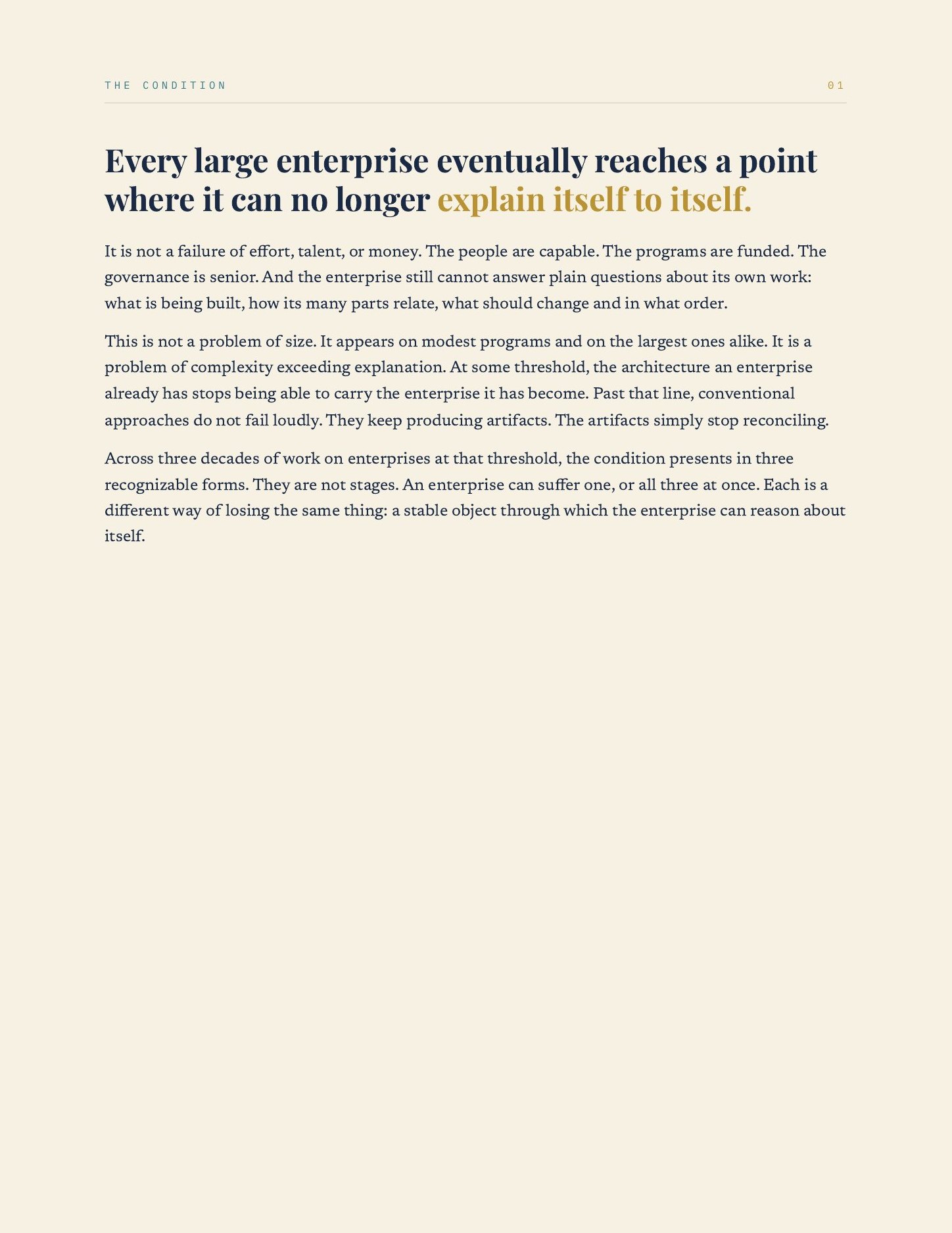
Every large enterprise eventually reaches a point where it can no longer explain itself to itself.
It is not a failure of effort, talent, or money. The people are capable. The programs are funded. The governance is senior. And the enterprise still cannot answer plain questions about its own work: what is being built, how its many parts relate, what should change and in what order.
This is not a problem of size. It appears on modest programs and on the largest ones alike. It is a problem of complexity exceeding explanation. At some threshold, the architecture an enterprise already has stops being able to carry the enterprise it has become. Past that line, conventional approaches do not fail loudly. They keep producing artifacts. The artifacts simply stop reconciling.
Across three decades of work on enterprises at that threshold, the condition presents in three recognizable forms. They are not stages. An enterprise can suffer one, or all three at once. Each is a different way of losing the same thing: a stable object through which the enterprise can reason about itself.
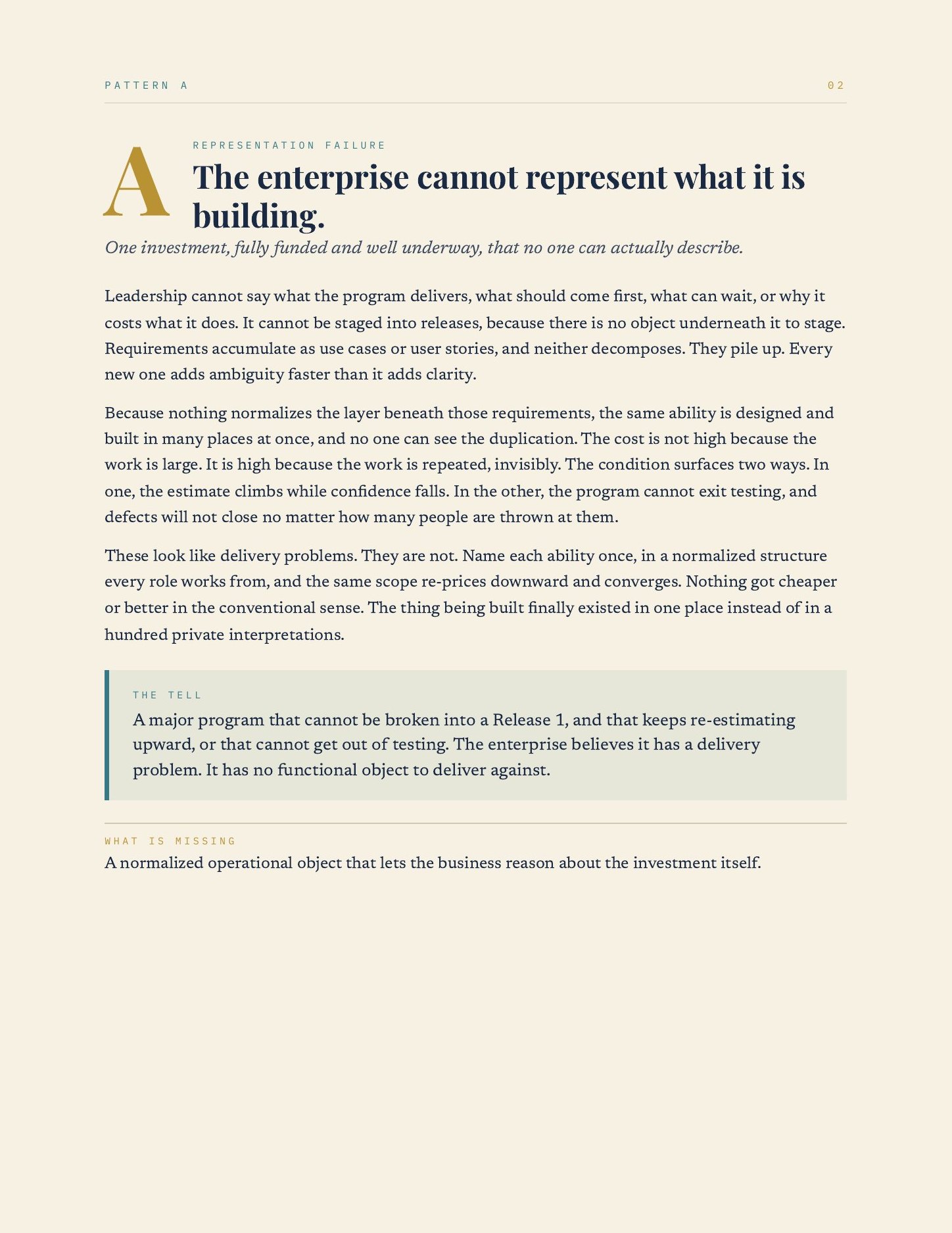
The enterprise cannot represent what it is building.
One investment, fully funded and well underway, that no one can actually describe.
Leadership cannot say what the program delivers, what should come first, what can wait, or why it costs what it does. It cannot be staged into releases, because there is no object underneath it to stage. Requirements accumulate as use cases or user stories, and neither decomposes. They pile up. Every new one adds ambiguity faster than it adds clarity.
Because nothing normalizes the layer beneath those requirements, the same ability is designed and built in many places at once, and no one can see the duplication. The cost is not high because the work is large. It is high because the work is repeated, invisibly. The condition surfaces two ways. In one, the estimate climbs while confidence falls. In the other, the program cannot exit testing, and defects will not close no matter how many people are thrown at them.
These look like delivery problems. They are not. Name each ability once, in a normalized structure every role works from, and the same scope re-prices downward and converges. Nothing got cheaper or better in the conventional sense. The thing being built finally existed in one place instead of in a hundred private interpretations.
A major program that cannot be broken into a Release 1, and that keeps re-estimating upward, or that cannot get out of testing. The enterprise believes it has a delivery problem. It has no functional object to deliver against.
A normalized operational object that lets the business reason about the investment itself.
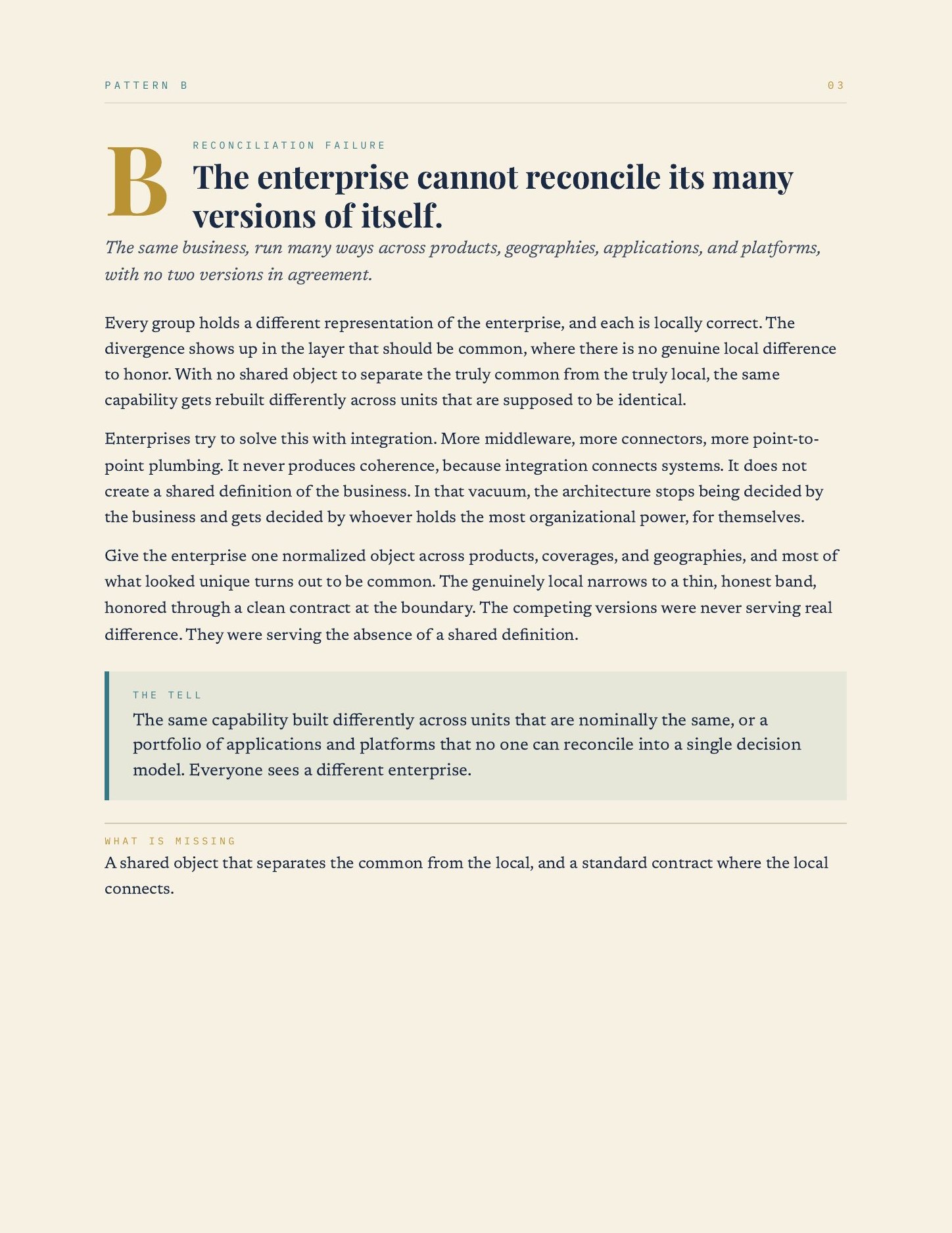
The enterprise cannot reconcile its many versions of itself.
The same business, run many ways across products, geographies, applications, and platforms, with no two versions in agreement.
Every group holds a different representation of the enterprise, and each is locally correct. The divergence shows up in the layer that should be common, where there is no genuine local difference to honor. With no shared object to separate the truly common from the truly local, the same capability gets rebuilt differently across units that are supposed to be identical.
Enterprises try to solve this with integration. More middleware, more connectors, more point-to-point plumbing. It never produces coherence, because integration connects systems. It does not create a shared definition of the business. In that vacuum, the architecture stops being decided by the business and gets decided by whoever holds the most organizational power, for themselves.
Give the enterprise one normalized object across products, coverages, and geographies, and most of what looked unique turns out to be common. The genuinely local narrows to a thin, honest band, honored through a clean contract at the boundary. The competing versions were never serving real difference. They were serving the absence of a shared definition.
The same capability built differently across units that are nominally the same, or a portfolio of applications and platforms that no one can reconcile into a single decision model. Everyone sees a different enterprise.
A shared object that separates the common from the local, and a standard contract where the local connects.
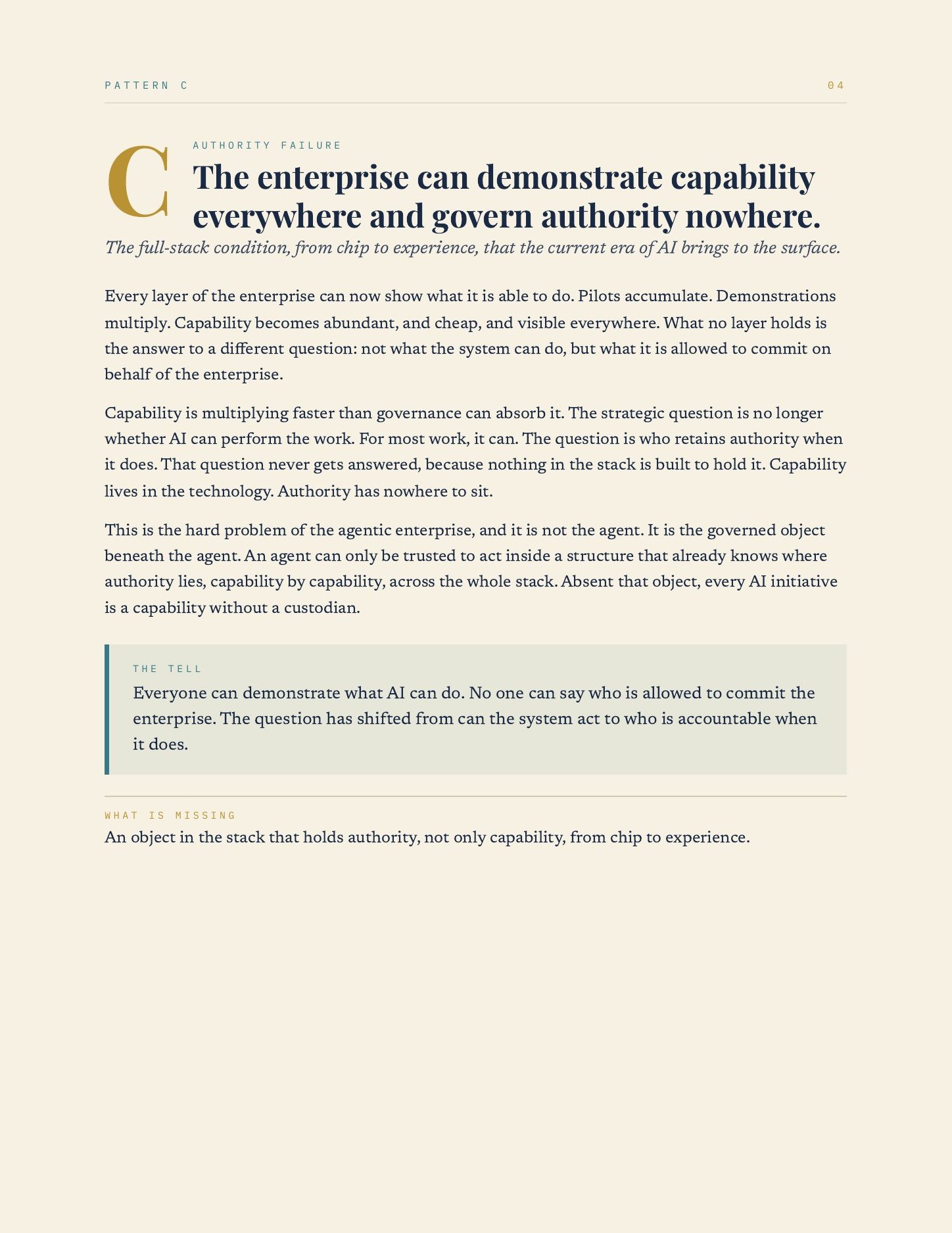
The enterprise can demonstrate capability everywhere and govern authority nowhere.
The full-stack condition, from chip to experience, that the current era of AI brings to the surface.
Every layer of the enterprise can now show what it is able to do. Pilots accumulate. Demonstrations multiply. Capability becomes abundant, and cheap, and visible everywhere. What no layer holds is the answer to a different question: not what the system can do, but what it is allowed to commit on behalf of the enterprise.
Capability is multiplying faster than governance can absorb it. The strategic question is no longer whether AI can perform the work. For most work, it can. The question is who retains authority when it does. That question never gets answered, because nothing in the stack is built to hold it. Capability lives in the technology. Authority has nowhere to sit.
This is the hard problem of the agentic enterprise, and it is not the agent. It is the governed object beneath the agent. An agent can only be trusted to act inside a structure that already knows where authority lies, capability by capability, across the whole stack. Absent that object, every AI initiative is a capability without a custodian.
Everyone can demonstrate what AI can do. No one can say who is allowed to commit the enterprise. The question has shifted from can the system act to who is accountable when it does.
An object in the stack that holds authority, not only capability, from chip to experience.
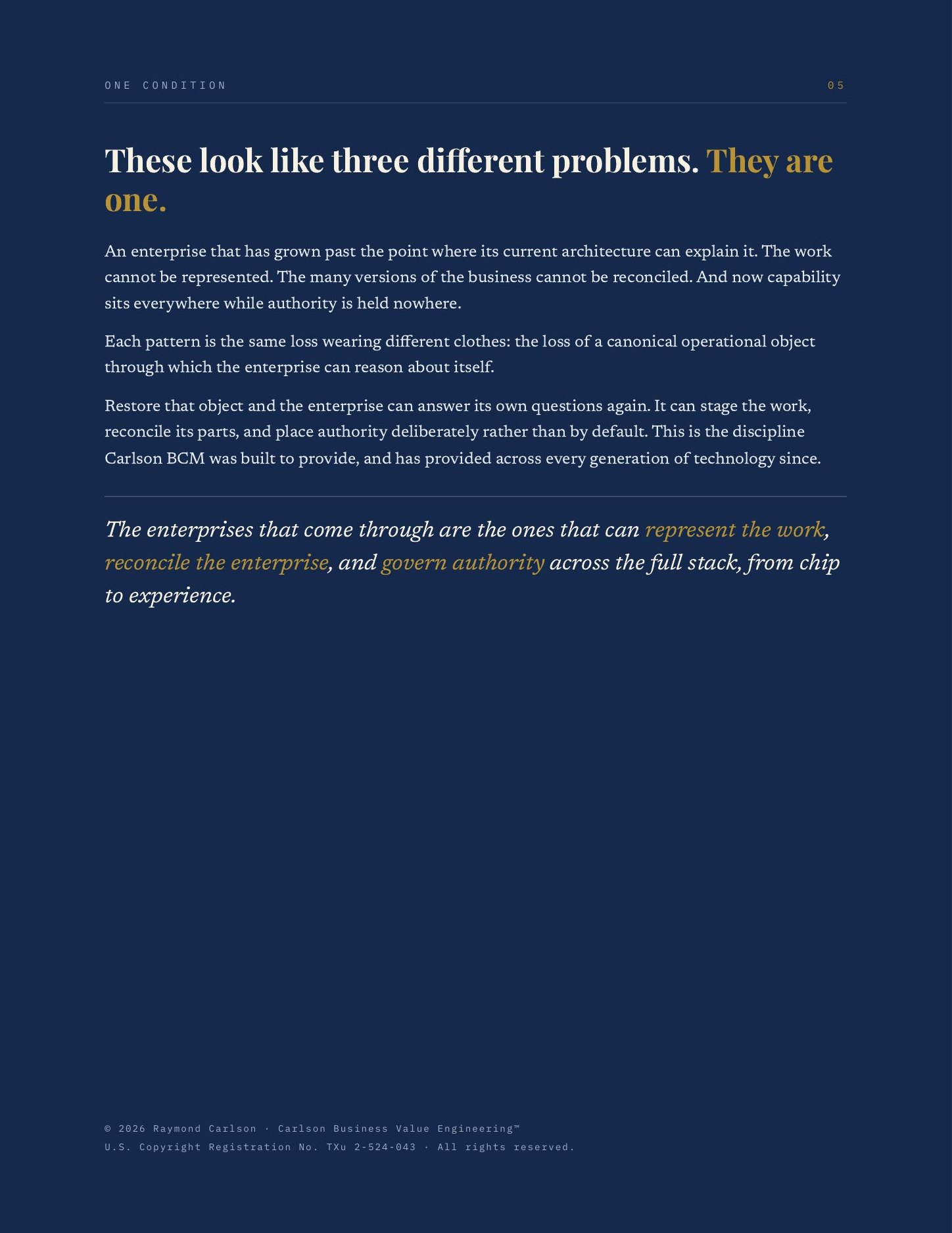
These look like three different problems. They are one.
An enterprise that has grown past the point where its current architecture can explain it. The work cannot be represented. The many versions of the business cannot be reconciled. And now capability sits everywhere while authority is held nowhere.
Each pattern is the same loss wearing different clothes: the loss of a canonical operational object through which the enterprise can reason about itself.
Restore that object and the enterprise can answer its own questions again. It can stage the work, reconcile its parts, and place authority deliberately rather than by default. This is the discipline Carlson BCM was built to provide, and has provided across every generation of technology since.
The enterprises that come through are the ones that can represent the work, reconcile the enterprise, and govern authority across the full stack, from chip to experience.