 Carlson BCM
Read as text
Every restructuring runs the same way. The smart people do the analysis, close the deal, and hand the actual work to a team with no method to do it.
The deal team does the financials, the market analysis, the deal-making. They line up the money, they enact the transaction, and they walk away. What is left is a room full of capable people, business analysts, subject-matter experts, business leaders, technology leads, told to figure out the integration or the separation. They were never a restructuring team. None of them has a method for redrawing an enterprise. None of them has a language for it. None brings a structural discipline to it. So it becomes the thing every company has lived through: the integration that turns into a months-long scramble, where the real entanglements surface one at a time, at the worst possible moment, and the cost lands long after the deal was priced.
Restructuring is not only an acquisition problem. The same act, redrawing the boundary of what belongs with what, happens when you merge, when you divest, when you acquire, and when you reorganize inside a single company with no transaction at all: two lines of business pulled apart, two geographies combined, a shared platform split. In every case the question is identical. Where does the business actually divide, and what has to move with it.
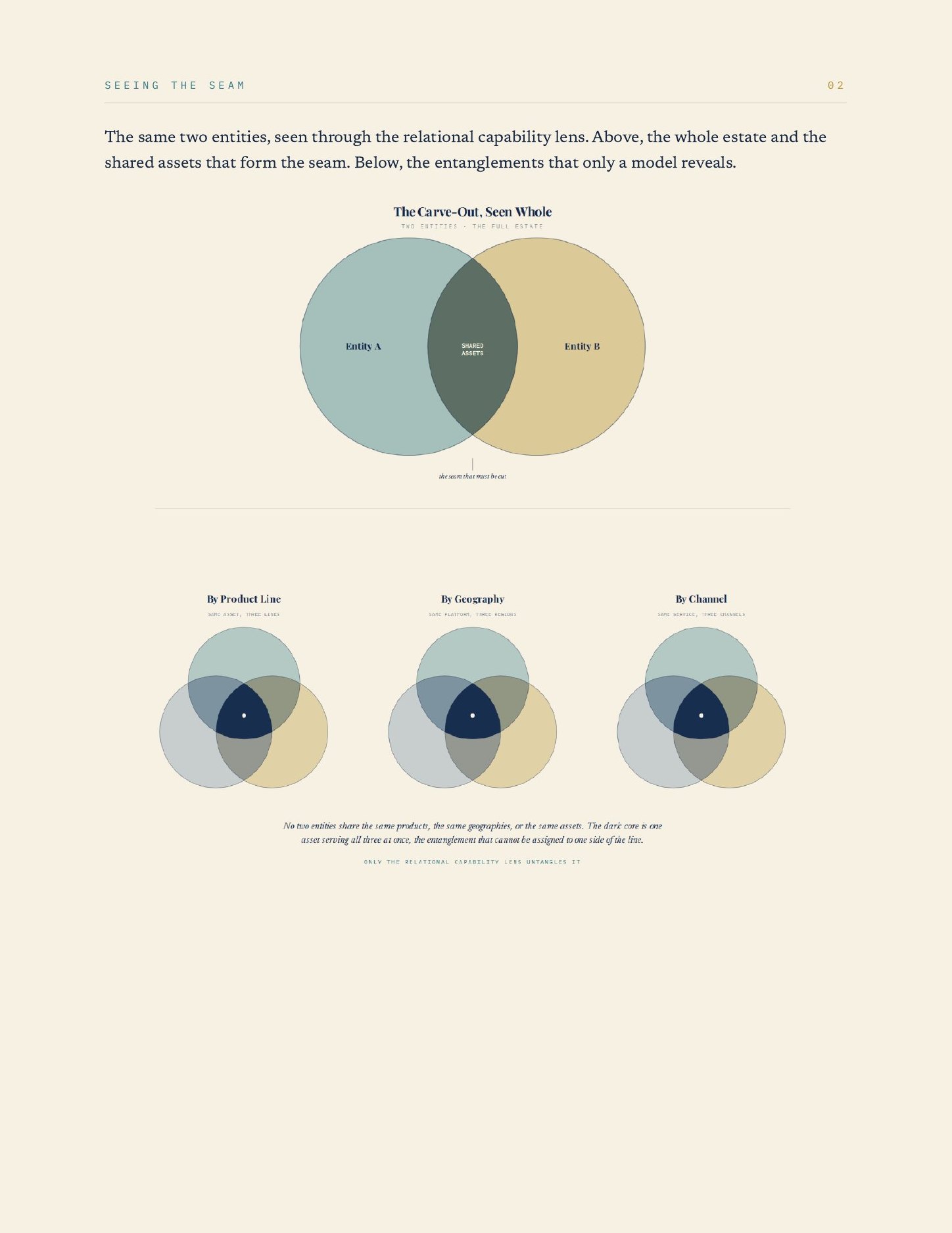
The honest answer is that the enterprise cannot see its own seam. The org chart says one thing. The application inventory says another. Neither is where the business truly separates, because the dependencies that decide the split do not live at either level. They live underneath, in the chain that runs from a business capability down through the applications that realize it to the infrastructure those applications sit on. A capability shared across both sides of the line is invisible on an org chart and looks like two unrelated systems on an inventory. You discover it only when you try to cut, and it does not cut.
The work everyone defers to integration is the work that should have driven the decision. It gets deferred because no one has a model that shows where the business, its applications, and its infrastructure actually connect, so the separation is planned against documents that do not describe the real entanglement.
The same two entities, seen through the relational capability lens. Above, the whole estate and the shared assets that form the seam. Below, the entanglements that only a model reveals.
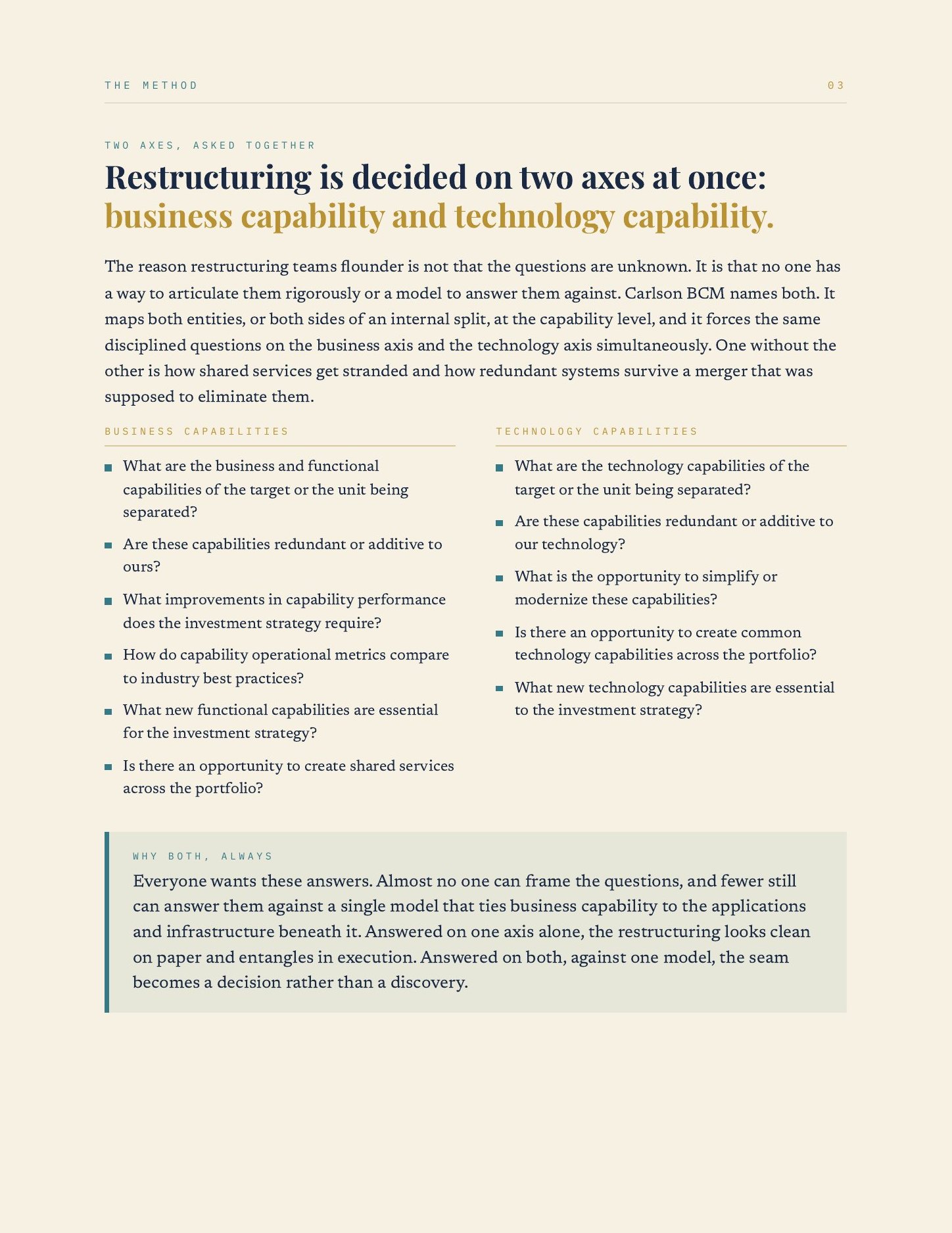
Restructuring is decided on two axes at once: business capability and technology capability.
The reason restructuring teams flounder is not that the questions are unknown. It is that no one has a way to articulate them rigorously or a model to answer them against. Carlson BCM names both. It maps both entities, or both sides of an internal split, at the capability level, and it forces the same disciplined questions on the business axis and the technology axis simultaneously. One without the other is how shared services get stranded and how redundant systems survive a merger that was supposed to eliminate them.
What are the business and functional capabilities of the target or the unit being separated?
What are the technology capabilities of the target or the unit being separated?
Are these capabilities redundant or additive to our technology?
Are these capabilities redundant or additive to ours?
What is the opportunity to simplify or modernize these capabilities?
What improvements in capability performance does the investment strategy require?
Is there an opportunity to create common technology capabilities across the portfolio?
How do capability operational metrics compare to industry best practices?
What new technology capabilities are essential to the investment strategy?
What new functional capabilities are essential for the investment strategy?
Is there an opportunity to create shared services across the portfolio?
Everyone wants these answers. Almost no one can frame the questions, and fewer still can answer them against a single model that ties business capability to the applications and infrastructure beneath it. Answered on one axis alone, the restructuring looks clean on paper and entangles in execution. Answered on both, against one model, the seam becomes a decision rather than a discovery.
The method does not care when you bring it. It pays before the deal, after the close, and inside a restructuring with no deal at all.
Brought forward into diligence, it tells the buyer what they are actually acquiring and what it will cost to separate or combine, before the price is set. That is the move that turns a restructuring from a leap into a calculation.
Brought to a separation already underway, at day 2, it gives the team the thing they were never handed: a method, a language, and a model that maps both sides at the capability level, and lets them decide where the line actually falls. It accelerates a separation that would otherwise be discovered one painful entanglement at a time.
This is not new ground. Carlson BCM has operated in this realm for three decades, alongside private equity firms on transaction diligence and inside major enterprises on carve-outs and separations, including the hardest pattern of all, where two divesting businesses share a single platform down to the database and the compute, and no inventory shows where one ends and the other begins. The method has surfaced that seam, every time, before the cut.
Restructuring is the act of redrawing a boundary. The enterprises that do it cleanly are the ones that can see the seam before they cut.