 Carlson BCM
Read as text
Workforce impact is not determined by automation. It is determined by the relationship between authority and execution.
hat follows is a business capability model for a database platform.
A capability model has always described what an enterprise does, and it has always lived at the business-process layer. This one is applied one layer below, to the technical substrate itself, and the discipline holds. The modern data platform does not store data. It internalizes execution: it ingests, scales, optimizes, tunes, backs up, secures, and enforces, without the operational labor those tasks once demanded. Read this way, that is its essence. Execution has moved inside the machine.
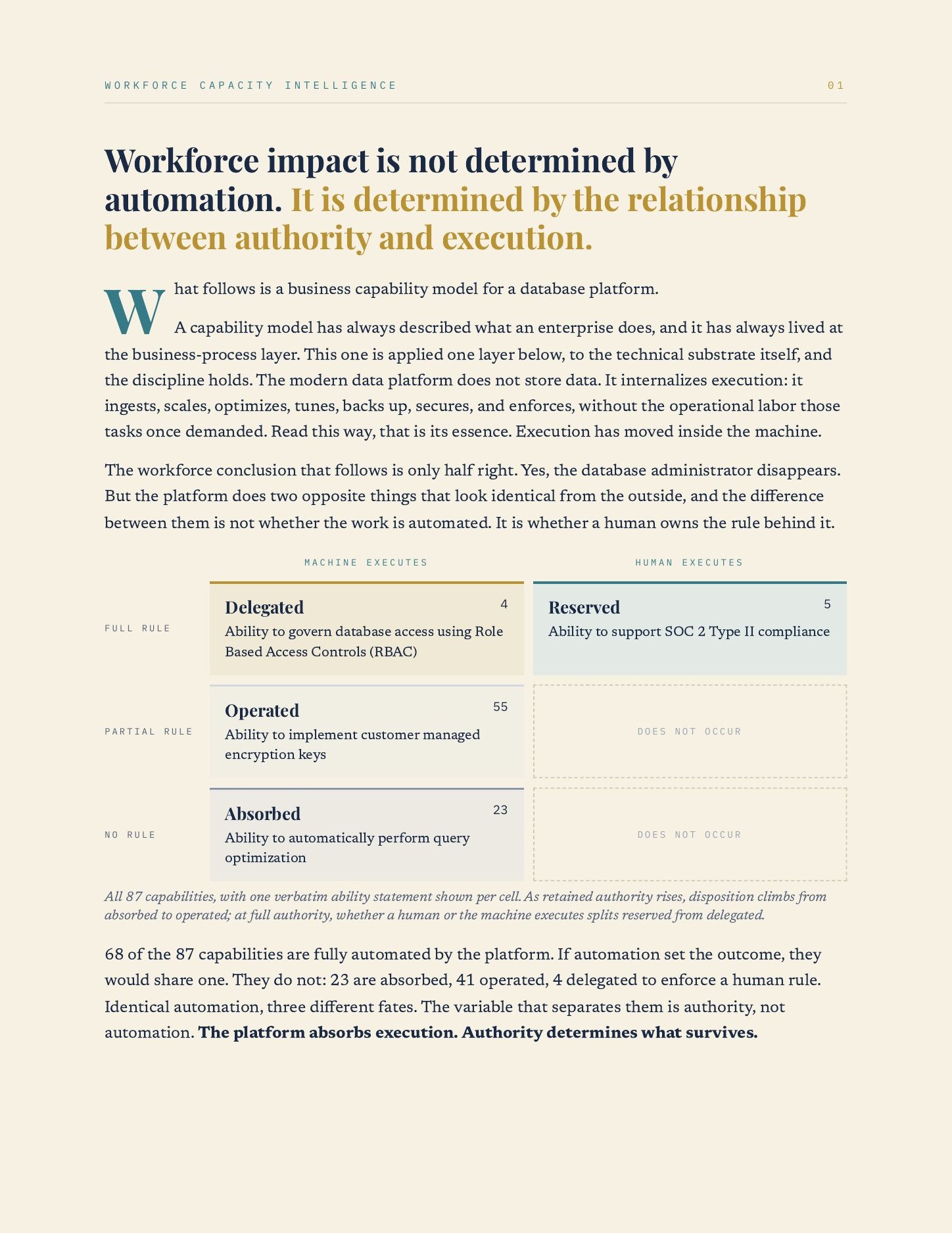
The workforce conclusion that follows is only half right. Yes, the database administrator disappears. But the platform does two opposite things that look identical from the outside, and the difference between them is not whether the work is automated. It is whether a human owns the rule behind it.
Ability to govern database access using Role Based Access Controls (RBAC)
All 87 capabilities, with one verbatim ability statement shown per cell. As retained authority rises, disposition climbs from absorbed to operated; at full authority, whether a human or the machine executes splits reserved from delegated.
68 of the 87 capabilities are fully automated by the platform. If automation set the outcome, they would share one. They do not: 23 are absorbed, 41 operated, 4 delegated to enforce a human rule. Identical automation, three different fates. The variable that separates them is authority, not automation. The platform absorbs execution. Authority determines what survives.
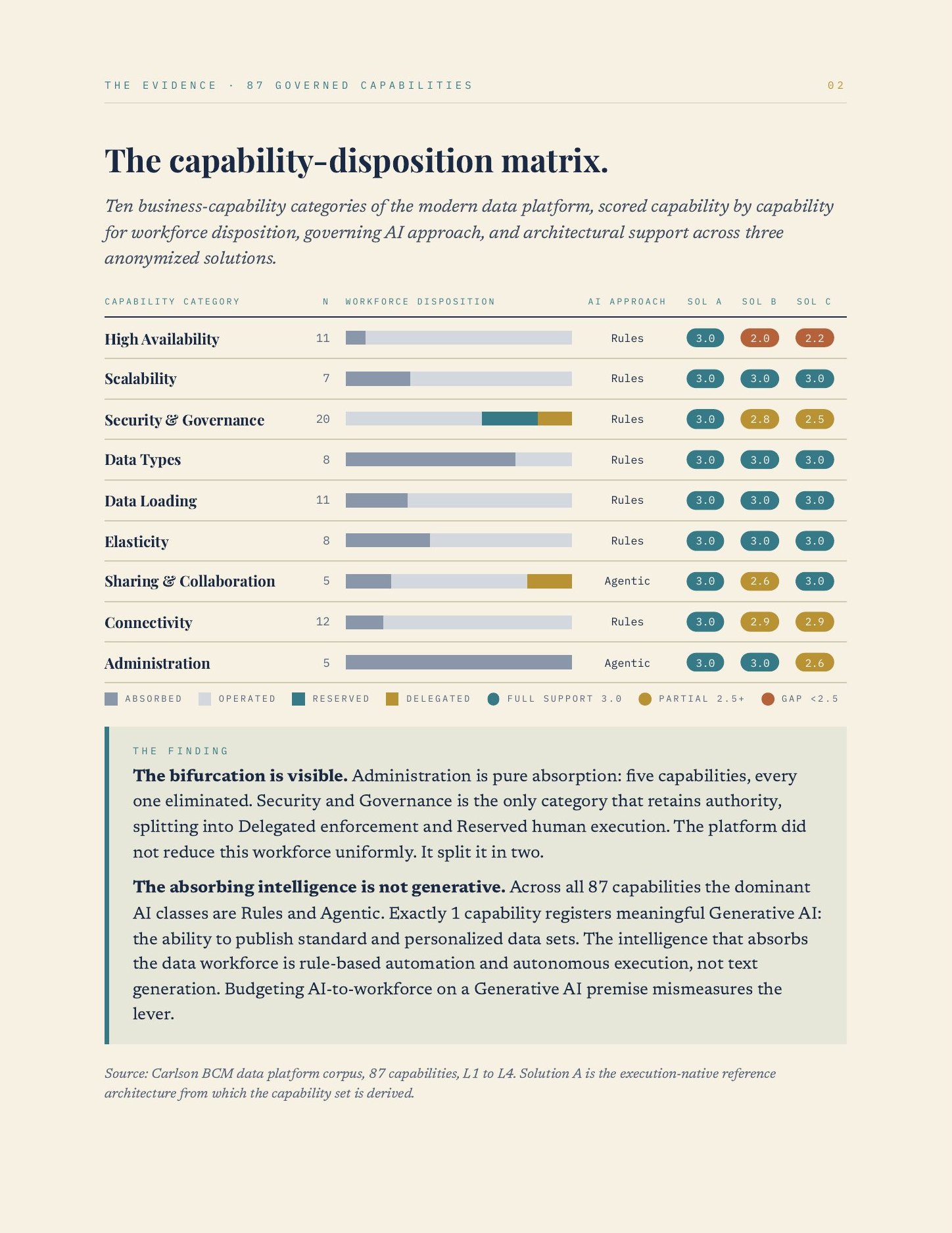
The capability-disposition matrix.
Ten business-capability categories of the modern data platform, scored capability by capability for workforce disposition, governing AI approach, and architectural support across three anonymized solutions.
The bifurcation is visible. Administration is pure absorption: five capabilities, every one eliminated. Security and Governance is the only category that retains authority, splitting into Delegated enforcement and Reserved human execution. The platform did not reduce this workforce uniformly. It split it in two.
The absorbing intelligence is not generative. Across all 87 capabilities the dominant AI classes are Rules and Agentic. Exactly 1 capability registers meaningful Generative AI: the ability to publish standard and personalized data sets. The intelligence that absorbs the data workforce is rule-based automation and autonomous execution, not text generation. Budgeting AI-to-workforce on a Generative AI premise mismeasures the lever.
Source: Carlson BCM data platform corpus, 87 capabilities, L1 to L4. Solution A is the execution-native reference architecture from which the capability set is derived.
Which roles the platform absorbs, and which it cannot.
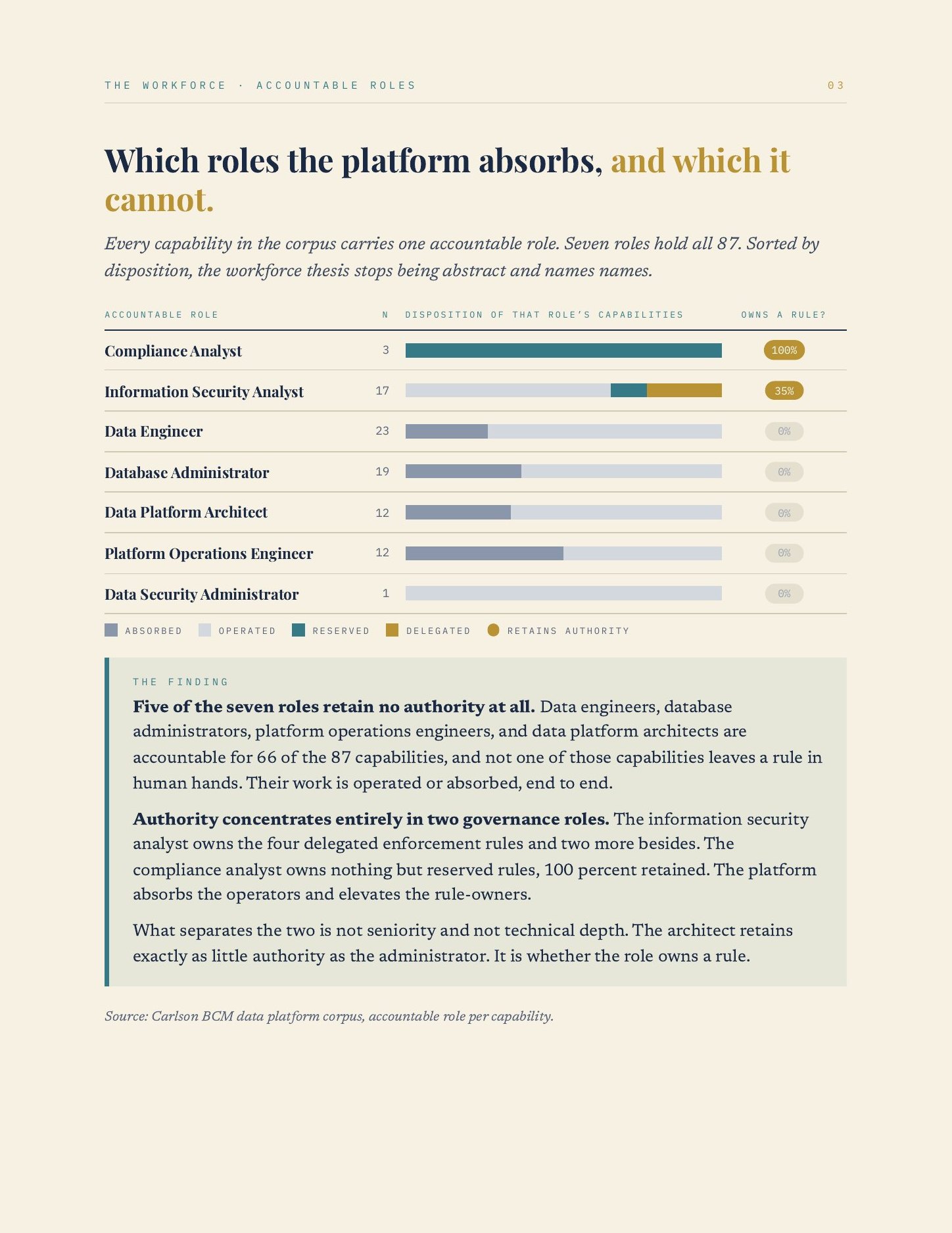
Every capability in the corpus carries one accountable role. Seven roles hold all 87. Sorted by disposition, the workforce thesis stops being abstract and names names.
Five of the seven roles retain no authority at all. Data engineers, database administrators, platform operations engineers, and data platform architects are accountable for 66 of the 87 capabilities, and not one of those capabilities leaves a rule in human hands. Their work is operated or absorbed, end to end.
Authority concentrates entirely in two governance roles. The information security analyst owns the four delegated enforcement rules and two more besides. The compliance analyst owns nothing but reserved rules, 100 percent retained. The platform absorbs the operators and elevates the rule-owners.
What separates the two is not seniority and not technical depth. The architect retains exactly as little authority as the administrator. It is whether the role owns a rule.
Source: Carlson BCM data platform corpus, accountable role per capability.
What a feature checklist cannot see.
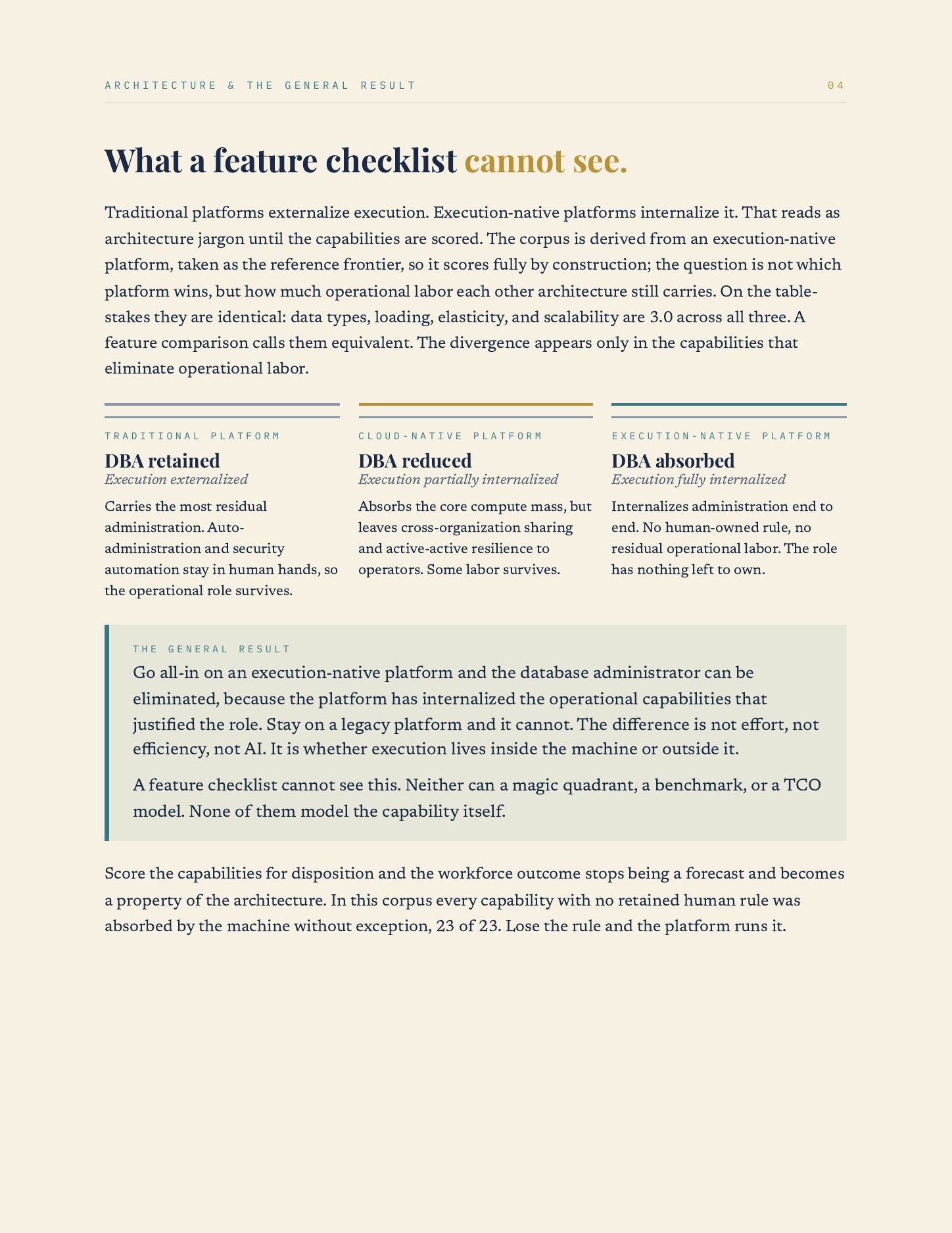
Traditional platforms externalize execution. Execution-native platforms internalize it. That reads as architecture jargon until the capabilities are scored. The corpus is derived from an execution-native platform, taken as the reference frontier, so it scores fully by construction; the question is not which platform wins, but how much operational labor each other architecture still carries. On the table-stakes they are identical: data types, loading, elasticity, and scalability are 3.0 across all three. A feature comparison calls them equivalent. The divergence appears only in the capabilities that eliminate operational labor.
Carries the most residual administration. Auto-administration and security automation stay in human hands, so operators. Some labor survives. the operational role survives.
Absorbs the core compute mass, but Internalizes administration end to leaves cross-organization sharing and active-active resilience to end. No human-owned rule, no residual operational labor. The role has nothing left to own.
Go all-in on an execution-native platform and the database administrator can be eliminated, because the platform has internalized the operational capabilities that justified the role. Stay on a legacy platform and it cannot. The difference is not effort, not efficiency, not AI. It is whether execution lives inside the machine or outside it.
A feature checklist cannot see this. Neither can a magic quadrant, a benchmark, or a TCO model. None of them model the capability itself.
Score the capabilities for disposition and the workforce outcome stops being a forecast and becomes a property of the architecture. In this corpus every capability with no retained human rule was absorbed by the machine without exception, 23 of 23. Lose the rule and the platform runs it.
Platform migration is authority migration.
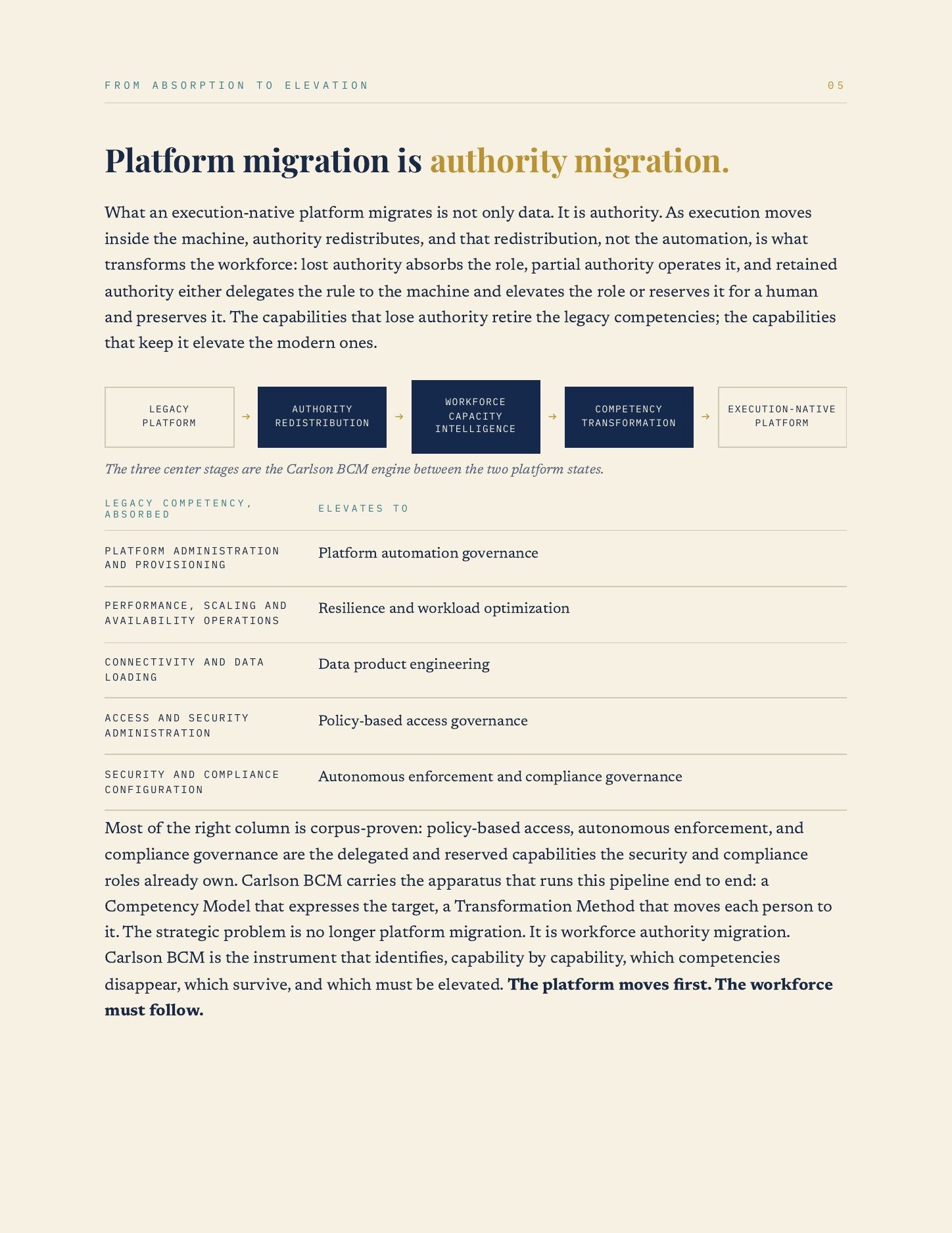
What an execution-native platform migrates is not only data. It is authority. As execution moves inside the machine, authority redistributes, and that redistribution, not the automation, is what transforms the workforce: lost authority absorbs the role, partial authority operates it, and retained authority either delegates the rule to the machine and elevates the role or reserves it for a human and preserves it. The capabilities that lose authority retire the legacy competencies; the capabilities that keep it elevate the modern ones.
The three center stages are the Carlson BCM engine between the two platform states.
Most of the right column is corpus-proven: policy-based access, autonomous enforcement, and compliance governance are the delegated and reserved capabilities the security and compliance roles already own. Carlson BCM carries the apparatus that runs this pipeline end to end: a Competency Model that expresses the target, a Transformation Method that moves each person to it. The strategic problem is no longer platform migration. It is workforce authority migration. Carlson BCM is the instrument that identifies, capability by capability, which competencies disappear, which survive, and which must be elevated. The platform moves first. The workforce must follow.
And this is the first descent.
The capability model has always stopped at the business process; here it held one real layer below, on the platform itself, and did not break. The first evidence that the discipline reads capability structure beneath the enterprise layer. Chip to experience is the horizon this opens. How far down it reads is the next paper.
Relational by discipline. Beyond relational by design.