 Carlson BCM

Read as text
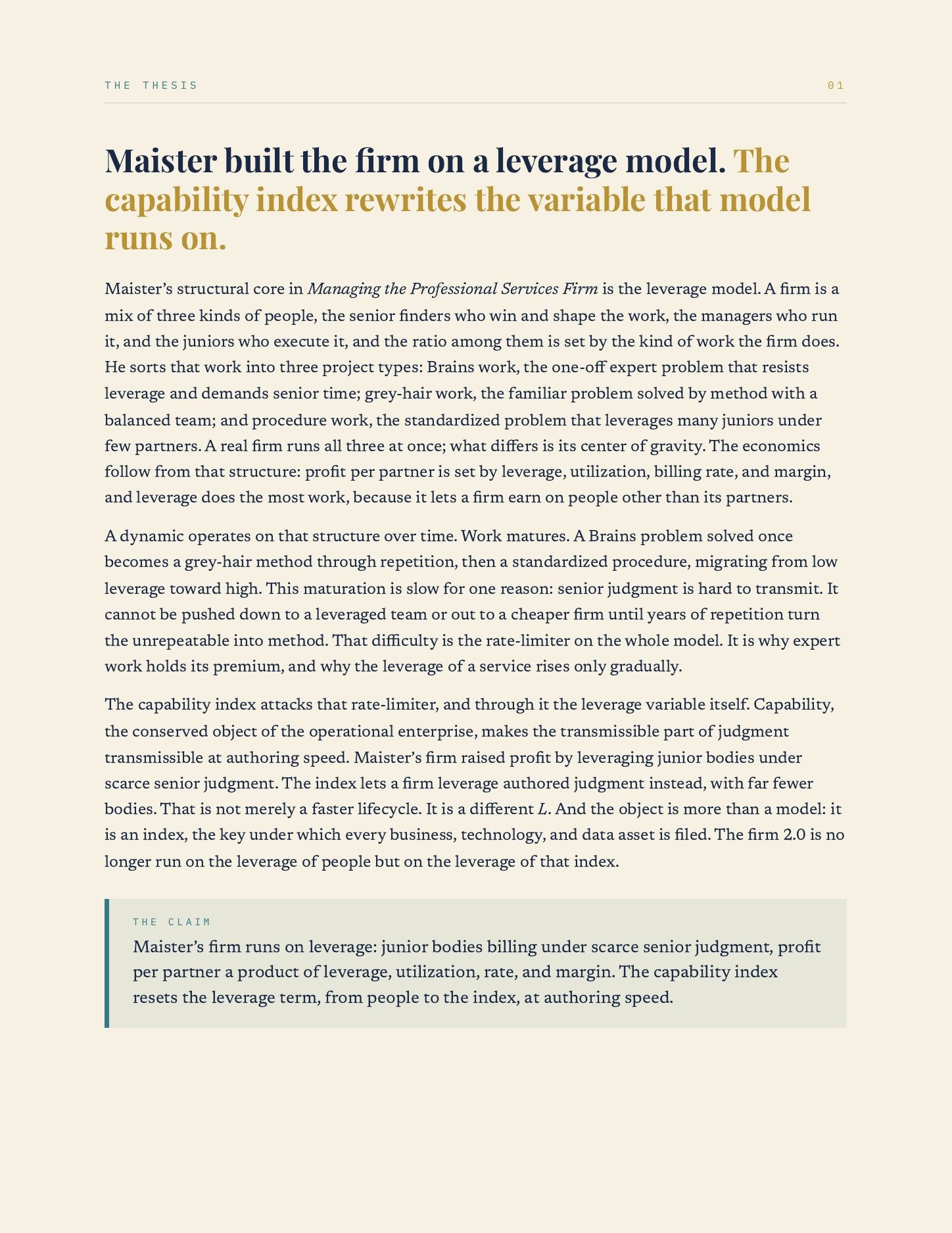
Maister built the firm on a leverage model. The capability index rewrites the variable that model runs on.
Maister’s structural core in Managing the Professional Services Firm is the leverage model. A firm is a mix of three kinds of people, the senior finders who win and shape the work, the managers who run it, and the juniors who execute it, and the ratio among them is set by the kind of work the firm does. He sorts that work into three project types: Brains work, the one-off expert problem that resists leverage and demands senior time; grey-hair work, the familiar problem solved by method with a balanced team; and procedure work, the standardized problem that leverages many juniors under few partners. A real firm runs all three at once; what differs is its center of gravity. The economics follow from that structure: profit per partner is set by leverage, utilization, billing rate, and margin, and leverage does the most work, because it lets a firm earn on people other than its partners.
A dynamic operates on that structure over time. Work matures. A Brains problem solved once becomes a grey-hair method through repetition, then a standardized procedure, migrating from low leverage toward high. This maturation is slow for one reason: senior judgment is hard to transmit. It cannot be pushed down to a leveraged team or out to a cheaper firm until years of repetition turn the unrepeatable into method. That difficulty is the rate-limiter on the whole model. It is why expert work holds its premium, and why the leverage of a service rises only gradually.
The capability index attacks that rate-limiter, and through it the leverage variable itself. Capability, the conserved object of the operational enterprise, makes the transmissible part of judgment transmissible at authoring speed. Maister’s firm raised profit by leveraging junior bodies under scarce senior judgment. The index lets a firm leverage authored judgment instead, with far fewer bodies. That is not merely a faster lifecycle. It is a different L is an index, the key under which every business, technology, and data asset is filed. The firm 2.0 is no longer run on the leverage of people but on the leverage of that index.
. And the object is more than a model: it
Maister’s firm runs on leverage: junior bodies billing under scarce senior judgment, profit per partner a product of leverage, utilization, rate, and margin. The capability index resets the leverage term, from people to the index, at authoring speed.
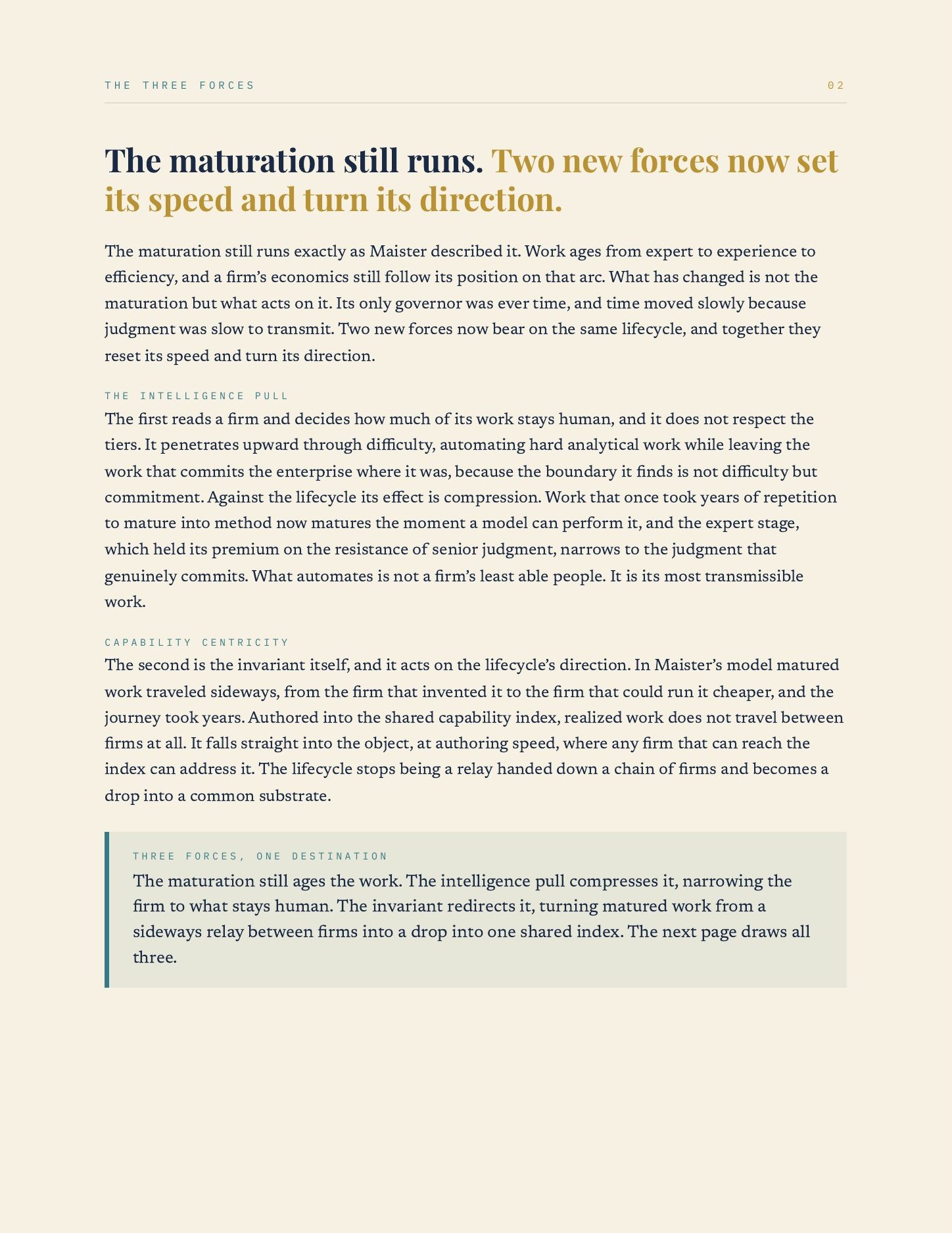
The maturation still runs. Two new forces now set its speed and turn its direction.
The maturation still runs exactly as Maister described it. Work ages from expert to experience to efficiency, and a firm’s economics still follow its position on that arc. What has changed is not the maturation but what acts on it. Its only governor was ever time, and time moved slowly because judgment was slow to transmit. Two new forces now bear on the same lifecycle, and together they reset its speed and turn its direction.
The first reads a firm and decides how much of its work stays human, and it does not respect the tiers. It penetrates upward through difficulty, automating hard analytical work while leaving the work that commits the enterprise where it was, because the boundary it finds is not difficulty but commitment. Against the lifecycle its effect is compression. Work that once took years of repetition to mature into method now matures the moment a model can perform it, and the expert stage, which held its premium on the resistance of senior judgment, narrows to the judgment that genuinely commits. What automates is not a firm’s least able people. It is its most transmissible work.
The second is the invariant itself, and it acts on the lifecycle’s direction. In Maister’s model matured work traveled sideways, from the firm that invented it to the firm that could run it cheaper, and the journey took years. Authored into the shared capability index, realized work does not travel between firms at all. It falls straight into the object, at authoring speed, where any firm that can reach the index can address it. The lifecycle stops being a relay handed down a chain of firms and becomes a drop into a common substrate.
The maturation still ages the work. The intelligence pull compresses it, narrowing the firm to what stays human. The invariant redirects it, turning matured work from a sideways relay between firms into a drop into one shared index. The next page draws all three.
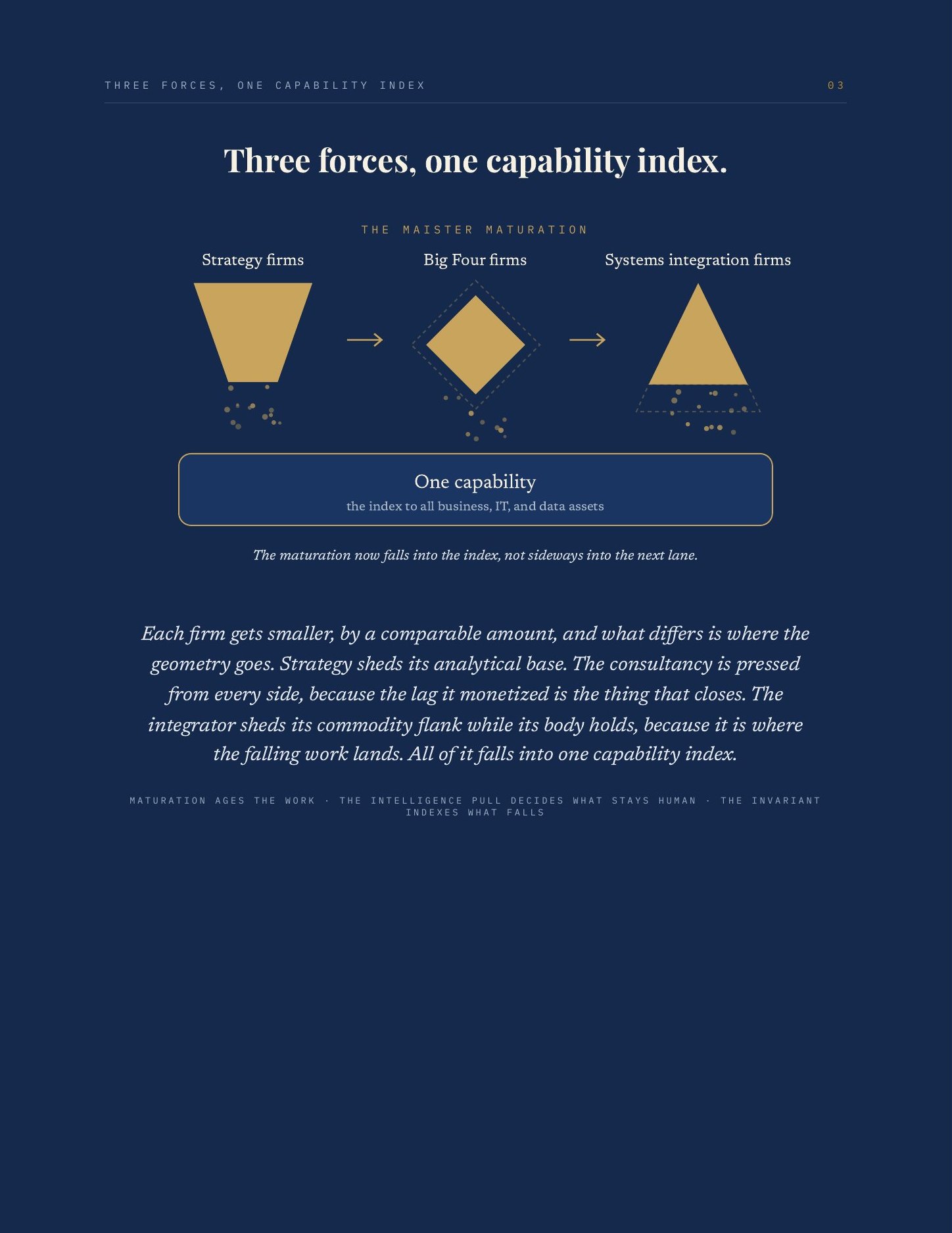
Three forces, one capability index.
The maturation now falls into the index, not sideways into the next lane.
Each firm gets smaller, by a comparable amount, and what differs is where the
geometry goes. Strategy sheds its analytical base. The consultancy is pressed
from every side, because the lag it monetized is the thing that closes. The
integrator sheds its commodity flank while its body holds, because it is where
the falling work lands. All of it falls into one capability index.
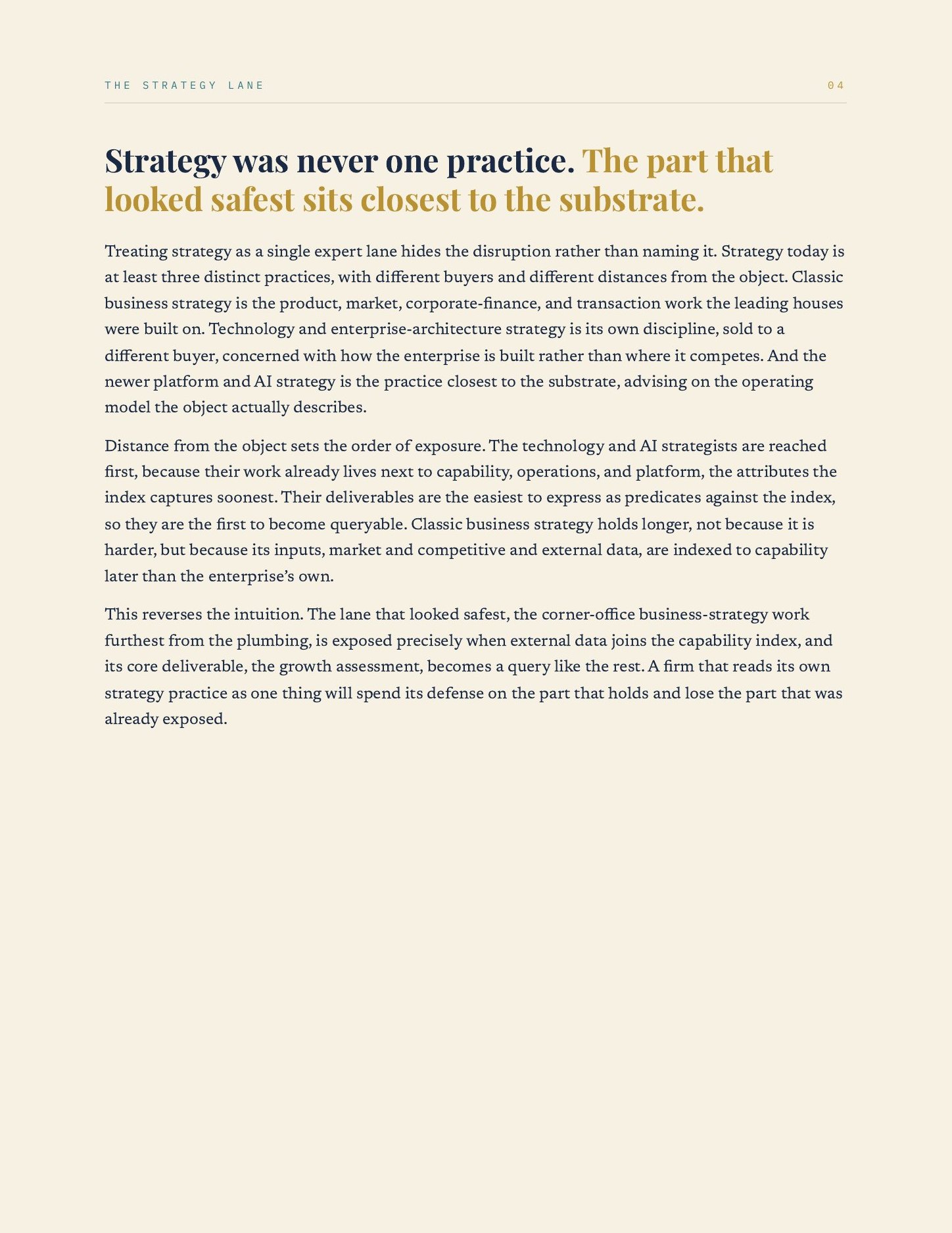
Strategy was never one practice. The part that looked safest sits closest to the substrate.
Treating strategy as a single expert lane hides the disruption rather than naming it. Strategy today is at least three distinct practices, with different buyers and different distances from the object. Classic business strategy is the product, market, corporate-finance, and transaction work the leading houses were built on. Technology and enterprise-architecture strategy is its own discipline, sold to a different buyer, concerned with how the enterprise is built rather than where it competes. And the newer platform and AI strategy is the practice closest to the substrate, advising on the operating model the object actually describes.
Distance from the object sets the order of exposure. The technology and AI strategists are reached first, because their work already lives next to capability, operations, and platform, the attributes the index captures soonest. Their deliverables are the easiest to express as predicates against the index, so they are the first to become queryable. Classic business strategy holds longer, not because it is harder, but because its inputs, market and competitive and external data, are indexed to capability later than the enterprise’s own.
This reverses the intuition. The lane that looked safest, the corner-office business-strategy work furthest from the plumbing, is exposed precisely when external data joins the capability index, and its core deliverable, the growth assessment, becomes a query like the rest. A firm that reads its own strategy practice as one thing will spend its defense on the part that holds and lose the part that was already exposed.
The capability index makes strategy formation queryable. The assembly that justified the team is what it absorbs.
Strategy, operations, and technology are the three attribute families, and every kind of data files under one of them. Customer and product data are operational. Market and competitive data are strategic. Systems and platform data are technology. Capability is the key that lets them interrelate, and without that key the enterprise holds its data in piles that cannot be queried against each other. With it, the relationships become predicates: where a carrier can grow in annuity, which coverage to add and in which geographies, which of two merging books has the better claims operation, who can actually run first notice of loss across both APAC and the US. These were the expert lane’s redoubt, because they required a firm to assemble a fact base no one else held.
The index removes the assembly. Once capability interrelates not only enterprise data but market, product, geographic, and external data, the strategy formation itself becomes a query against the capability index. And that query is not lane-bound. The assessment that one firm authored once, slowly, becomes a predicate any firm reaching the index can run. The gathering and the synthesis that justified the team and the premium is exactly what the index absorbs.
What it does not absorb is two things, and they are what the firm has left to stand on. The first is authoring the index: getting the right capabilities, products, markets, and external signals filed under the right key. That is the recognition act, and it is still expert and still human. The second is the commitment, standing behind the recommendation the query returns. The query proposes. A human commits. The middle is gone, and the middle is what most of the firm used to be.
There is a competing bet. Point enough intelligence at enough data and structure is unnecessary. It is wrong, and the error is architectural.
The strongest case against this paper is that the capability index is obsolete before it is built. Ingest everything, point a general model at the lake, and let it find the pattern. The platform companies are running that bet at scale. The prediction here is that they lose the same account to a firm that arrives with the authored index. And that they lose it permanently.
The reason is not effort. It is structure. Intelligence over an unindexed lake reasons across instances with no schema. It returns correlations over raw data that has not been rationalized, normalized, or semantically resolved. It cannot answer a capability question, because the capability the question is about was never authored. Mass ingestion scales the data. It does not manufacture the invariant. And as intelligence becomes general, the gap does not close. It widens. Intelligence applied to an index compounds. Applied to a lake, it only produces faster correlations over noise.
So the scarce asset, as data becomes ubiquitous and intelligence becomes general, is neither the data nor the reasoning. It is the capability index that makes both addressable, and the index is authored, not bought. The recognition step is the one thing more ingestion cannot produce: deciding what in the raw signal even counts as a capability, and filing it under the right key.
Ingestion scales the data. Indexing makes it mean something. As intelligence becomes general, the capability index is the last scarce advantage, because it is the one thing intelligence needs and ingestion cannot author.
The same event reaches every firm, and asks each a different question.
Their lane is not one thing, and their safest-looking practice is their most exposed. The move is to become the authors of the capability index rather than the assemblers of the picture, because authoring is the frontier that does not mechanize, and to do it first where they are hit first, in technology and AI strategy.
The lag they monetized, the years between a method existing and a method becoming general, is exactly what the transduction closes. The squeeze comes from every side and it is structural. The move is to convert their methods into authored capability they own in the index, not to defend a gap that is already closing.
Translating the realization, code from one language to another, is motion and not transformation, because the operational object stays as illegible as before. Their body survives, and they are where the falling work lands, but only if they stop skipping the index at the data layer where they operate. The firm that indexes the data does the work the firm that skips it can only pretend to do faster.
The hardest lesson. Ingestion is not a substitute for the index. The intelligence is real and the data is vast, and both are pointed at a lake that nothing has rationalized. The firm that arrives with the authored index wins the account, and no additional ingestion closes the gap, because the gap is the index itself.
The capability index does more than absorb the middle. It opens the boundary every firm was held behind.
The lane was never a wall of competence. It was a limit on reach, held in place by the absence of a shared object, and the capability index removes it. For the first time a firm can act across the boundary that used to define it, because the object connecting strategy, operations, and technology is addressable by anyone who can reach it. The structure that once confined each firm to a single layer becomes a structure each firm can move through.
The new reach runs both ways. A strategy firm’s recommendations once stopped at the edge of advice. Now it can execute down into operations and technology, because the index carries its authored judgment into delivery with no second firm in the loop. An integrator once began work only after someone else had formed the strategy. Now it can reach up into strategy formation itself, because that formation is a query it can run too. The consultancy in the middle gains the widest aperture, and faces the sharpest choice. Its monetized lag is gone, and both directions are open. Three lanes become one field, and position on the index, not membership in a lane, now decides how far a firm can move.
None of this is free, and the paper has not pretended otherwise. The middle of every firm, the assembly and synthesis the index absorbs, shrinks, and the firms that defend it will lose it. But that is the price of the reach, not a sentence passed on the firm. The work that leaves was the transmissible work always destined to mature out of its hands. What it buys is ground the firm could never touch while the boundaries held.
So the question for leadership is no longer how to defend a lane. It is two decisions taken together. What judgment to author into the capability index, making it the firm’s own and letting it finally transmit. And what newly opened ground to reach into. Capability is the invariant of the operational enterprise, and the index built on it is the last scarce advantage in a world of general intelligence and ubiquitous data. The firms that author it well will find the lanes were holding them in as much as out. The only firms with nothing left to reach for are the ones still defending a boundary the capability index has already opened.