 Carlson BCM
Read as text
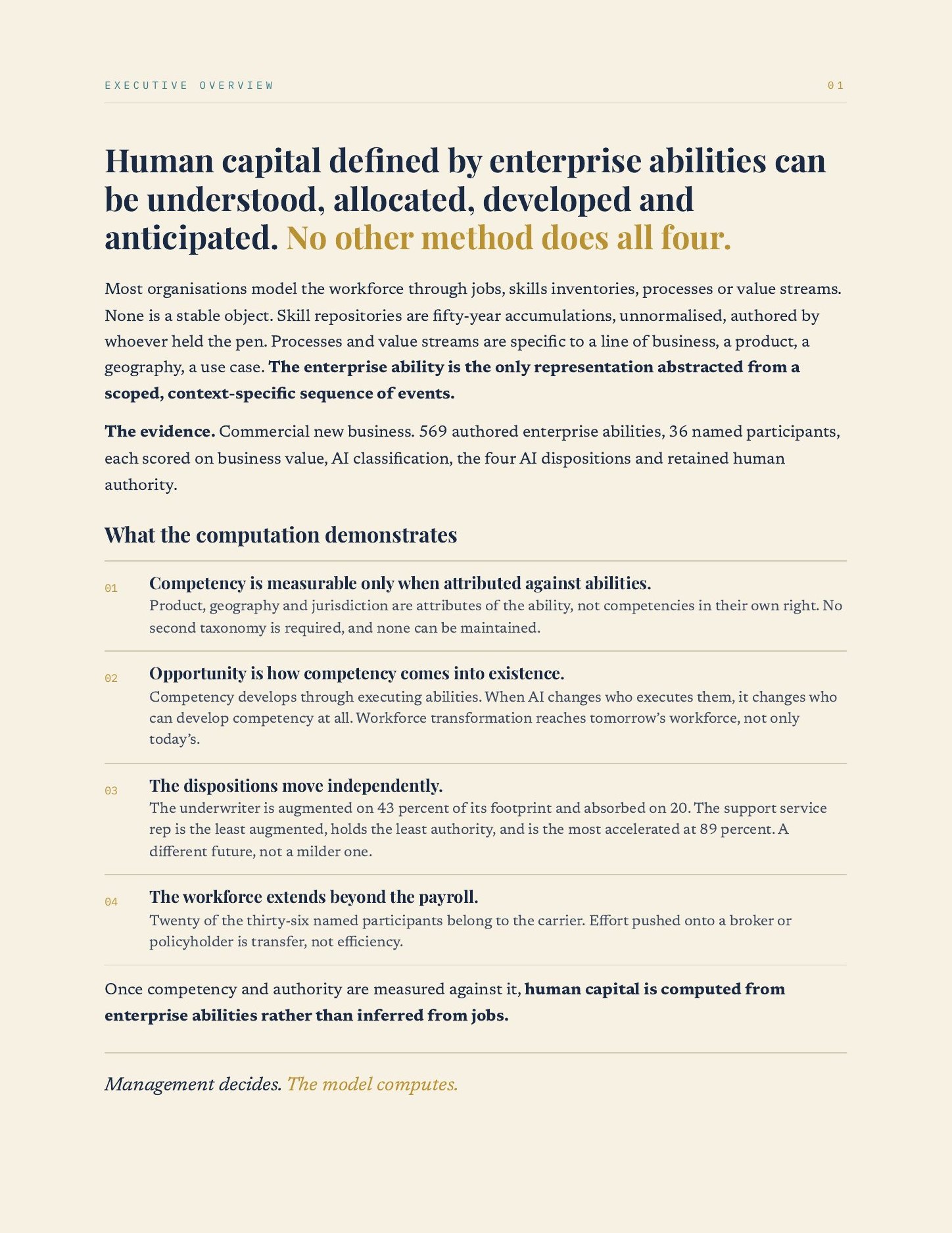
Define human capital by enterprise abilities and it can be understood, allocated, developed and anticipated. No other method does all four.
Most organizations model the workforce through jobs, skills inventories, processes or value streams. None of them is stable. Skills inventories accumulate for decades, unnormalized and written by whoever held the pen. Processes and value streams change with every line of business, product, geography and use case. The enterprise ability is the one representation that holds still while the context around it changes.
The evidence. Commercial new business: 569 authored abilities and 36 named participants, each scored on business value, AI classification, the four AI dispositions and retained human authority.
What the computation demonstrates
Competency is measurable only against abilities.
Product, geography and jurisdiction are attributes of the ability, not competencies of their own. No second taxonomy is needed, and none could be maintained.
Competency comes from opportunity.
People build competency by performing abilities. When AI changes who performs them, it changes who can build competency at all. Workforce transformation reaches tomorrow's workforce, not just today's.
The dispositions move independently.
The underwriter is augmented on 43 percent of its footprint and absorbed on 20. The support service rep is the least augmented, holds the least authority, and is the most accelerated, at 89 percent. Its future is different, not milder.
The workforce extends beyond the payroll.
Twenty of the 36 participants belong to the carrier. Effort pushed onto a broker or a policyholder is transfer, not efficiency.
Management decides. The model computes.
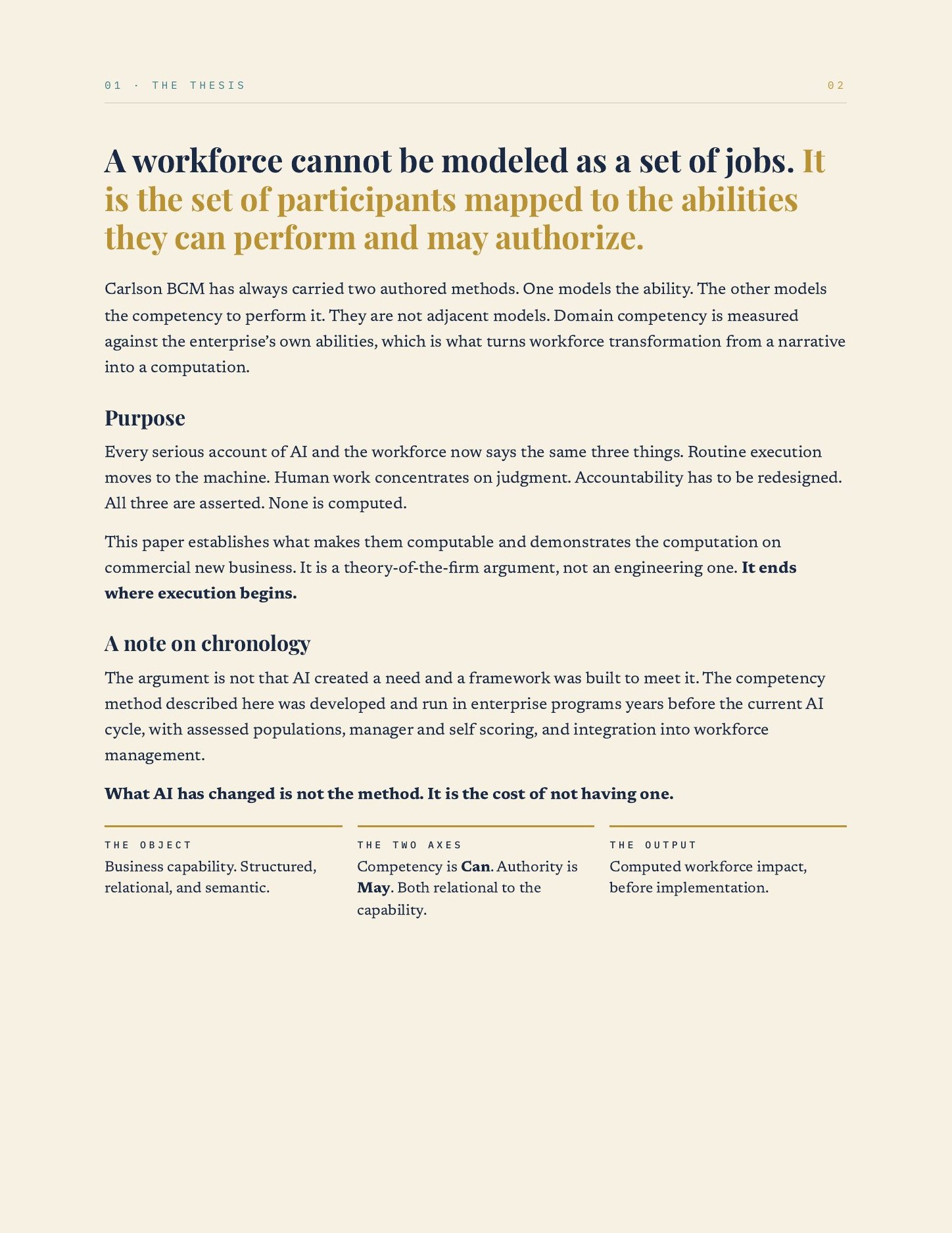
A workforce is not a set of jobs. It is a set of participants mapped to the abilities they can perform and may authorize.
Carlson BCM carries two authored methods. One models the ability. The other models the competency to perform it, and it is measured against the first. That is what turns workforce transformation from a narrative into a computation.
Purpose
Every serious account of AI and the workforce now makes the same three claims. Routine execution moves to the machine. Human work concentrates on judgment. Accountability has to be redesigned. All three are asserted. None is computed.
This paper shows what makes them computable and runs the computation on commercial new business. It is an argument about the firm, not about engineering, and it stops where execution begins.
A note on chronology
This method was not built in response to AI. It was developed and run in enterprise programs years before the current AI cycle, with assessed populations, manager and self scoring, and integration into workforce management.
AI has not changed the method. It has raised the cost of not having one.
THE OBJECT
The business capability: structured, relational and semantic.
THE TWO AXES
Competency is Can. Authority is May. Both attach to the capability.
THE OUTPUT
Workforce impact, computed before anything is implemented.
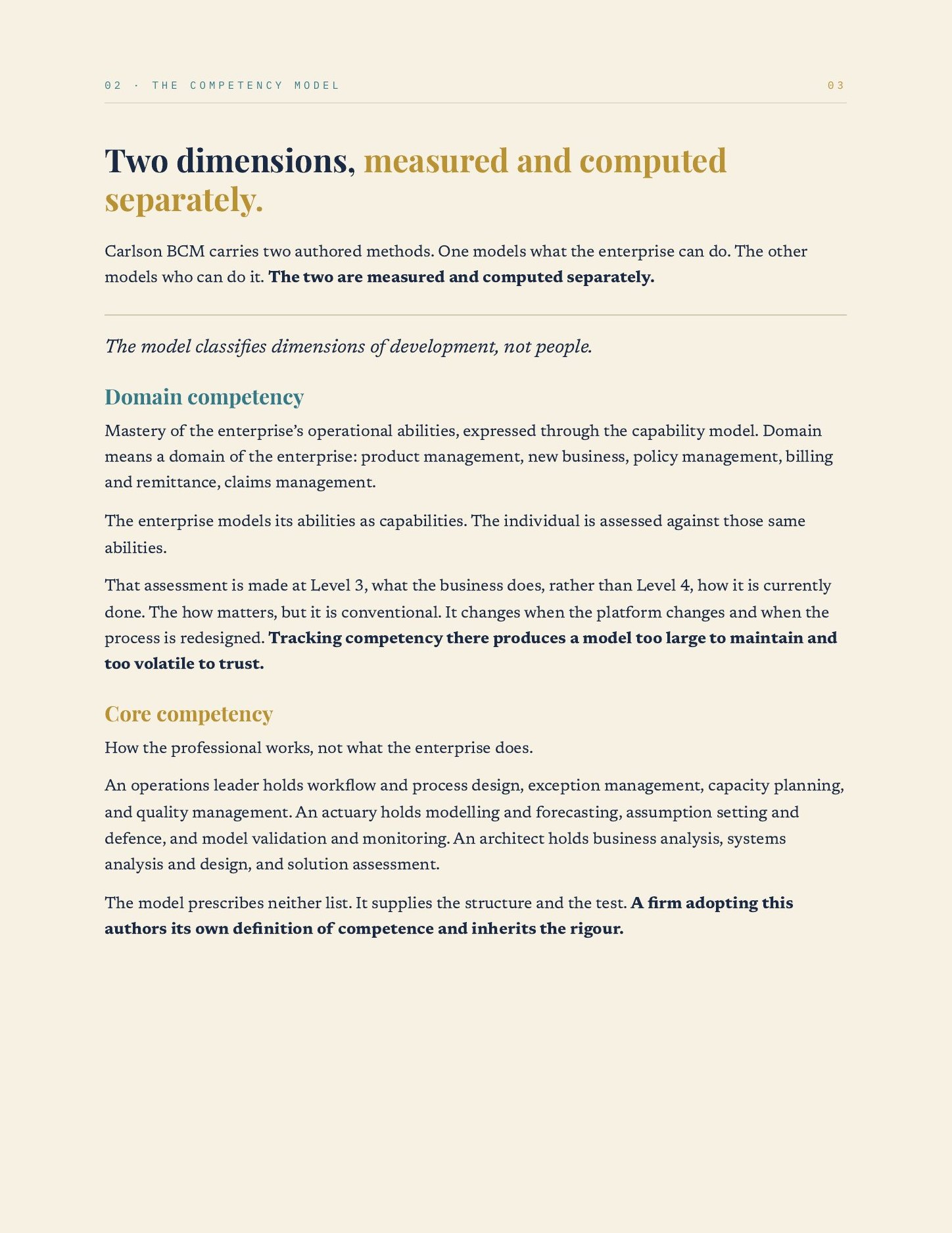
Two dimensions, measured and computed separately.
The model classifies dimensions of development, not people.
Domain competency
Mastery of the enterprise's own abilities, as the capability model expresses them. Domain means a domain of the enterprise: product management, new business, policy management, billing and remittance, claims. Each person is assessed against the same abilities the enterprise has modeled.
Assessment happens at Level 3, what the business does, not Level 4, how it currently does it. The how changes whenever the platform or the process changes. Competency tracked there produces a model too large to maintain and too volatile to trust.
Core competency
How the professional works, not what the enterprise does.
An operations leader holds workflow design, exception management, capacity planning and quality management. An actuary holds modeling and forecasting, assumption setting and defense, and model validation. An architect holds business analysis, systems design and solution assessment.
The model prescribes neither list. It supplies the structure and the test. A firm that adopts it writes its own definition of competence and inherits the rigor.
Product is not a competency. It is an attribute of one.
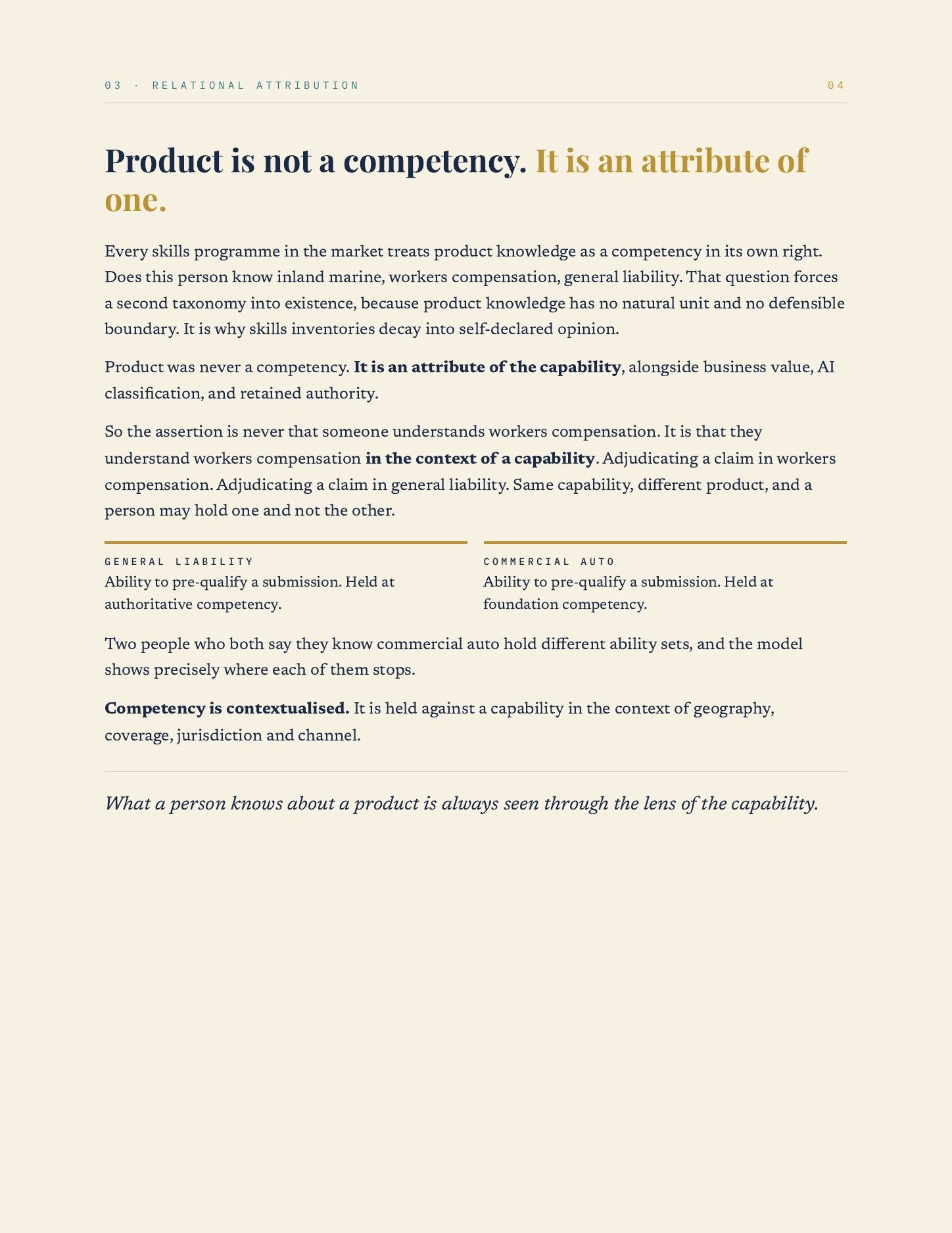
Skills programs treat product knowledge as a competency of its own. Does this person know inland marine, workers' compensation, general liability? That question forces a second taxonomy into existence, because product knowledge has no natural unit and no defensible boundary. It is why skills inventories decay into self-declared opinion.
Product is an attribute of the capability, alongside business value, AI classification and retained authority.
So the claim is never that someone knows workers' compensation. It is that they can adjudicate a workers' compensation claim. Adjudicating a general liability claim is the same capability on a different product, and a person may hold one without the other.
GENERAL LIABILITY
Ability to pre-qualify a submission. Held at authoritative competency.
COMMERCIAL AUTO
Ability to pre-qualify a submission. Held at foundation competency.
One person, one ability, two products, two levels. Ask whether they know commercial lines and the answer is yes. Ask where they stop and the model shows it.
Competency is always held in context. It is held against a capability in a geography, a coverage, a jurisdiction and a channel.
Product knowledge is always seen through the capability.
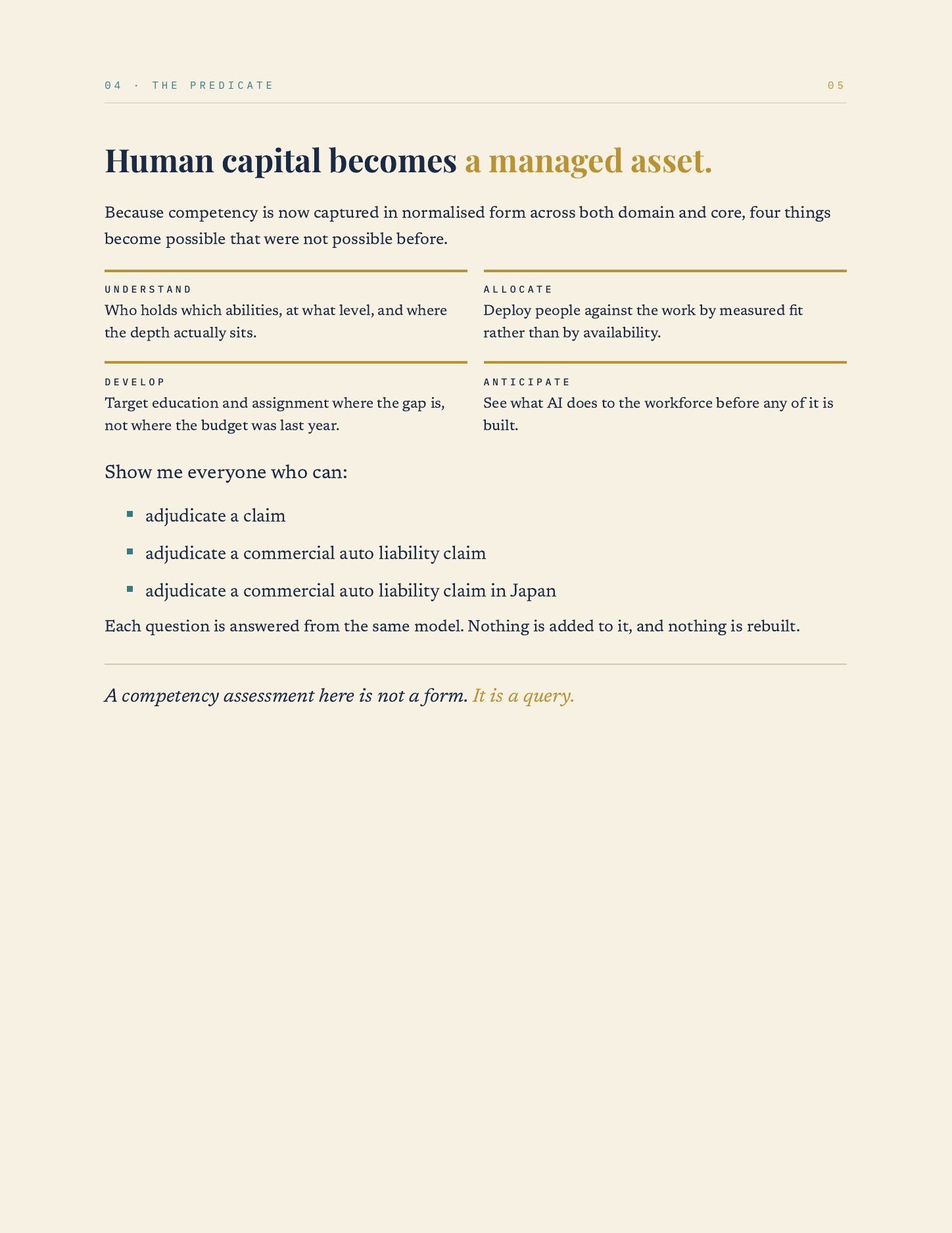
Human capital becomes a managed asset.
With competency captured in normalized form across domain and core, four things become possible.
UNDERSTAND
Who holds which abilities, at what level, and where the depth sits.
ALLOCATE
Deploy people by measured fit, not availability.
DEVELOP
Aim education and assignments at the gap, not at last year's budget.
ANTICIPATE
See what AI does to the workforce before any of it is built.
Show me everyone who can:
adjudicate a claim
adjudicate a commercial auto liability claim
adjudicate a commercial auto liability claim in Japan
Each question runs against the same model. Nothing is added and nothing is rebuilt.
A competency assessment here is not a form. It is a query.
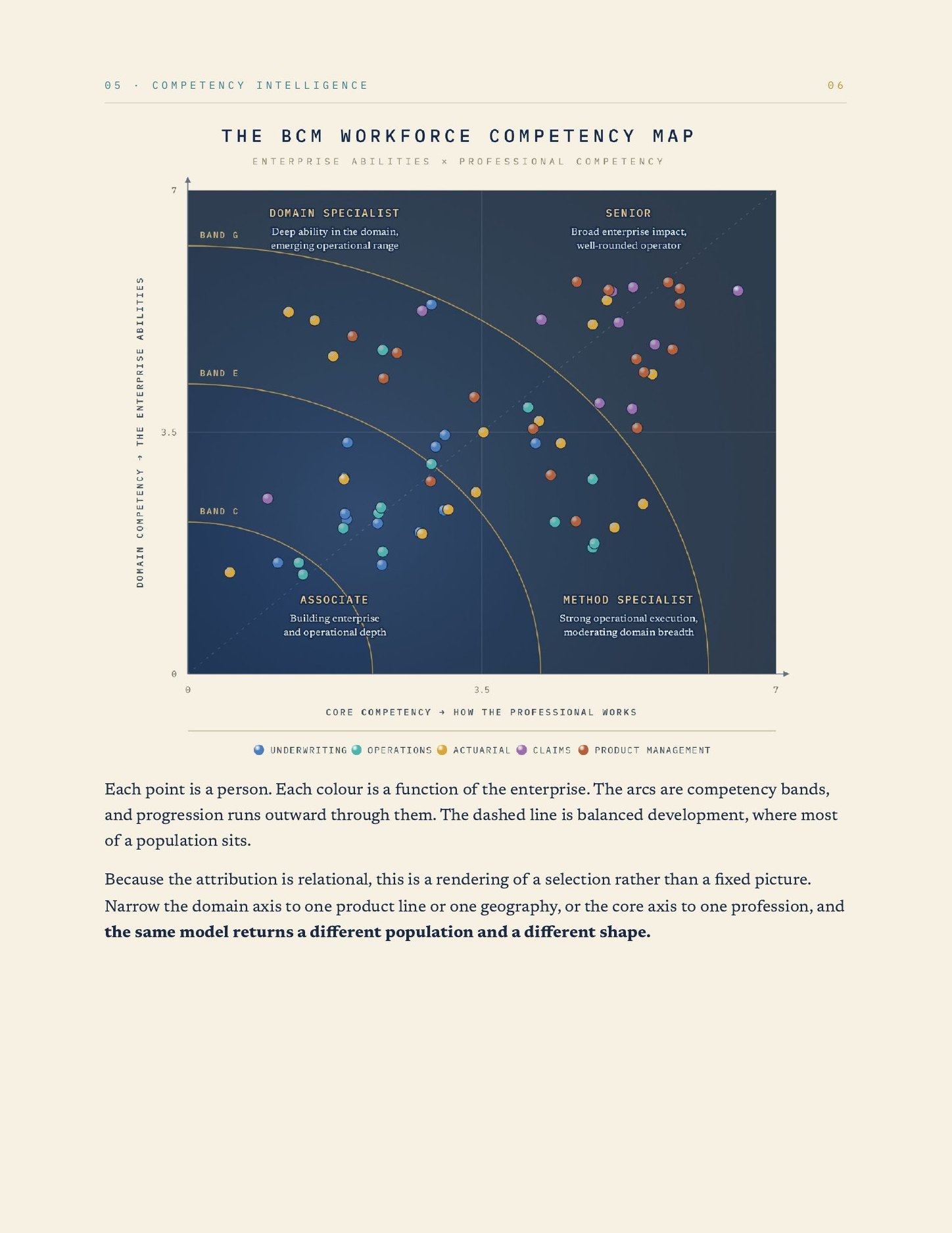
Each point is a person and each color a function of the enterprise. The arcs are competency bands, and progression runs outward through them. The dashed line marks balanced development, where most of a population sits.
Because attribution is relational, the chart is a query, not a fixed picture. Narrow the domain axis to one product line or geography, or the core axis to one profession, and the same model returns a different population and a different shape.
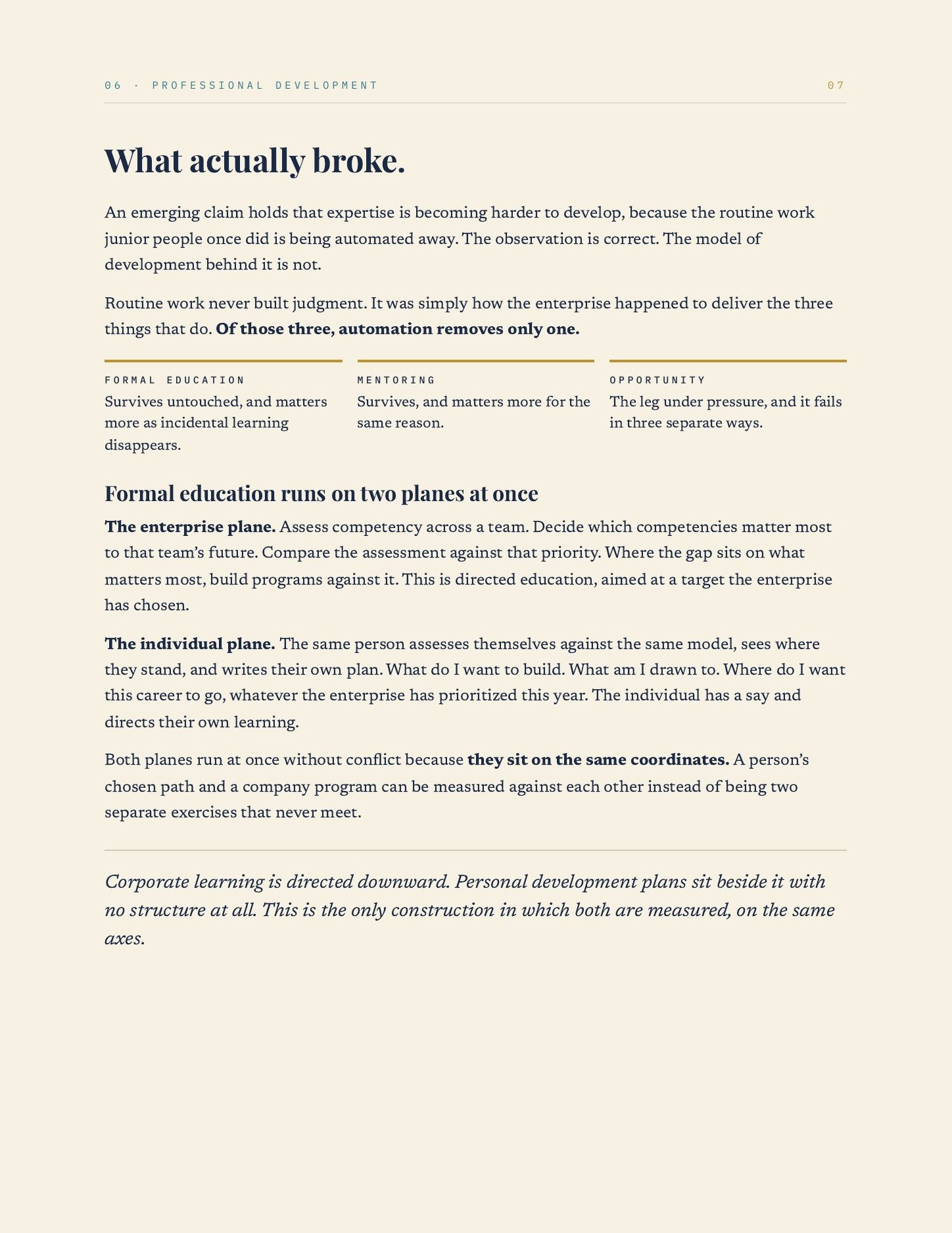
What actually broke.
A growing argument holds that expertise is getting harder to develop because AI is automating the routine work junior people once did. The observation is right. The model of development behind it is wrong.
Routine work never built judgment. It was only how the enterprise happened to deliver the three things that do. Automation removes only one of them.
FORMAL EDUCATION
Survives, and matters more as incidental learning disappears.
MENTORING
Survives, and matters more for the same reason.
OPPORTUNITY
Under pressure, and failing in three separate ways.
Formal education runs on two planes
The enterprise plane. Assess a team, decide which competencies matter most to its future, and build programs where the gap meets the priority. This is directed education, aimed at a target the enterprise has chosen.
The individual plane. The same person assesses themselves against the same model and writes their own plan: what to build, what they are drawn to, where they want their career to go, whatever the enterprise prioritized this year.
The two run without conflict because they share coordinates. A personal plan and a company program can be measured against each other instead of never meeting.
Corporate learning is directed from above, and personal plans sit beside it with no structure. This is the one construction that measures both on the same axes.
Mentoring, and the question of certification.
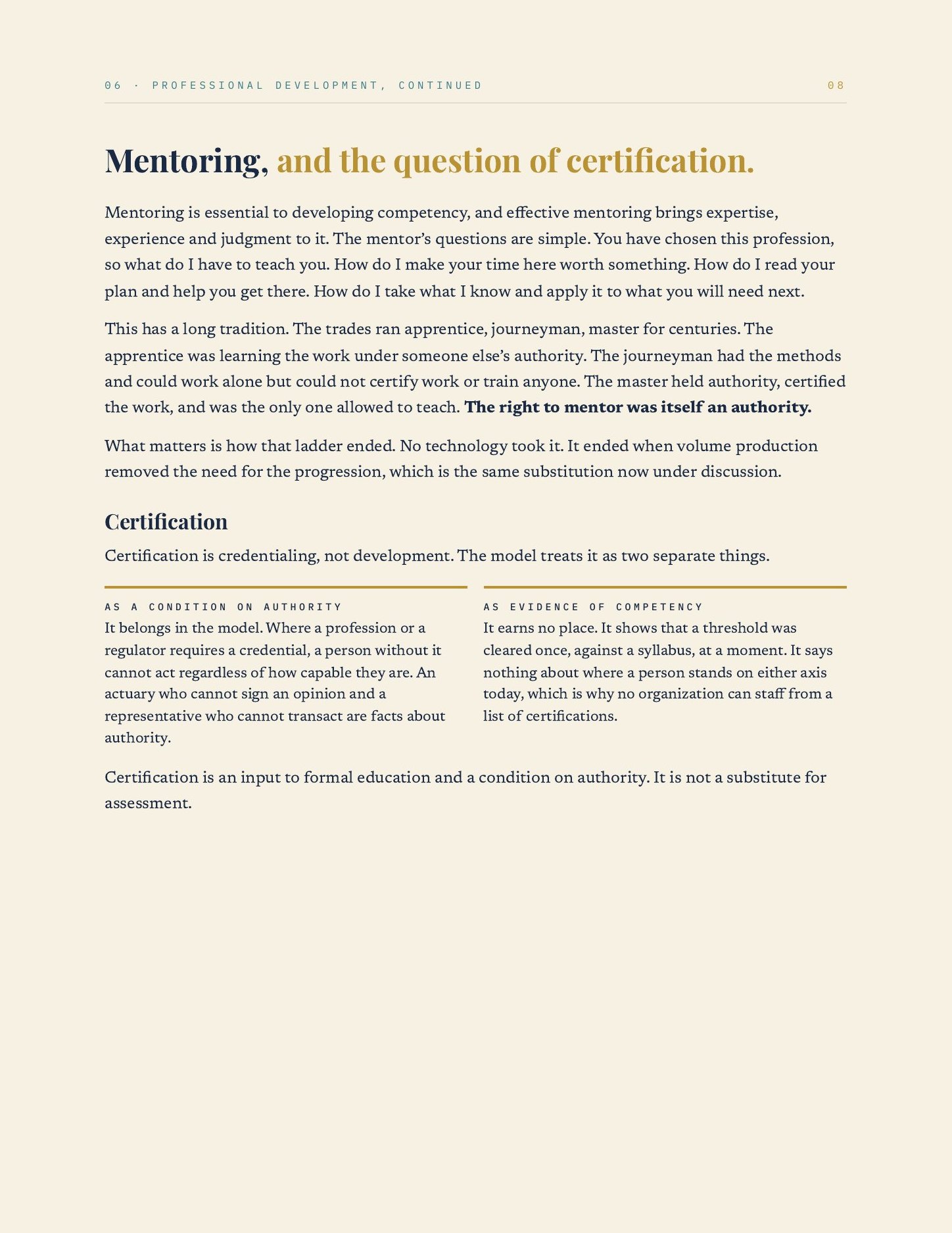
Mentoring brings expertise, experience and judgment to development. The mentor's questions are simple. What do I have to teach you? How do I make your time here worth something? How do I help you reach your plan, and apply what I know to what you will need next?
The trades ran apprentice, journeyman and master for centuries. The apprentice learned under someone else's authority. The journeyman could work alone but could not certify work or train others. The master held authority, certified the work and was the only one allowed to teach. The right to mentor was itself an authority.
No technology ended that ladder. Volume production did, by removing the need for the progression. That is the same substitution now under discussion.
Certification
Certification is credentialing, not development, and the model treats it two ways.
AS A CONDITION ON AUTHORITY
It belongs in the model. Where a profession or regulator requires a credential, a person without it cannot act, however capable. An actuary who cannot sign an opinion and a representative who cannot transact are facts about authority.
AS EVIDENCE OF COMPETENCY
It earns no place. It shows that a threshold was cleared once, against a syllabus. It says nothing about where a person stands today, which is why no one can staff from a list of certifications.
Certification feeds formal education and conditions authority. It does not replace assessment.
Opportunity is the leg that fails.
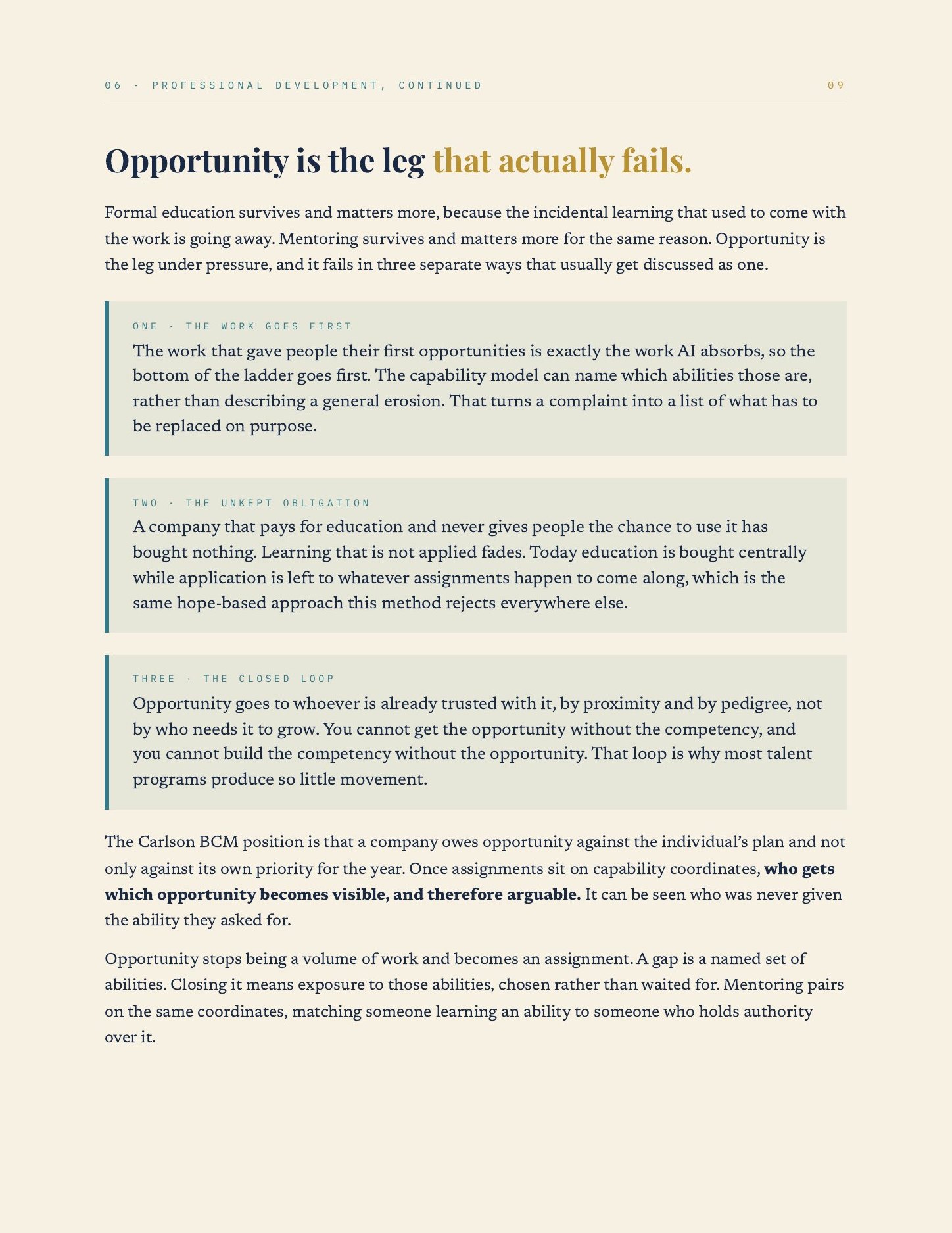
Education and mentoring survive and matter more. Opportunity is under pressure, and it fails in three ways that usually get discussed as one.
ONE · THE WORK GOES FIRST
The work that gave people their first opportunities is the work AI absorbs, so the bottom of the ladder goes first. The capability model names which abilities those are, which turns a general complaint into a list of what has to be replaced on purpose.
TWO · THE UNKEPT OBLIGATION
Education that is never applied fades. Companies buy education centrally and leave its application to whatever assignments come along, the same hope-based approach this method rejects everywhere else.
THREE · THE CLOSED LOOP
Opportunity goes to whoever is already trusted, by proximity and pedigree, not to whoever needs it to grow. No opportunity without competency, no competency without opportunity. That loop is why most talent programs produce so little movement.
Carlson BCM holds that a company owes opportunity against the individual's plan, not only against its own priorities for the year. Once assignments sit on capability coordinates, who gets which opportunity becomes visible, and so arguable. It shows who was never given the ability they asked for.
Opportunity stops being a volume of work and becomes an assignment. A gap is a named set of abilities, and closing it means chosen exposure to them. Mentoring pairs on the same coordinates: someone learning an ability with someone who holds authority over it.
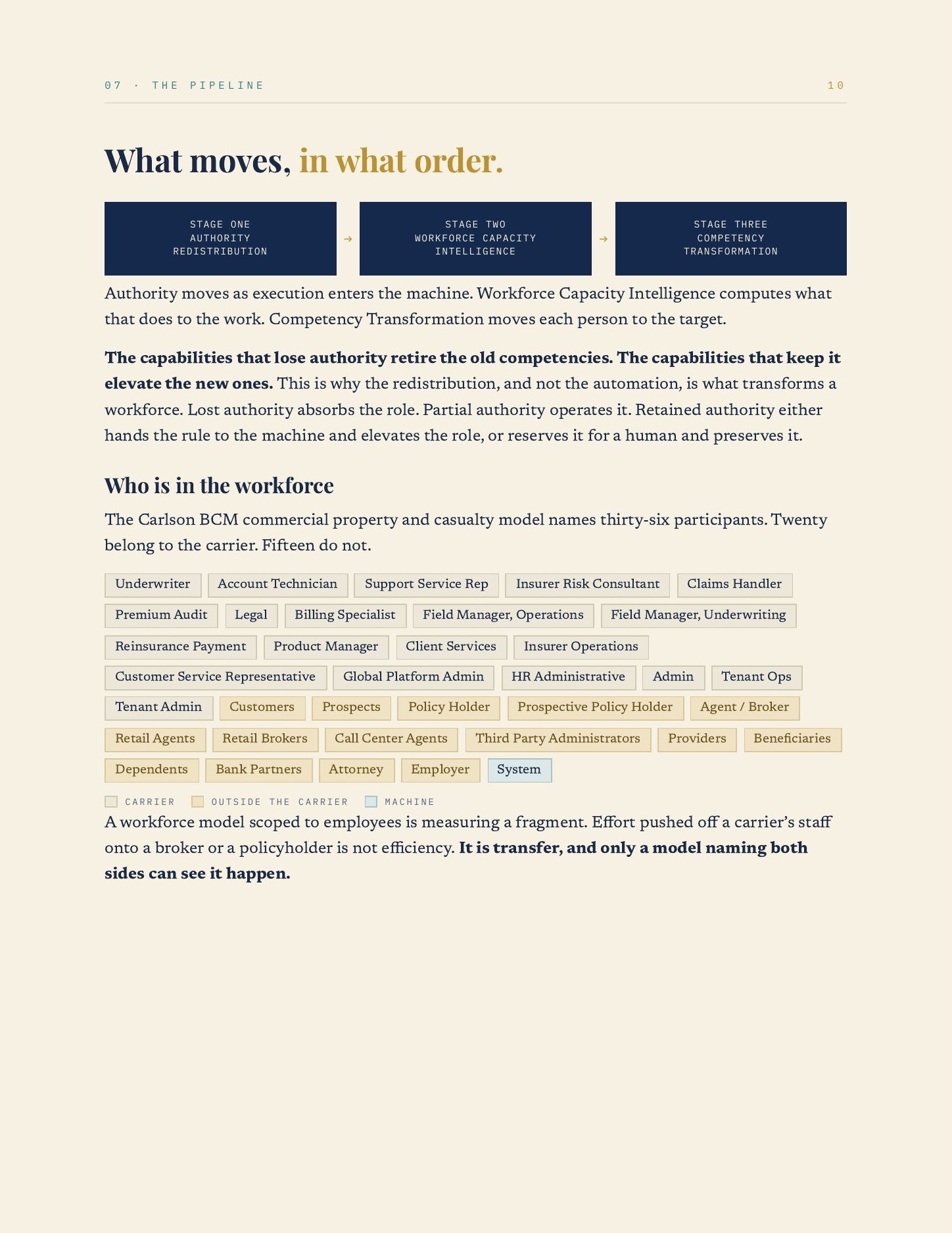
What moves, in what order.
STAGE ONE AUTHORITY REDISTRIBUTION
STAGE TWO WORKFORCE CAPACITY INTELLIGENCE
STAGE THREE COMPETENCY TRANSFORMATION
Execution moves to the machine first. Authority moves only where the enterprise decides it should, and the two do not move together. Workforce Capacity Intelligence computes what that redistribution does to the work. Competency Transformation moves each person to the target.
Where a capability loses authority, its old competencies retire. Where it keeps authority, new ones are elevated. That is why redistribution, not automation, transforms a workforce. Lost authority absorbs the role. Partial authority operates alongside the machine. Retained authority either sets the rule the machine follows, which elevates the role, or keeps the decision, which preserves it.
Who is in the workforce
The Carlson BCM commercial property and casualty model names 36 participants: twenty inside the carrier, fifteen outside it, and the system itself, which takes part in the work but is not part of the workforce.
A workforce model limited to employees measures a fragment. Effort shifted from carrier staff to a broker or policyholder is not efficiency. It is transfer, and only a model that names both sides can see it.
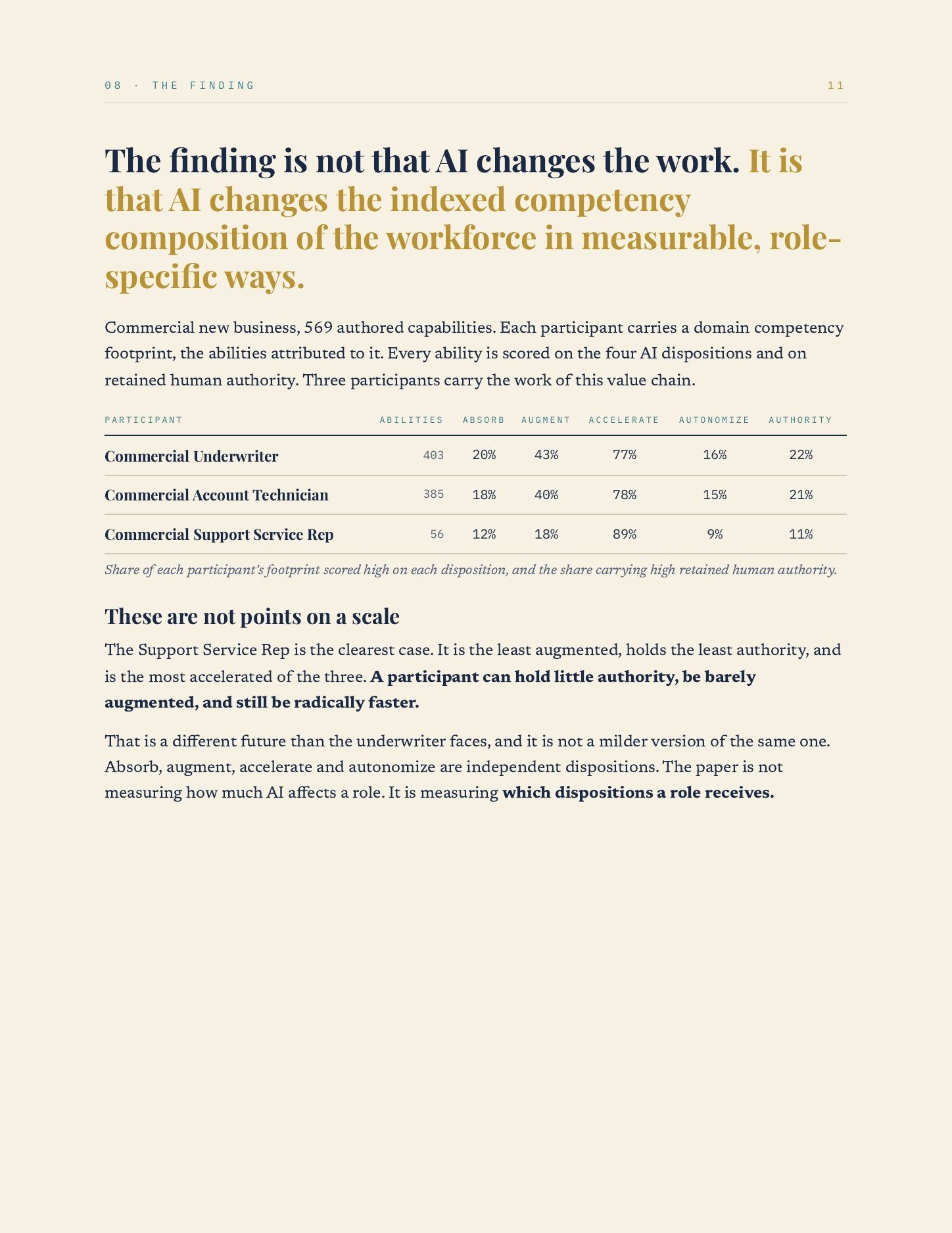
AI does not just change the work. It changes the competency composition of the workforce, in measurable, role-specific ways.
Commercial new business, 569 authored capabilities. Each participant carries a footprint, the abilities attributed to it at Levels 3 and 4, and each ability is scored on the four AI dispositions and on retained human authority. Three participants carry the work of this value chain.
Participant · Abilities · Absorb · Augment · Accelerate · Autonomize · Authority
Commercial Underwriter · 403 · 20% · 43% · 77% · 16% · 22%
Commercial Account Technician · 385 · 18% · 40% · 78% · 15% · 21%
Commercial Support Service Rep · 56 · 12% · 18% · 89% · 9% · 11%
Not points on one scale
The support service rep is the clearest case: least augmented, least authority, most accelerated. A role can hold little authority, barely be augmented, and still become radically faster.
That is a different future from the underwriter's, not a milder version of it. The paper does not measure how much AI affects a role. It measures which dispositions the role receives.
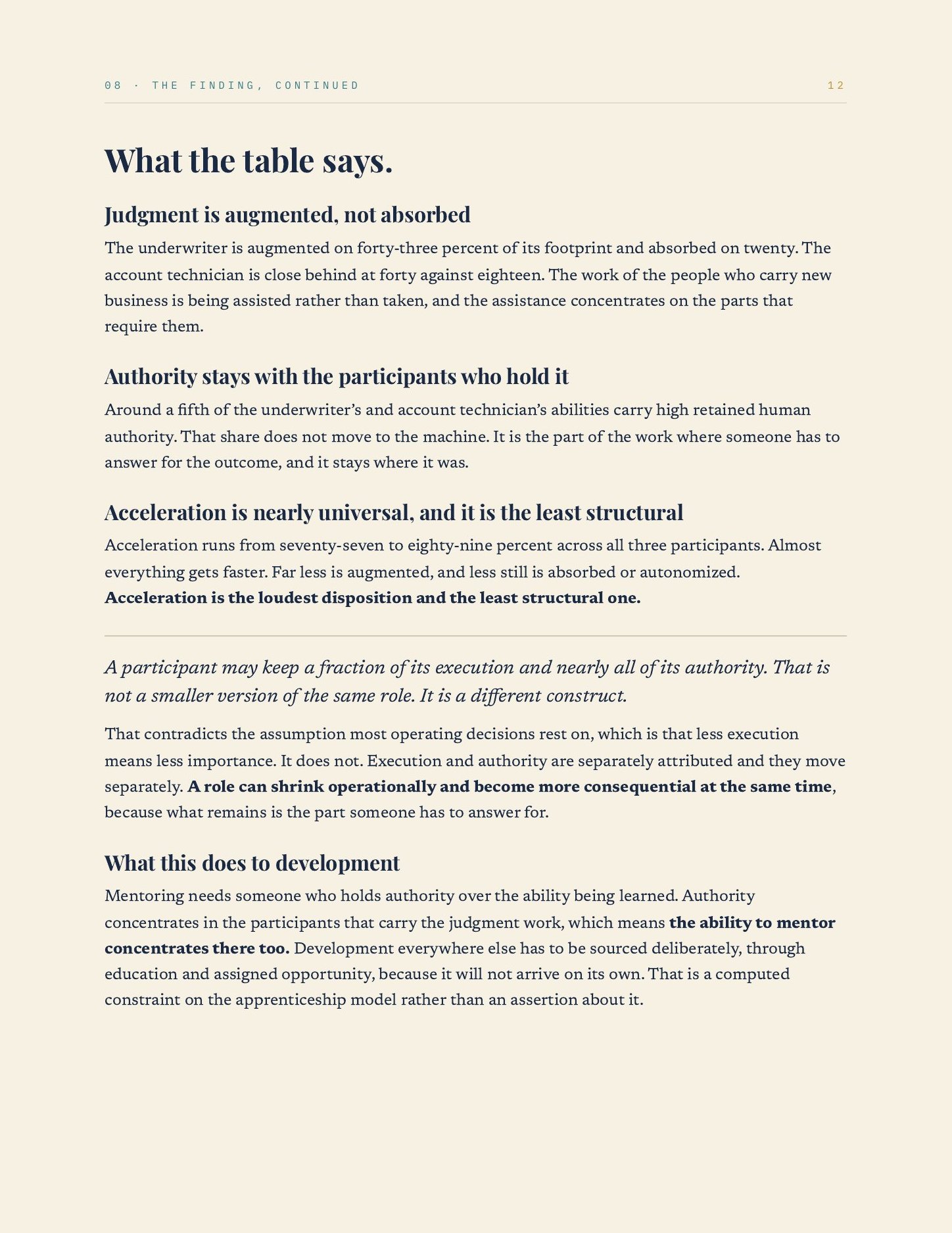
What the table says.
Judgment is augmented, not absorbed
The underwriter is augmented on 43 percent of its footprint and absorbed on 20. The account technician is close behind at 40 against 18. The people who carry new business are being assisted rather than replaced, and the assistance lands on the parts of the work that need them.
Authority stays where it is
About a fifth of the underwriter's and account technician's abilities carry high retained authority. That share does not move to the machine. It is the work someone has to answer for.
Acceleration is nearly universal, and the least structural
Acceleration runs from 77 to 89 percent across all three. Almost everything gets faster. Far less is augmented, and less still is absorbed or autonomized. Acceleration is the loudest disposition and the least structural one.
A role can keep a fraction of its execution and nearly all of its authority. That is not a smaller version of the same role. It is a different one.
Most operating decisions assume that less execution means less importance. It does not. Execution and authority are attributed separately and move separately. A role can shrink operationally and become more consequential, because what remains is the part someone has to answer for.
What this does to development
Mentoring requires someone with authority over the ability being learned. Authority concentrates in the roles that carry judgment, so the capacity to mentor concentrates there too. Everywhere else, development has to be supplied deliberately, through education and assigned opportunity. That is a computed constraint on apprenticeship, not an assertion about it.
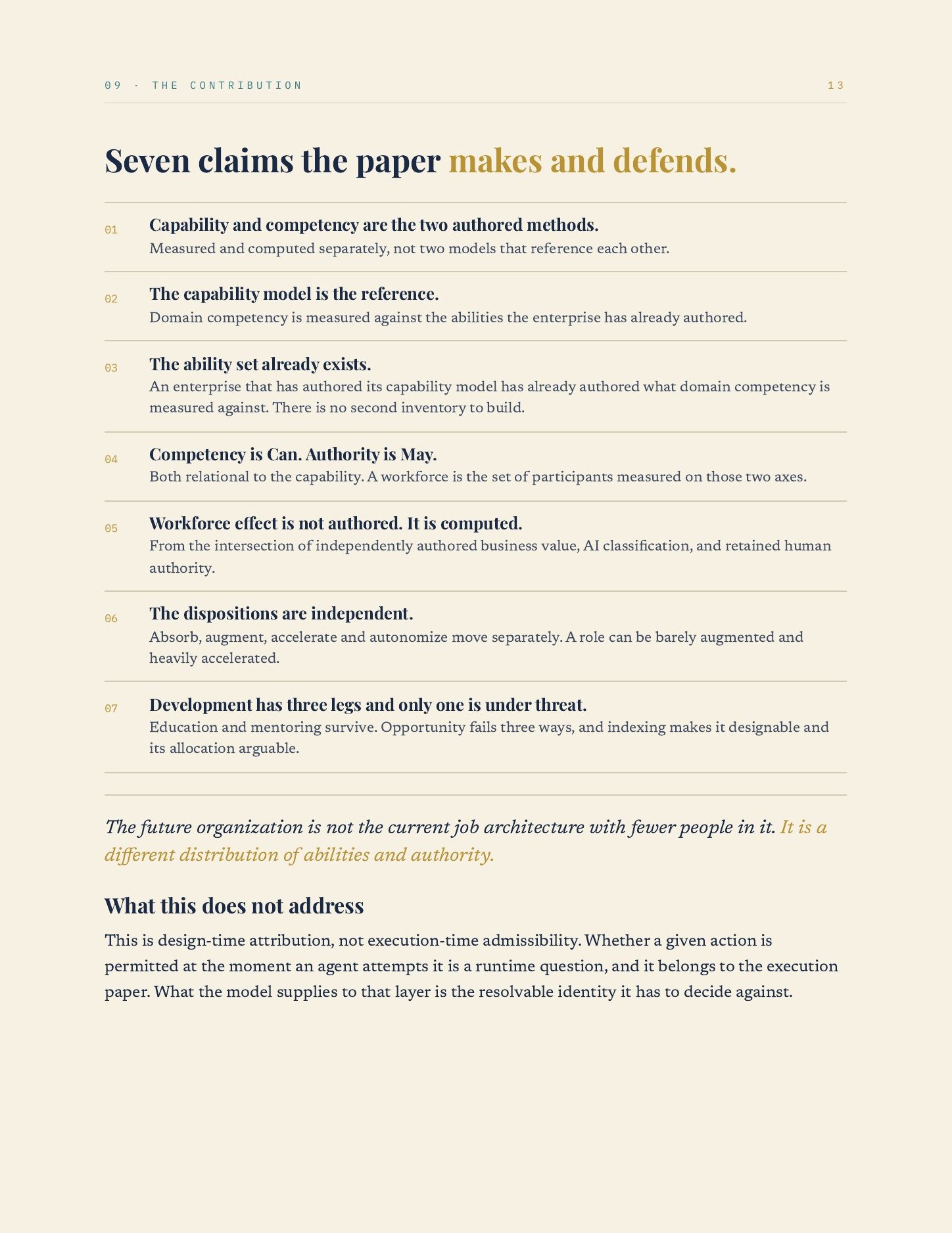
Seven claims the paper makes and defends.
Capability and competency are two authored methods.
They are measured and computed separately.
The capability model is the reference.
Domain competency is measured against abilities the enterprise has already authored.
There is no second inventory.
An enterprise with a capability model already has what domain competency is measured against.
Competency is Can. Authority is May.
Both attach to the capability, and a workforce is its participants measured on both.
Workforce effect is computed, not authored.
It comes from the intersection of independently authored business value, AI classification and retained authority.
The dispositions are independent.
Absorb, augment, accelerate and autonomize move separately. A role can be barely augmented and heavily accelerated.
Development has three legs, and only one is under threat.
Education and mentoring survive. Opportunity fails three ways, and indexing it to capabilities makes it designable and its allocation arguable.
The future organization is not today's job architecture with fewer people in it. It is a different distribution of abilities and authority.
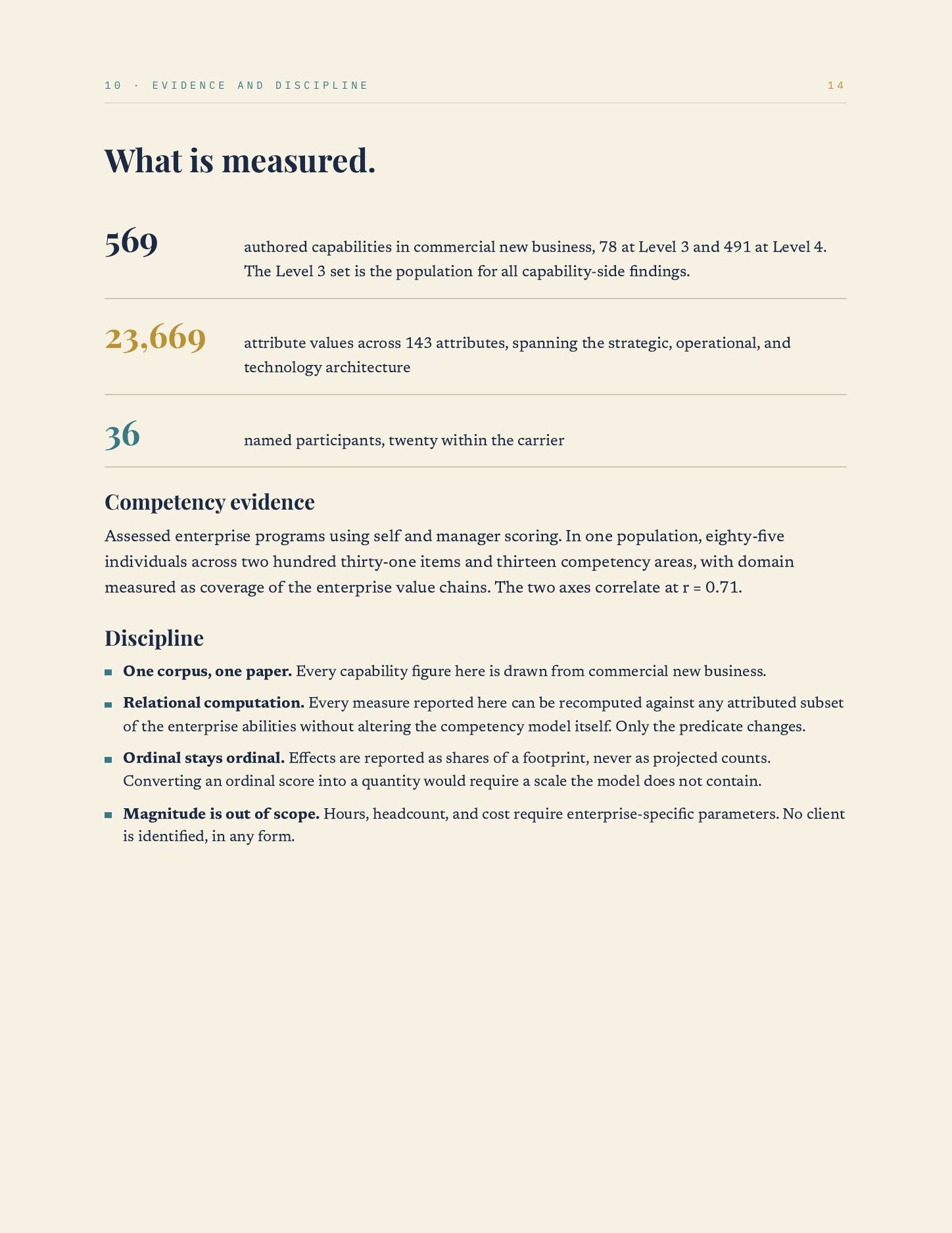
What is measured.
569 authored capabilities in commercial new business, 78 at Level 3 and 491 at Level 4. Participant footprints and disposition shares span both levels. Competency is assessed at Level 3.
23,669 attribute values across 143 attributes, spanning strategic, operational and technology architecture
36 named participants, twenty within the carrier
Competency evidence
Assessed enterprise programs using self and manager scoring. In one population, 85 individuals across 231 items and thirteen competency areas, with domain measured as coverage of the enterprise value chains. Domain and core competency correlate at r = 0.71.
Discipline
One corpus, one paper. Every capability figure here comes from commercial new business.
Relational computation. Every measure can be recomputed against any attributed subset of abilities without changing the competency model. Only the predicate changes.
Ordinal stays ordinal. Effects are reported as shares of a footprint, never as projected counts. Converting an ordinal score into a quantity would need a scale the model does not contain.
Magnitude is out of scope. Hours, headcount and cost require enterprise-specific parameters. No client is identified, in any form.
What this does not address
This paper covers design-time attribution, not runtime admissibility. Whether an agent may take a given action at the moment it tries is a runtime question for the execution paper. This model supplies the identity that layer decides against.
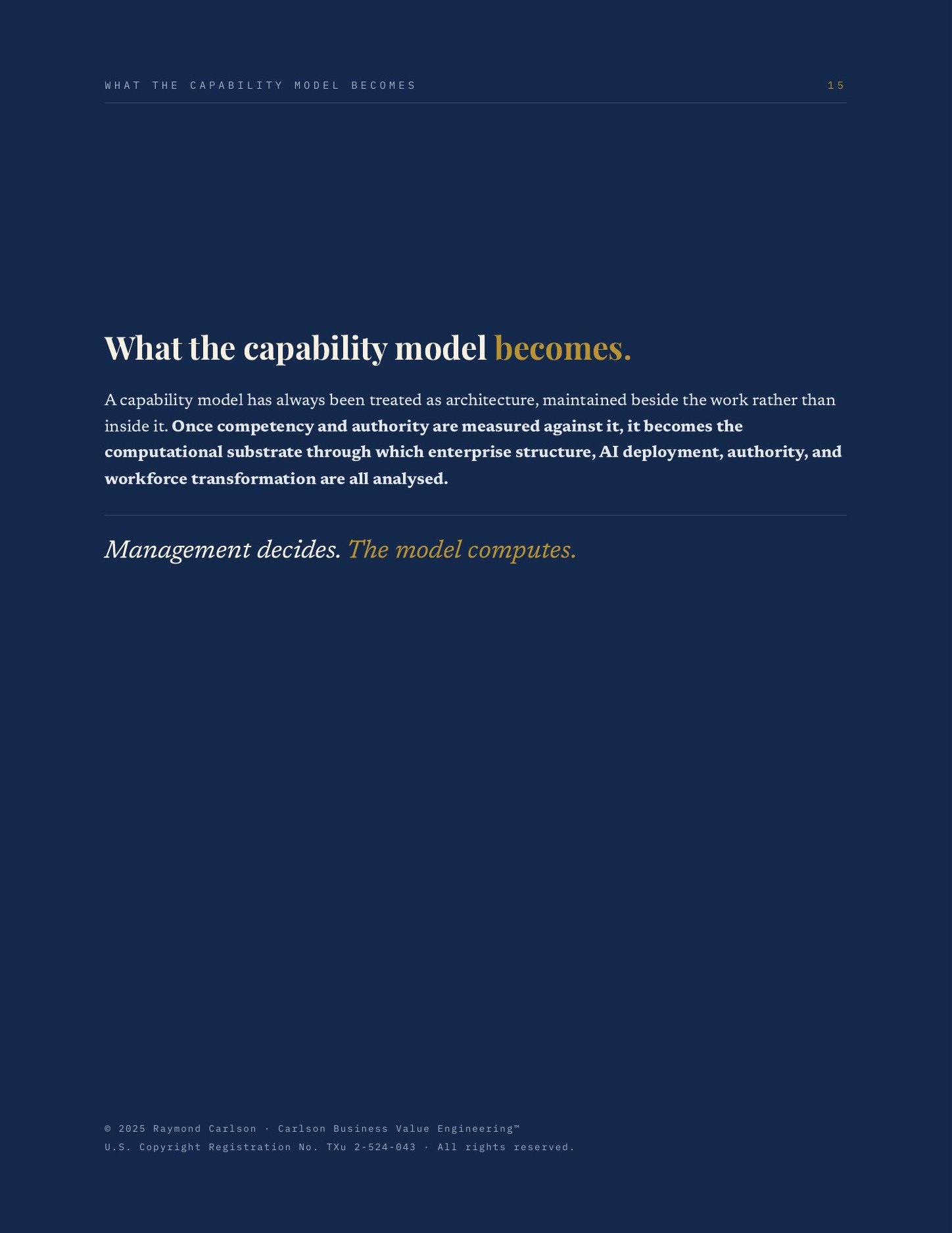
What the capability model becomes.
A capability model has always been treated as architecture, maintained beside the work rather than inside it. Once competency and authority are measured against it, it becomes the computational base for analyzing enterprise structure, AI deployment, authority and workforce transformation together.
Management decides. The model computes.