 Carlson BCM
Read as text
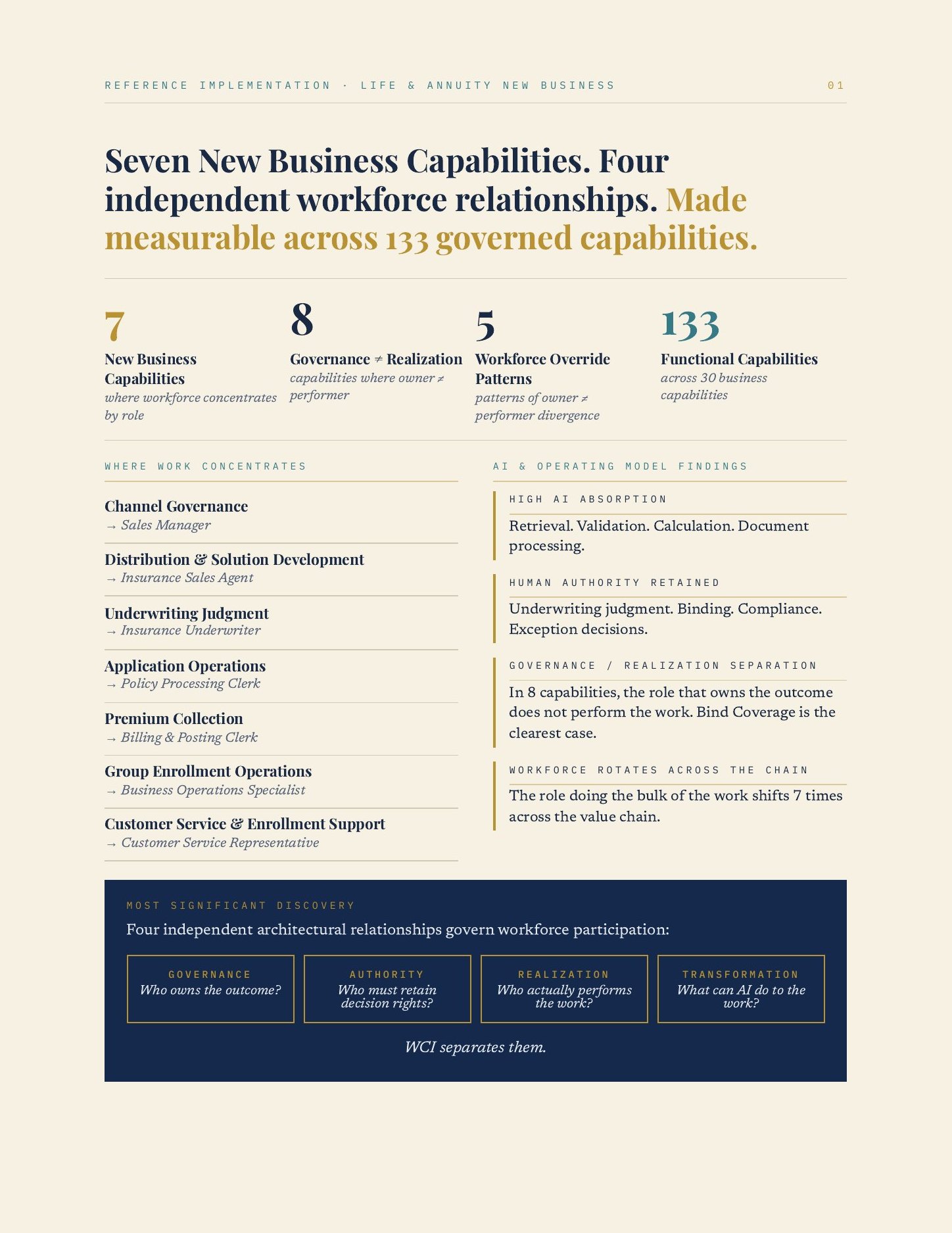
Seven New Business Capabilities. Four independent workforce relationships. Made measurable across 133 governed capabilities.
Retrieval. Validation. Calculation. Document processing.
Underwriting judgment. Binding. Compliance. Exception decisions.
In 8 capabilities, the role that owns the outcome does not perform the work. Bind Coverage is the clearest case.
The role doing the bulk of the work shifts 7 times across the value chain.
Four independent architectural relationships govern workforce participation:
Who owns the outcome?
Who must retain decision rights?
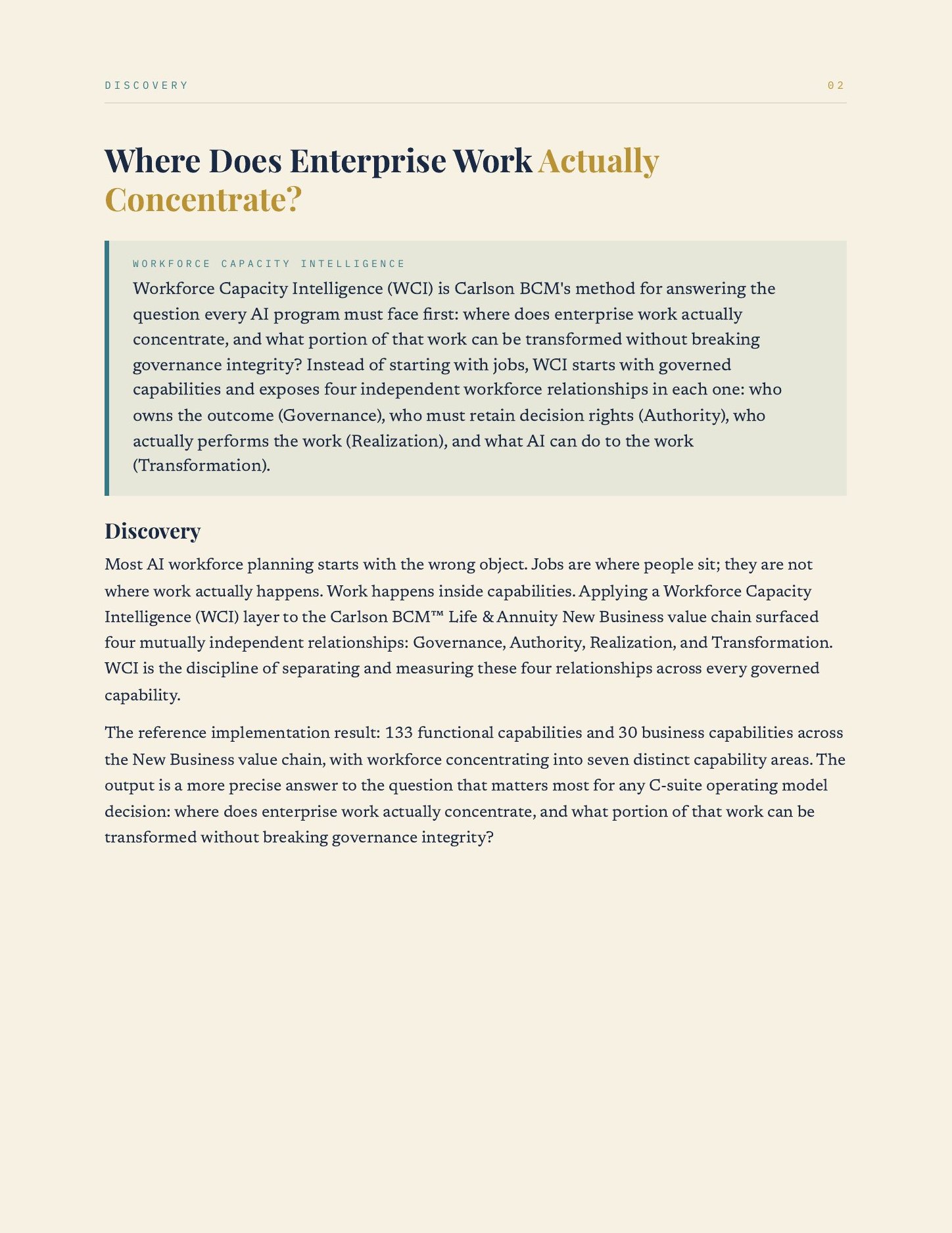
Where Does Enterprise Work Actually Concentrate?
Workforce Capacity Intelligence (WCI) is Carlson BCM's method for answering the question every AI program must face first: where does enterprise work actually concentrate, and what portion of that work can be transformed without breaking governance integrity? Instead of starting with jobs, WCI starts with governed capabilities and exposes four independent workforce relationships in each one: who owns the outcome (Governance), who must retain decision rights (Authority), who actually performs the work (Realization), and what AI can do to the work (Transformation).
Most AI workforce planning starts with the wrong object. Jobs are where people sit; they are not where work actually happens. Work happens inside capabilities. Applying a Workforce Capacity Intelligence (WCI) layer to the Carlson BCM™ Life & Annuity New Business value chain surfaced four mutually independent relationships: Governance, Authority, Realization, and Transformation. WCI is the discipline of separating and measuring these four relationships across every governed capability.
The reference implementation result: 133 functional capabilities and 30 business capabilities across the New Business value chain, with workforce concentrating into seven distinct capability areas. The output is a more precise answer to the question that matters most for any C-suite operating model decision: where does enterprise work actually concentrate, and what portion of that work can be transformed without breaking governance integrity?
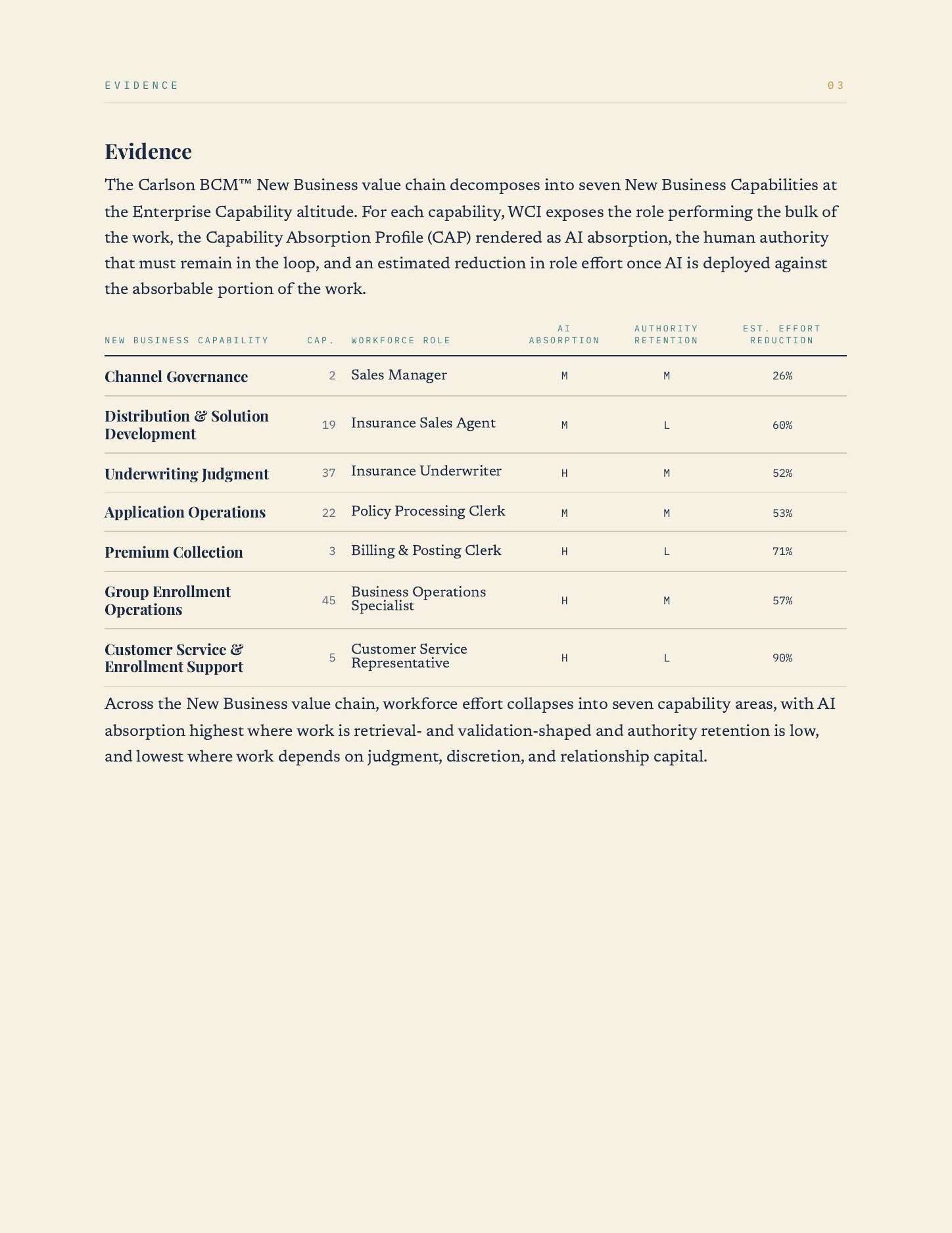
The Carlson BCM™ New Business value chain decomposes into seven New Business Capabilities at the Enterprise Capability altitude. For each capability, WCI exposes the role performing the bulk of the work, the Capability Absorption Profile (CAP) rendered as AI absorption, the human authority that must remain in the loop, and an estimated reduction in role effort once AI is deployed against the absorbable portion of the work.
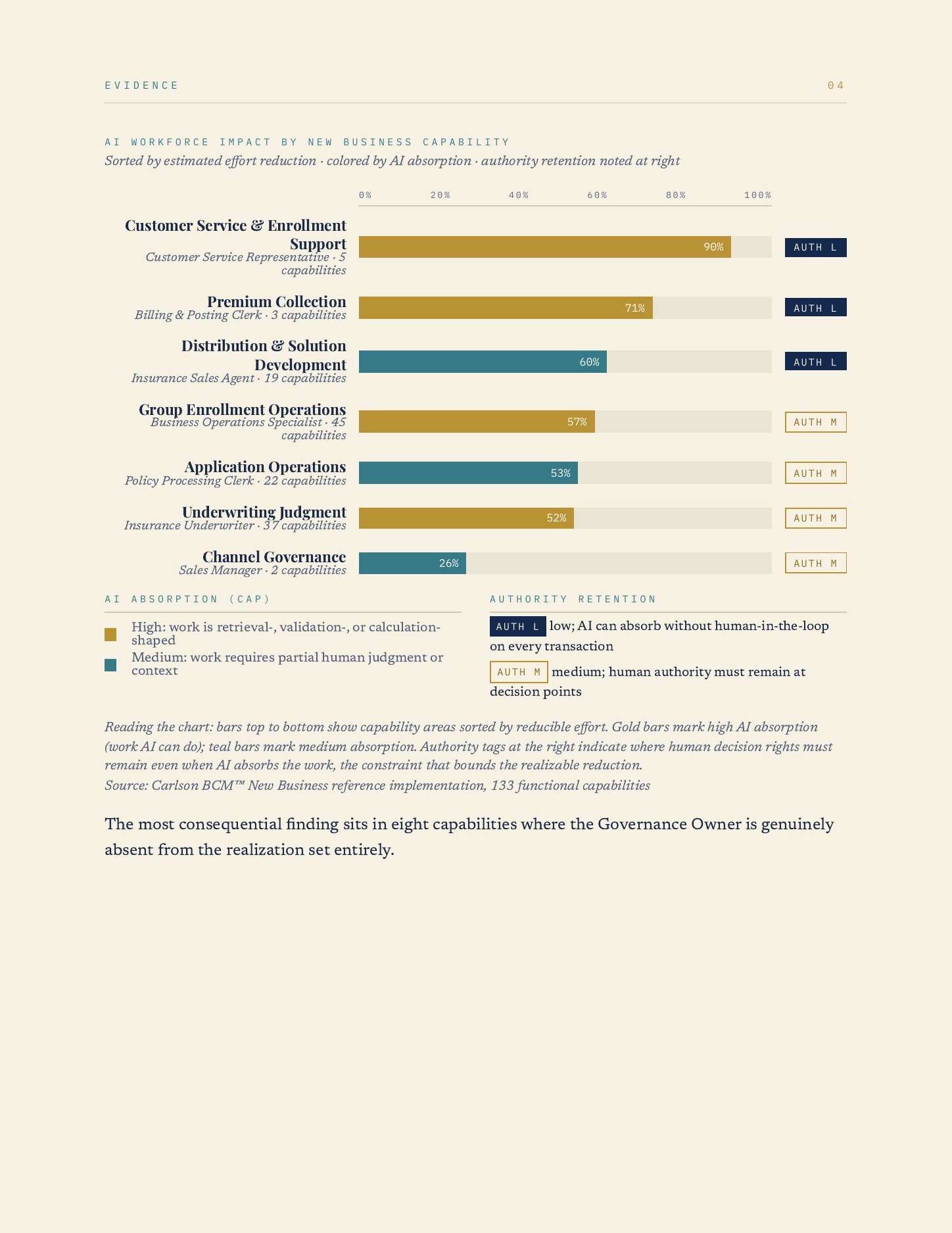
Across the New Business value chain, workforce effort collapses into seven capability areas, with AI absorption highest where work is retrieval- and validation-shaped and authority retention is low, and lowest where work depends on judgment, discretion, and relationship capital.
Sorted by estimated effort reduction · colored by AI absorption · authority retention noted at right
High: work is retrieval-, validation-, or calculation-shaped Medium: work requires partial human judgment or context
Reading the chart: bars top to bottom show capability areas sorted by reducible effort. Gold bars mark high AI absorption (work AI can do); teal bars mark medium absorption. Authority tags at the right indicate where human decision rights must remain even when AI absorbs the work, the constraint that bounds the realizable reduction. Source: Carlson BCM™ New Business reference implementation, 133 functional capabilities
The most consequential finding sits in eight capabilities where the Governance Owner is genuinely absent from the realization set entirely.
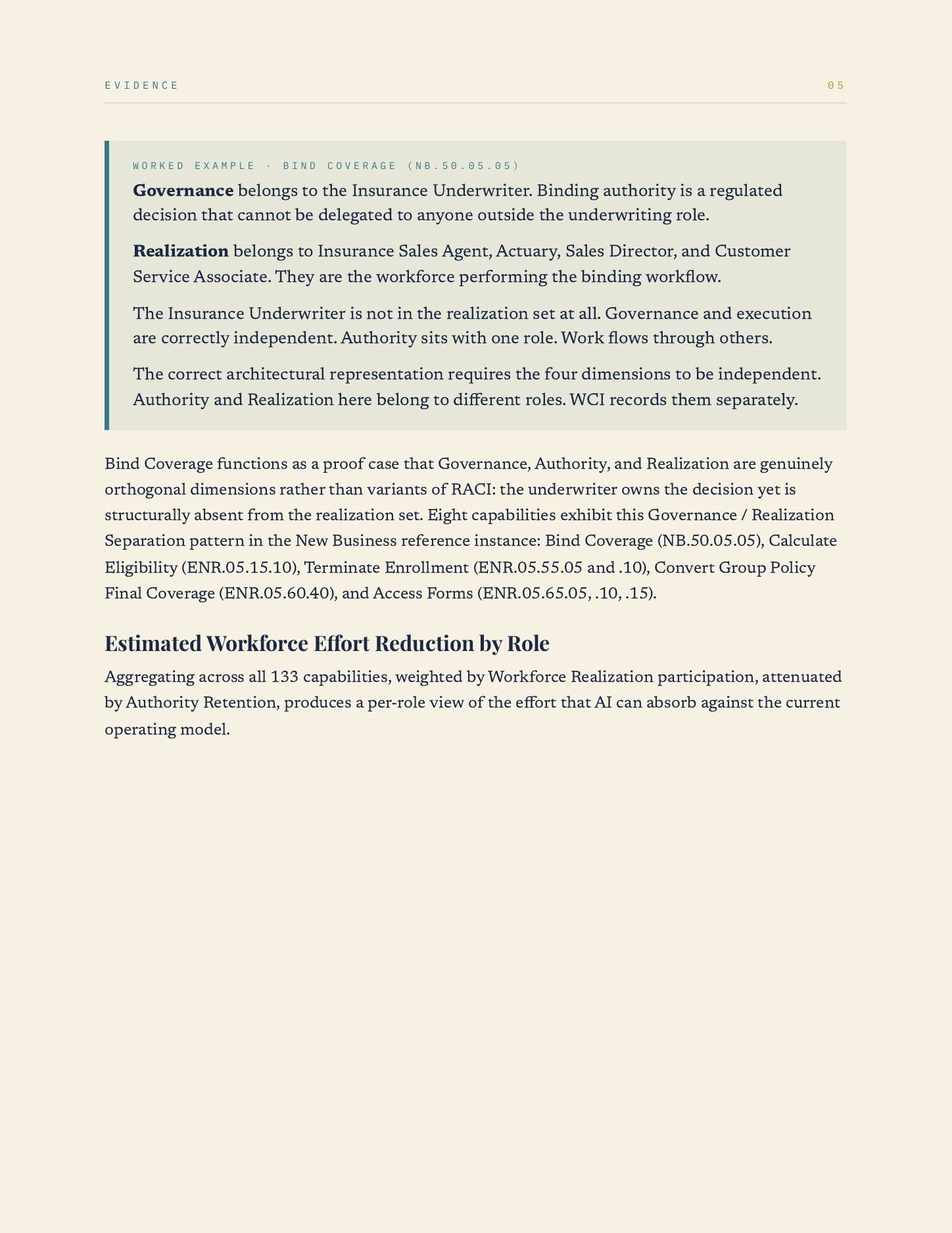
Governance belongs to the Insurance Underwriter. Binding authority is a regulated decision that cannot be delegated to anyone outside the underwriting role.
Realization belongs to Insurance Sales Agent, Actuary, Sales Director, and Customer Service Associate. They are the workforce performing the binding workflow.
The Insurance Underwriter is not in the realization set at all. Governance and execution are correctly independent. Authority sits with one role. Work flows through others.
The correct architectural representation requires the four dimensions to be independent. Authority and Realization here belong to different roles. WCI records them separately.
Bind Coverage functions as a proof case that Governance, Authority, and Realization are genuinely orthogonal dimensions rather than variants of RACI: the underwriter owns the decision yet is structurally absent from the realization set. Eight capabilities exhibit this Governance / Realization Separation pattern in the New Business reference instance: Bind Coverage (NB.50.05.05), Calculate Eligibility (ENR.05.15.10), Terminate Enrollment (ENR.05.55.05 and .10), Convert Group Policy Final Coverage (ENR.05.60.40), and Access Forms (ENR.05.65.05, .10, .15).
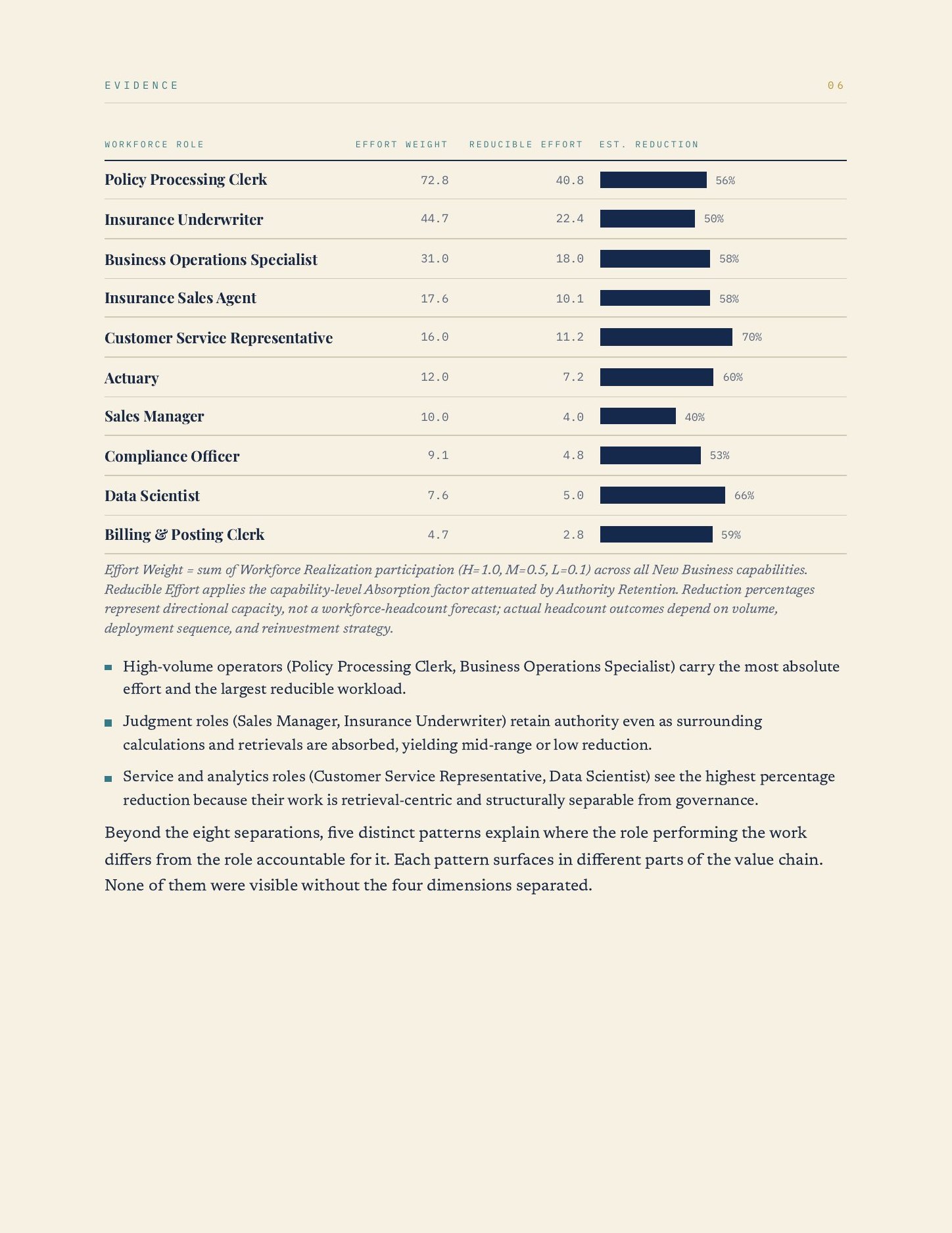
Aggregating across all 133 capabilities, weighted by Workforce Realization participation, attenuated by Authority Retention, produces a per-role view of the effort that AI can absorb against the current operating model.
Effort Weight = sum of Workforce Realization participation (H=1.0, M=0.5, L=0.1) across all New Business capabilities. Reducible Effort applies the capability-level Absorption factor attenuated by Authority Retention. Reduction percentages represent directional capacity, not a workforce-headcount forecast; actual headcount outcomes depend on volume, deployment sequence, and reinvestment strategy.
High-volume operators (Policy Processing Clerk, Business Operations Specialist) carry the most absolute effort and the largest reducible workload.
Judgment roles (Sales Manager, Insurance Underwriter) retain authority even as surrounding calculations and retrievals are absorbed, yielding mid-range or low reduction.
Service and analytics roles (Customer Service Representative, Data Scientist) see the highest percentage reduction because their work is retrieval-centric and structurally separable from governance.
Beyond the eight separations, five distinct patterns explain where the role performing the work differs from the role accountable for it. Each pattern surfaces in different parts of the value chain. None of them were visible without the four dimensions separated.
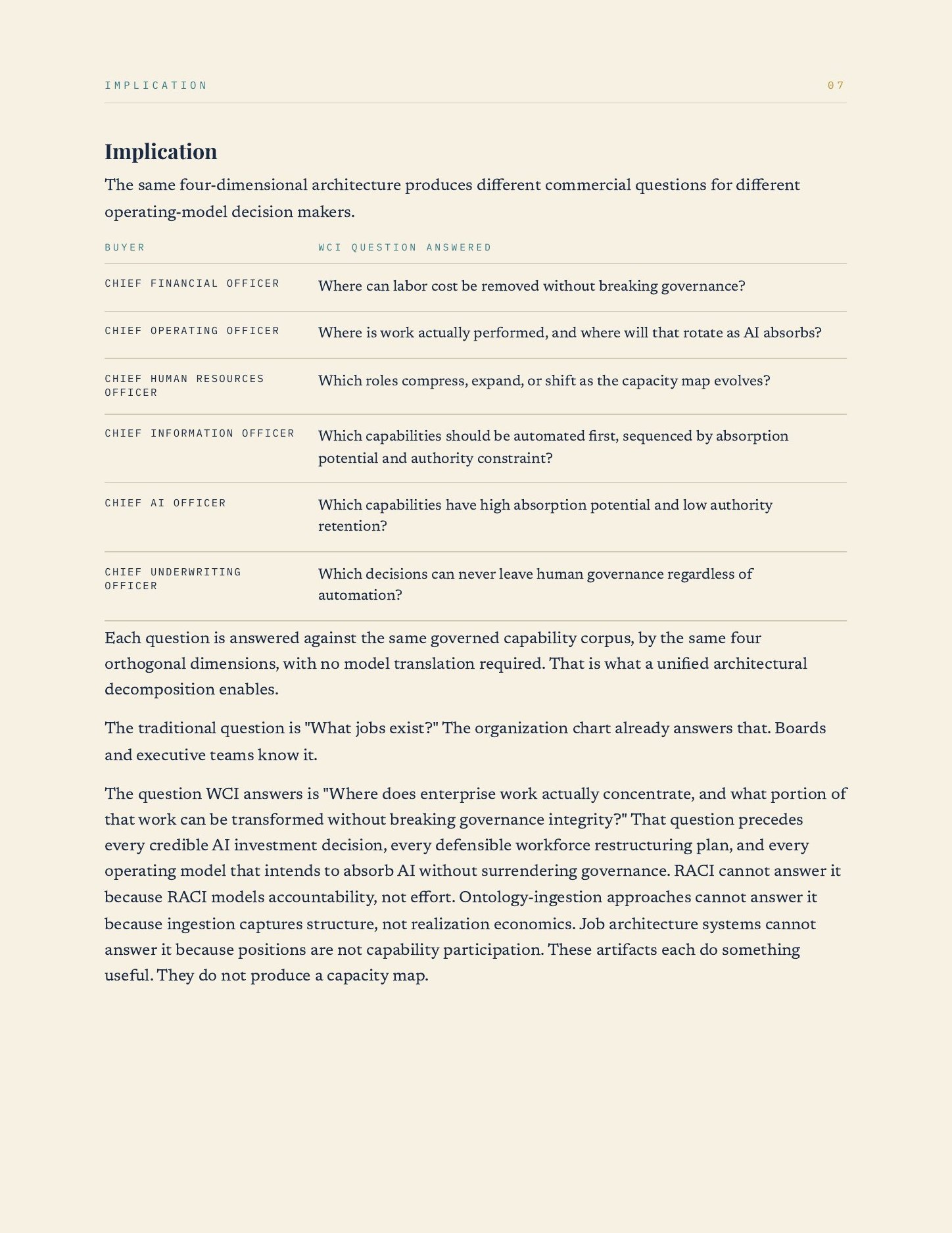
The same four-dimensional architecture produces different commercial questions for different operating-model decision makers.
Where can labor cost be removed without breaking governance?
Where is work actually performed, and where will that rotate as AI absorbs?
Which roles compress, expand, or shift as the capacity map evolves?
Which capabilities should be automated first, sequenced by absorption potential and authority constraint?
Which capabilities have high absorption potential and low authority retention?
Which decisions can never leave human governance regardless of automation?
Each question is answered against the same governed capability corpus, by the same four orthogonal dimensions, with no model translation required. That is what a unified architectural decomposition enables.
The traditional question is "What jobs exist?" The organization chart already answers that. Boards and executive teams know it.
The question WCI answers is "Where does enterprise work actually concentrate, and what portion of that work can be transformed without breaking governance integrity?" That question precedes every credible AI investment decision, every defensible workforce restructuring plan, and every operating model that intends to absorb AI without surrendering governance. RACI cannot answer it because RACI models accountability, not effort. Ontology-ingestion approaches cannot answer it because ingestion captures structure, not realization economics. Job architecture systems cannot answer it because positions are not capability participation. These artifacts each do something useful. They do not produce a capacity map.
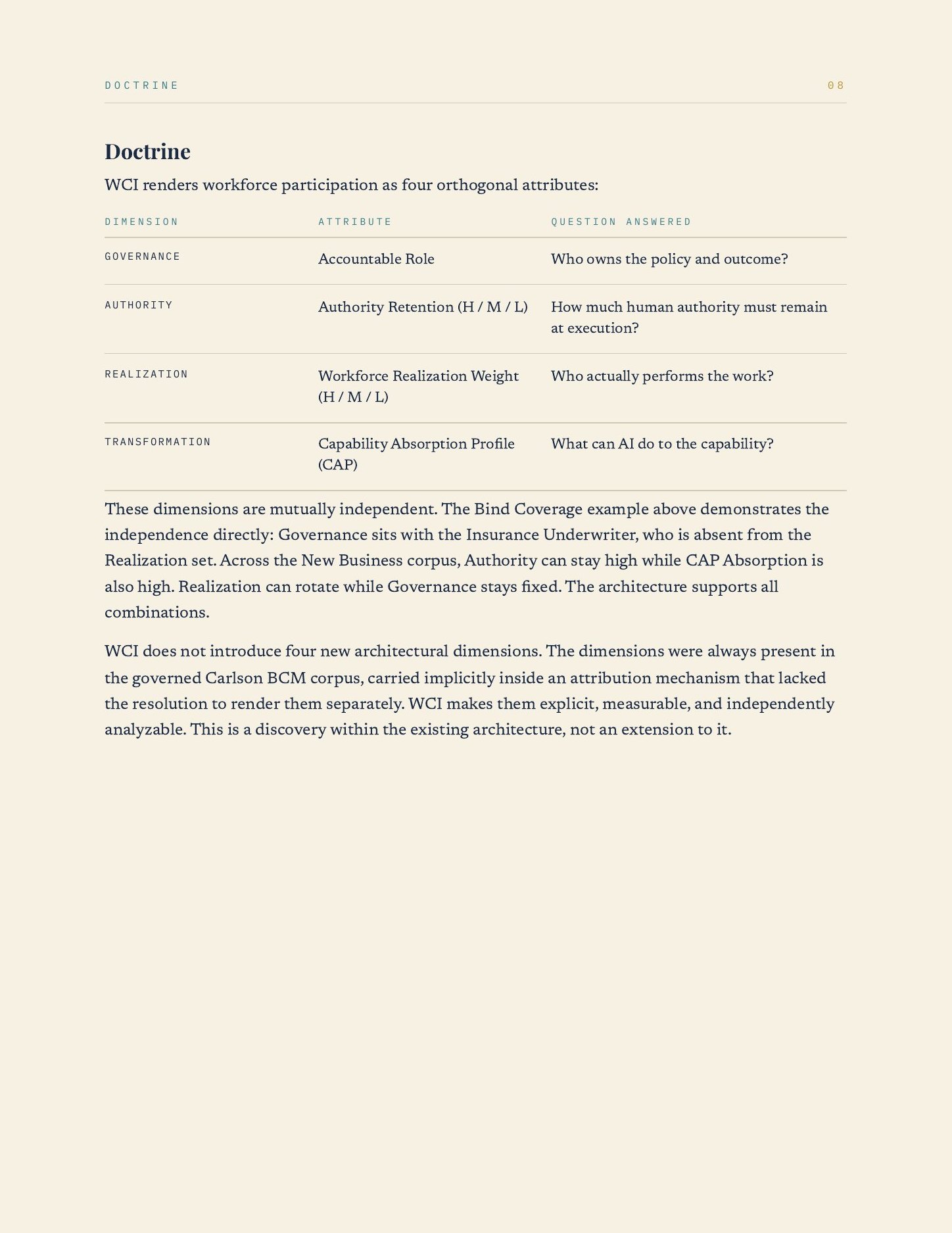
WCI renders workforce participation as four orthogonal attributes:
Who owns the policy and outcome?
Authority Retention (H / M / L)
How much human authority must remain at execution?
Workforce Realization Weight (H / M / L)
Who actually performs the work?
What can AI do to the capability?
These dimensions are mutually independent. The Bind Coverage example above demonstrates the independence directly: Governance sits with the Insurance Underwriter, who is absent from the Realization set. Across the New Business corpus, Authority can stay high while CAP Absorption is also high. Realization can rotate while Governance stays fixed. The architecture supports all combinations.
WCI does not introduce four new architectural dimensions. The dimensions were always present in the governed Carlson BCM corpus, carried implicitly inside an attribution mechanism that lacked the resolution to render them separately. WCI makes them explicit, measurable, and independently analyzable. This is a discovery within the existing architecture, not an extension to it.
Forward
A fully rendered Workforce Capacity Intelligence map of an insurer is the basis for capacity economics, AI absorption planning, workforce transition modeling, operating model simulation, and future-state organization design. It produces a math-anchored view of where work concentrates, where authority must remain human, and where AI can absorb capacity without surrendering governance.
The discovery underneath the map is that workforce attribution has always carried four independent architectural relationships in a single mark. The work of WCI is separating them. The work after WCI is using them.
Enterprise Capability Absorption Economics is the financial lens. Carlson BCM™ is the governing architecture. Workforce Capacity Intelligence is the product that lets AI operating-model decisions be made against capability facts rather than workforce proxies.