 Carlson BCM
Read as text
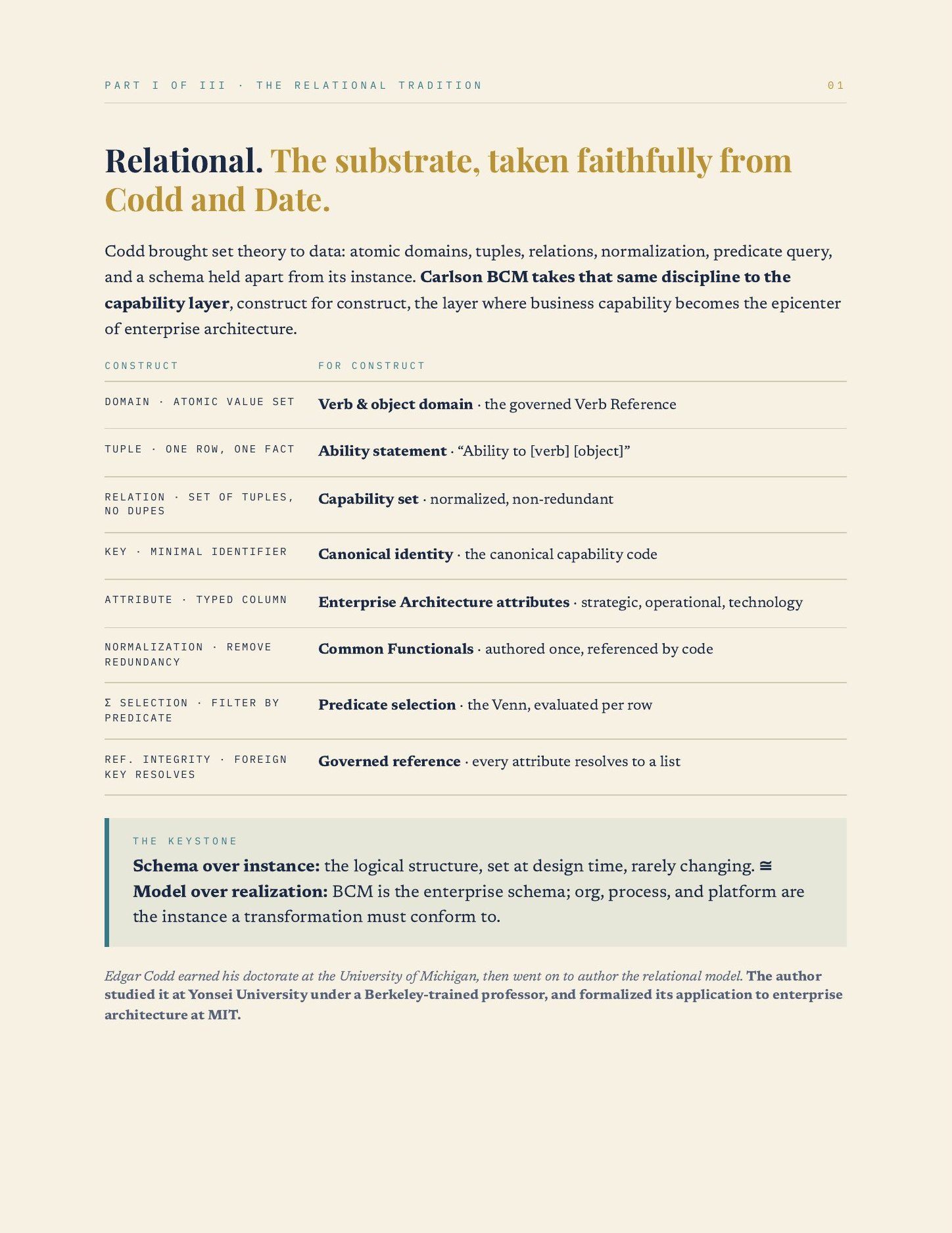
Relational. The substrate, taken faithfully from Codd and Date.
Codd brought set theory to data: atomic domains, tuples, relations, normalization, predicate query, and a schema held apart from its instance. Carlson BCM takes that same discipline to the capability layer of enterprise architecture. , construct for construct, the layer where business capability becomes the epicenter
Ability statement · “Ability to [verb] [object]”
Schema over instance: the logical structure, set at design time, rarely changing. ≅ Model over realization: BCM is the enterprise schema; org, process, and platform are the instance a transformation must conform to.
Edgar Codd earned his doctorate at the University of Michigan, then went on to author the relational model. The author studied it at Yonsei University under a Berkeley-trained professor, and formalized its application to enterprise architecture at MIT.
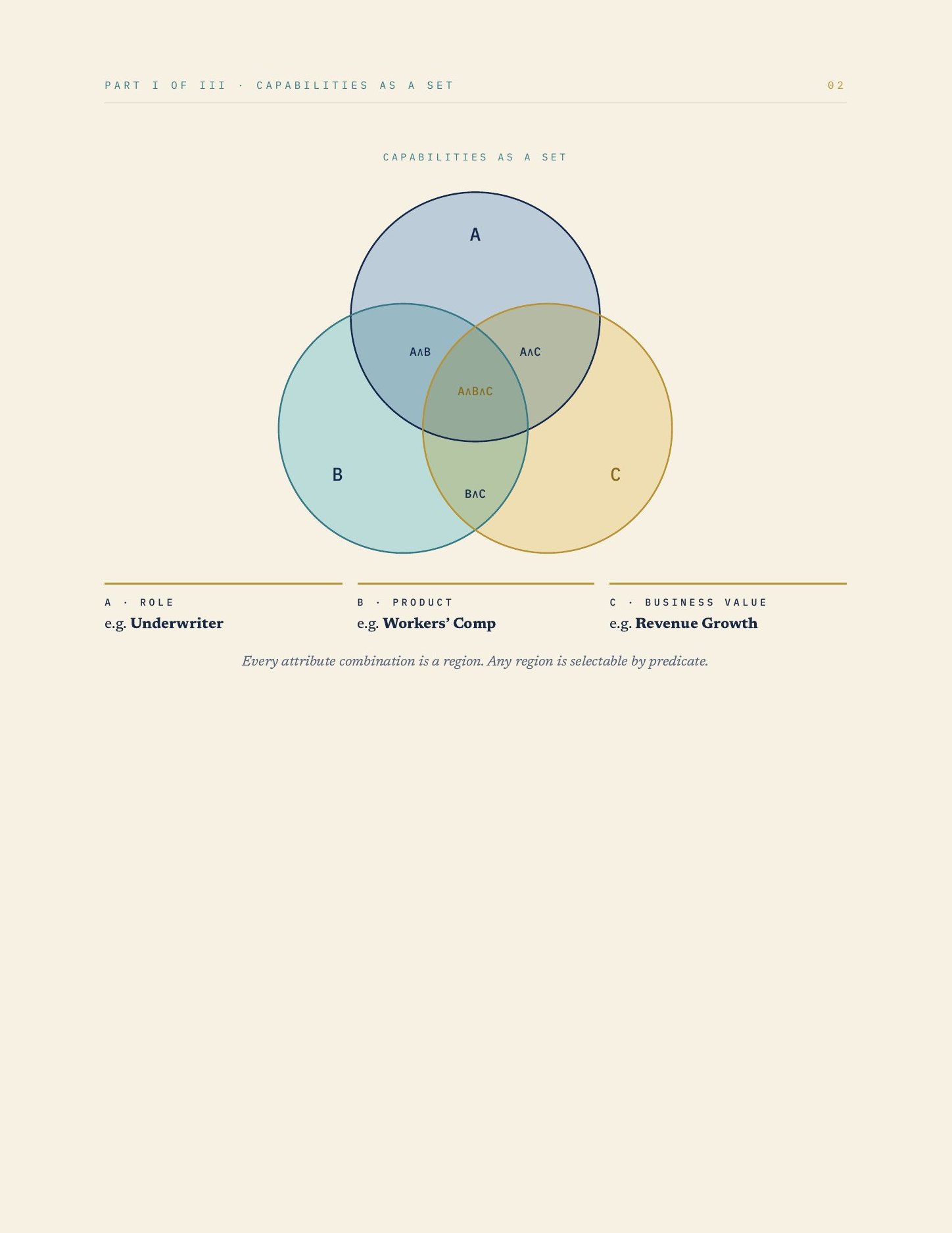
Every attribute combination is a region. Any region is selectable by predicate.
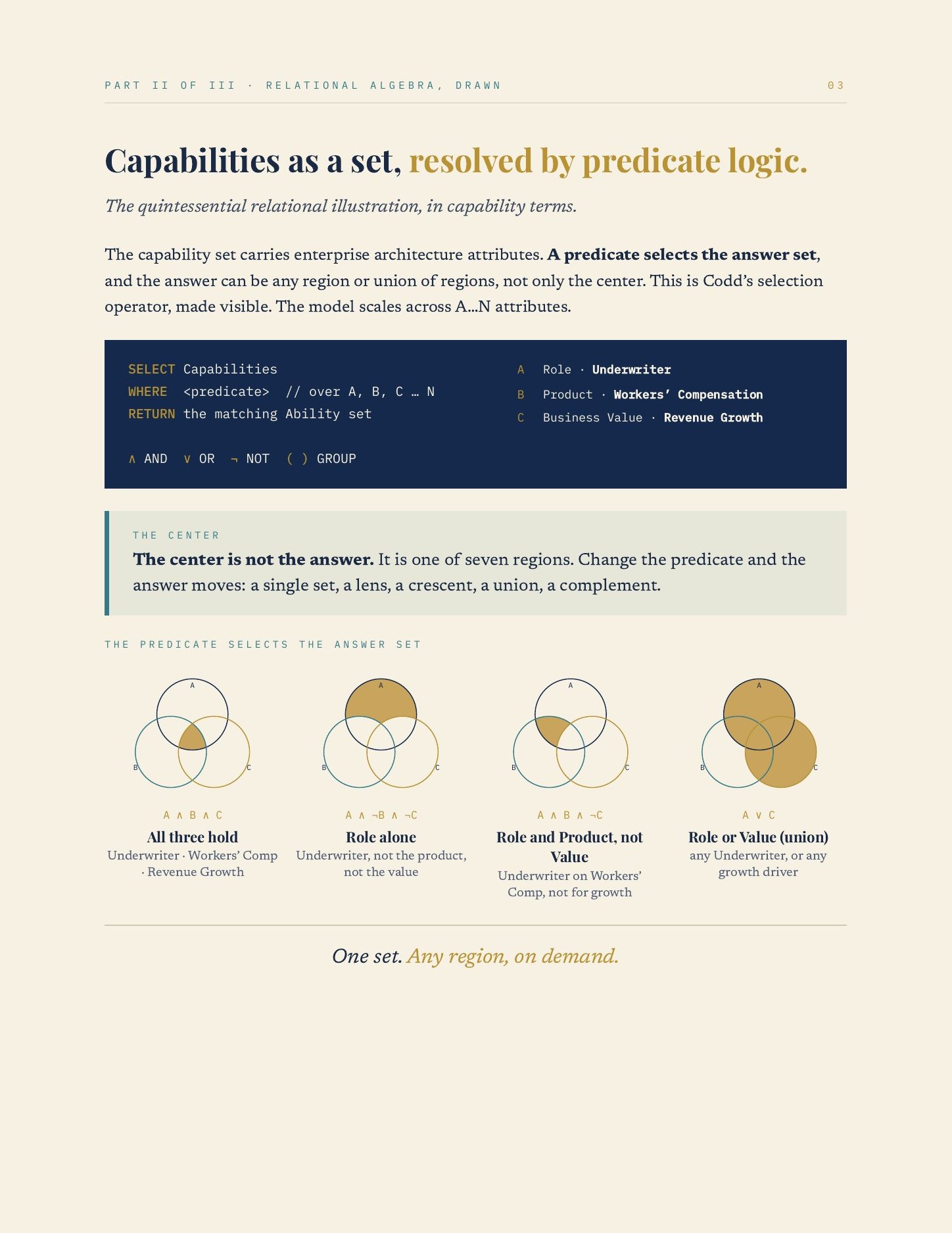
Capabilities as a set, resolved by predicate logic.
The quintessential relational illustration, in capability terms.
The capability set carries enterprise architecture attributes. A predicate selects the answer set and the answer can be any region or union of regions, not only the center. This is Codd’s selection operator, made visible. The model scales across A…N attributes.
The center is not the answer. It is one of seven regions. Change the predicate and the answer moves: a single set, a lens, a crescent, a union, a complement.
One set. Any region, on demand.
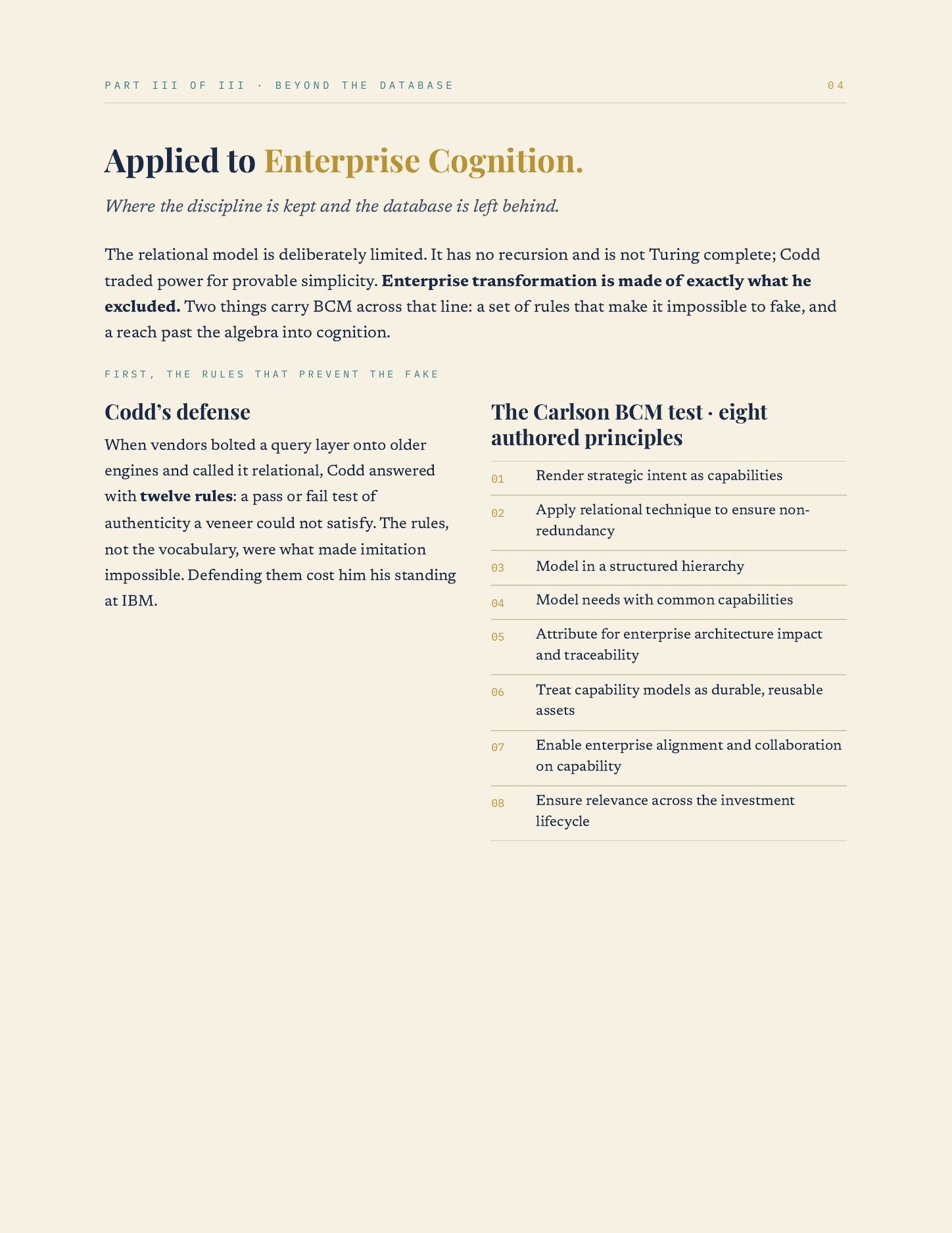
Applied to Enterprise Cognition.
Where the discipline is kept and the database is left behind.
The relational model is deliberately limited. It has no recursion and is not Turing complete; Codd traded power for provable simplicity. Enterprise transformation is made of exactly what he excluded. Two things carry BCM across that line: a set of rules that make it impossible to fake, and a reach past the algebra into cognition.
When vendors bolted a query layer onto older engines and called it relational, Codd answered with twelve rules authenticity a veneer could not satisfy. The rules, not the vocabulary, were what made imitation impossible. Defending them cost him his standing at IBM.
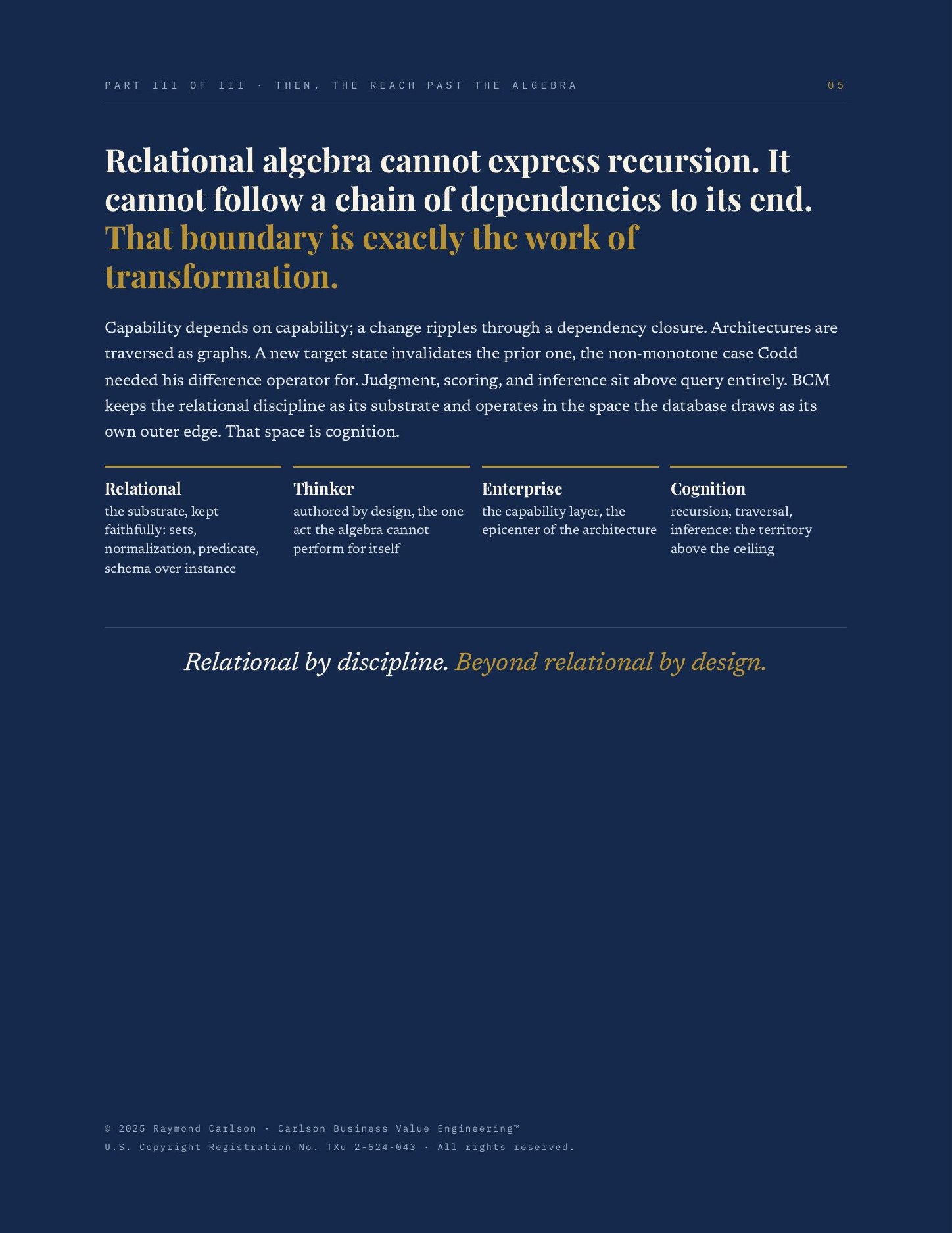
Relational algebra cannot express recursion. It cannot follow a chain of dependencies to its end. That boundary is exactly the work of transformation.
Capability depends on capability; a change ripples through a dependency closure. Architectures are traversed as graphs. A new target state invalidates the prior one, the non-monotone case Codd needed his difference operator for. Judgment, scoring, and inference sit above query entirely. BCM keeps the relational discipline as its substrate and operates in the space the database draws as its own outer edge. That space is cognition. the substrate, kept faithfully: sets, normalization, predicate, schema over instance authored by design, the one the capability layer, the act the algebra cannot perform for itself
Relational by discipline. Beyond relational by design.