 Carlson BCM
Read as text
Every executive can state the strategy, show the org chart, and list the investments. Almost none can name what the company is able to do.
That gap is not a documentation problem. It is the tell that an enterprise is being managed by everything except the thing that delivers the result.
Consider what a company actually manages. It manages functions, and reorganizes them. It manages projects, and closes them. It manages applications, and replaces them. It manages budgets, and resets them every year. Each of these is a real object with a real owner, a real cost, and a real governance forum. Not one of them is what creates the value.
They are proxies. They are the constructs an enterprise uses to organize work, and they are all transient by design. The function is redrawn at the next reorganization. The project ends. The application is decommissioned. The budget expires in December. Underneath every one of them sits something that does not move: the ability the company had before the reorganization and still has after it.
The consequence is visible in the way large companies actually behave. When the strategy shifts, the enterprise commissions a study, because the picture it needs does not exist and has to be reassembled. Weeks later the study answers one question, and the moment the question changes it is discarded and the next study begins. Every consequential decision crosses the boundaries between the proxies, so every consequential decision requires the same reconstruction. Executives treat this as the cost of doing business.
It is not the cost of doing business. It is the cost of managing the wrong object.
An enterprise cannot govern what it has never named. The abilities that produce its outcomes are owned by no one, planned around by no one, and tracked by no system. They are the enterprise’s largest unmanaged asset.
This is not another way to organize work. Work was never the right object of management.
For thirty years, the answer to every enterprise problem has been a new way to organize work. Process reengineering. Value streams. Lean. Operating models. Each is a genuine discipline, and each models the same thing: activity. What the enterprise does, in what order, at what speed, with how much waste.
But activity is only how an ability is exercised in a given moment. The ability itself persists across all those moments. An insurer can adjudicate a claim whether or not one is on the desk right now. Optimize the flow all you like: the ability the flow exercises remains unnamed, ungoverned, and unowned. Activities change with every reorganization. Abilities endure.
An enterprise ability is the enduring capacity to produce a specific business outcome. Price a risk. Adjudicate a claim. Underwrite a decision. Serve a segment. It is what the enterprise can do, independent of who performs it, in what sequence, on what platform.
The enterprise is not fundamentally an organization, a process, or a technology estate. It is an organized set of abilities. Everything else it manages is a projection of them.
Capability is the engineering construct that represents an ability in governed, relational form. It is how the object is made rigorous enough to reason with. But the object itself is older and simpler than any notation, and every executive already understands it: it is what the company is able to do.
Strategy, operations, and technology are not three domains. They are one ability, seen from three sides.
The strategist looks at an ability and sees what it is worth: which objectives it carries, what value it creates, what risk it holds. The operator looks at the same ability and sees how it runs: its maturity, its performance, the products and channels and geographies it serves. The technologist looks at the same ability and sees what realizes it: the applications, the data, the platforms it depends on.
Three people. Three vocabularies. Three governance forums, three budgets, three reporting lines. And one object, which none of them named.
This is why the translation problem is so durable. Strategy is rendered into projects, projects into requirements, requirements into architectures, architectures into systems. Each translation is a handoff between people who believe they are working on different things, and each handoff is a place where meaning is lost. The enterprise then commissions a study to recover what the last translation dropped, and calls the loss the cost of doing business.
The loss is not inherent to transformation. It is an artifact of a missing object. When strategy, operations, and technology are attributed to the same ability, a question can run across all three in a single move: which abilities carry the most value, what supports them today, where the risk sits, and what must change to strengthen them. That is one question, not three, and it is answerable because there is one object to ask it of.
If ability is the enduring object, management’s work is no longer to reconcile separate domains. It is to perform different operations on the same object.
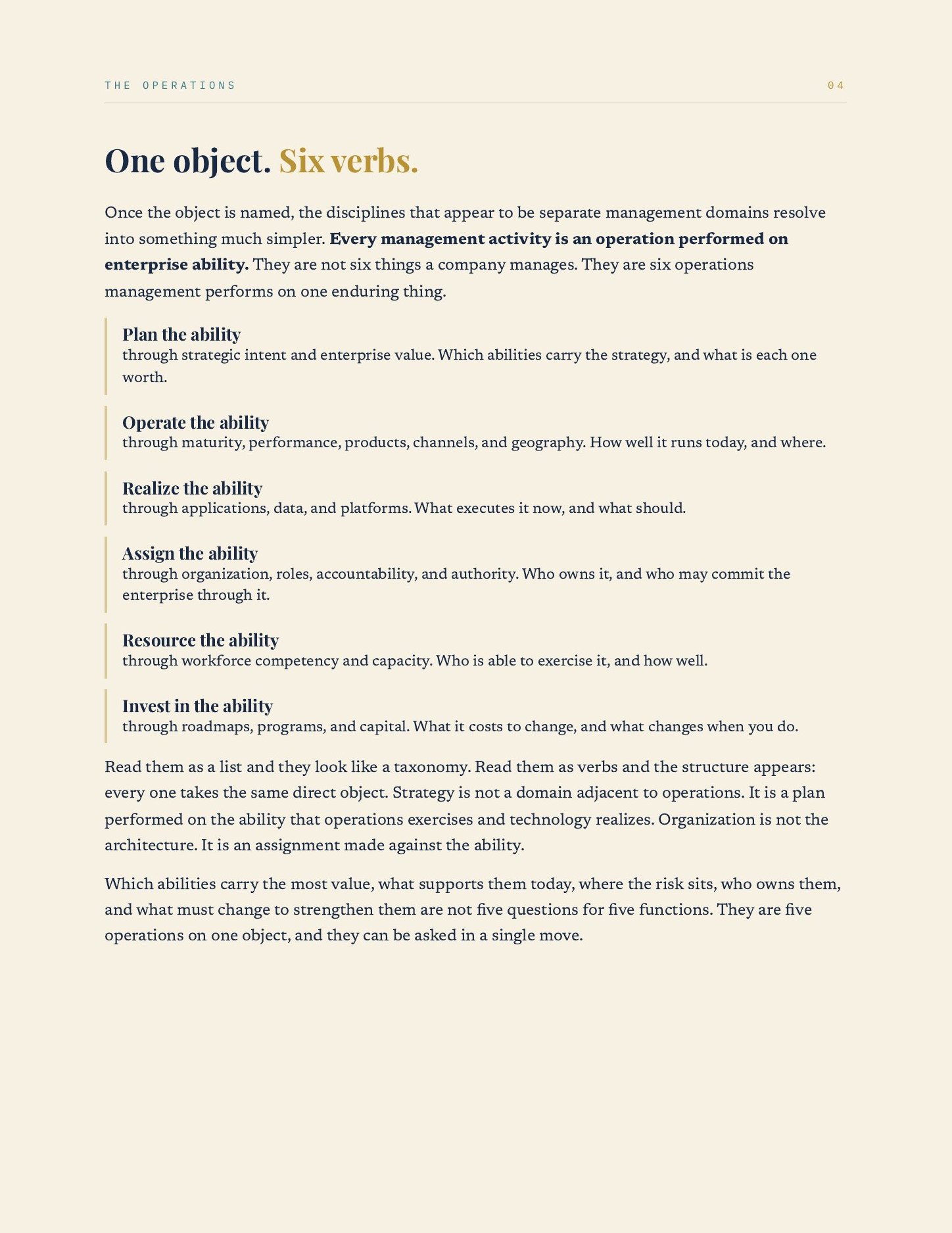
One object. Six verbs.
Once the object is named, the disciplines that appear to be separate management domains resolve into something much simpler. Every management activity is an operation performed on enterprise ability. They are not six things a company manages. They are six operations management performs on one enduring thing. through strategic intent and enterprise value. Which abilities carry the strategy, and what is each one worth. through maturity, performance, products, channels, and geography. How well it runs today, and where. through applications, data, and platforms. What executes it now, and what should. through organization, roles, accountability, and authority. Who owns it, and who may commit the enterprise through it. through workforce competency and capacity. Who is able to exercise it, and how well. through roadmaps, programs, and capital. What it costs to change, and what changes when you do.
Read them as a list and they look like a taxonomy. Read them as verbs and the structure appears: every one takes the same direct object. Strategy is not a domain adjacent to operations. It is a plan performed on the ability that operations exercises and technology realizes. Organization is not the architecture. It is an assignment made against the ability.
Which abilities carry the most value, what supports them today, where the risk sits, who owns them, and what must change to strengthen them are not five questions for five functions. They are five operations on one object, and they can be asked in a single move.
The organization chart is not the architecture. It is a picture of one.
Of the six operations, one is routinely mistaken for the enterprise itself. Companies reorganize as though redrawing the chart changes what they are able to do. It does not. The reorganization reassigns accountability and capacity against a set of abilities that were there before the meeting and are there after it.
Read that way, the chart stops being a source of truth and becomes what it always was: an instance. Assignment is a management operation, performed on the ability, and it can be performed again. An enterprise that knows its abilities can re-derive its organization cleanly at every reorganization, because the thing being reorganized was never the abilities. It was only the allocation of responsibility for them.
Enterprise ability requires human ability.
An enterprise organized around abilities cannot be run by people who are not. Abilities define what the enterprise must be able to do. Competencies define what its people must be able to do to author, govern, exercise, and transform them.
These are not the same ability. Underwrite commercial risk belongs to the enterprise. Apply underwriting judgment and govern the underwriting architecture belong to people. They share a form, both are statements of what something is able to do, but they have different subjects and different purposes. The enterprise ability is the object. The human competency is the capacity to operate on it.
Which means the workforce is not a separate domain either. It is the resourcing operation, and it fails the way the others fail: an enterprise that manages abilities while developing its people against functions, roles, and skills is managing one object and building for another. That is the subject of the next paper.
Name the object, and strategy stops having to be translated before execution can begin.
Today, strategic intent is translated into a different enterprise object before anything can be built. It becomes projects, then requirements, then architectures, then systems. Every one of those translations is a place where meaning is lost, and every study ever commissioned exists to recover what the last translation dropped.
When strategy and execution are expressed against the same ability, the chain of translations collapses. They were never separate objects. They were separate views of one, held apart by the fact that no one had named the thing they were both looking at.
An enterprise that manages its abilities does not become simpler. It becomes legible. The questions that cross every functional line have somewhere to be asked. The organization can be redrawn without losing the thread. The platform can be replaced without losing the business. And the strategic agenda can change, as it will, without requiring the enterprise to reconstruct itself in order to answer for it.
The studies stop, not because anyone banned them, but because the thing they kept rebuilding already exists.
An enterprise is an organized set of abilities. Manage them, and everything else you manage becomes what it always was: a projection.