 Carlson BCM
Read as text
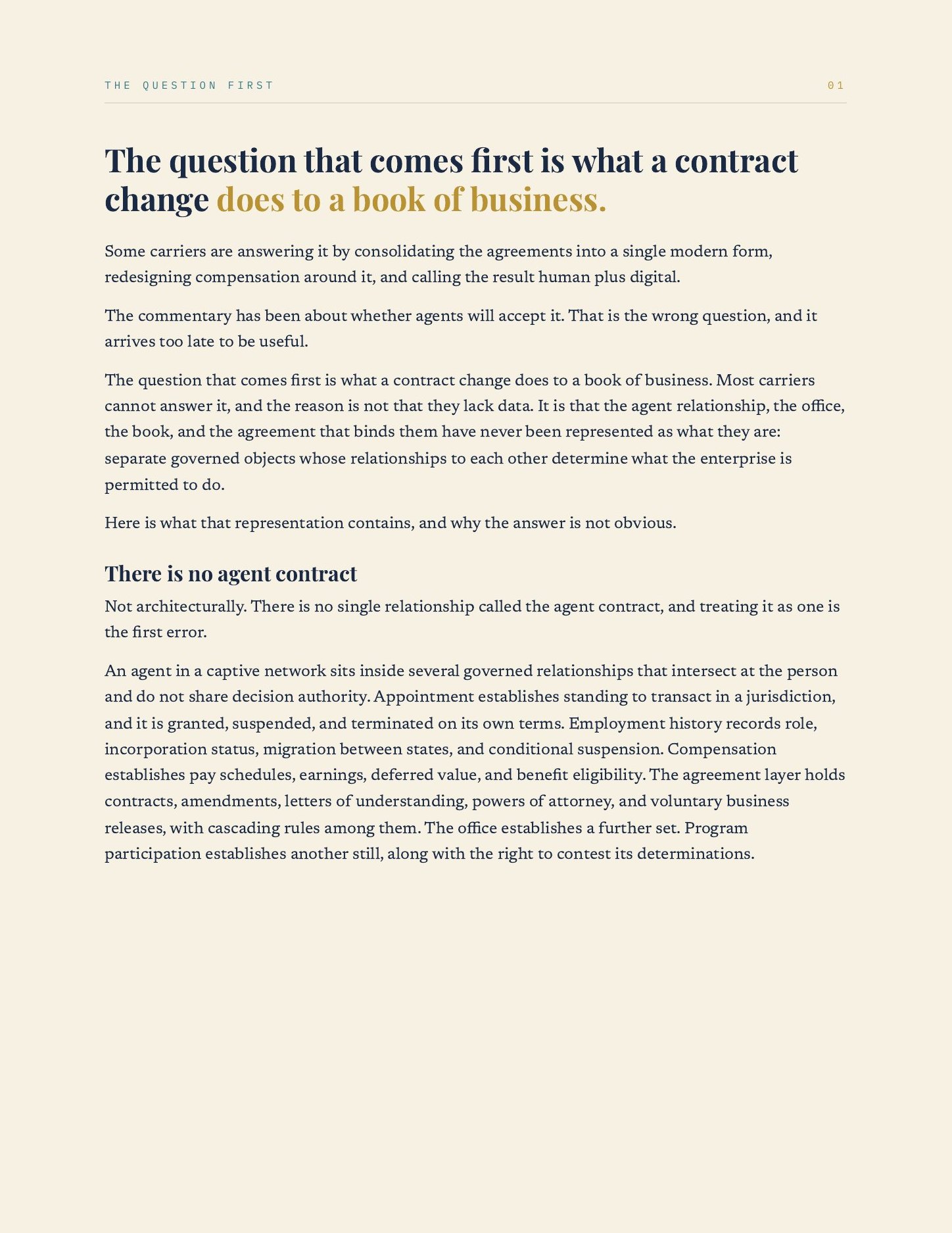
The question that comes first is what a contract change does to a book of business.
Some carriers are answering it by consolidating the agreements into a single modern form, redesigning compensation around it, and calling the result human plus digital.
The commentary has been about whether agents will accept it. That is the wrong question, and it arrives too late to be useful.
The question that comes first is what a contract change does to a book of business. Most carriers cannot answer it, and the reason is not that they lack data. It is that the agent relationship, the office, the book, and the agreement that binds them have never been represented as what they are: separate governed objects whose relationships to each other determine what the enterprise is permitted to do.
Here is what that representation contains, and why the answer is not obvious.
Not architecturally. There is no single relationship called the agent contract, and treating it as one is the first error.
An agent in a captive network sits inside several governed relationships that intersect at the person and do not share decision authority. Appointment establishes standing to transact in a jurisdiction, and it is granted, suspended, and terminated on its own terms. Employment history records role, incorporation status, migration between states, and conditional suspension. Compensation establishes pay schedules, earnings, deferred value, and benefit eligibility. The agreement layer holds contracts, amendments, letters of understanding, powers of attorney, and voluntary business releases, with cascading rules among them. The office establishes a further set. Program participation establishes another still, along with the right to contest its determinations.
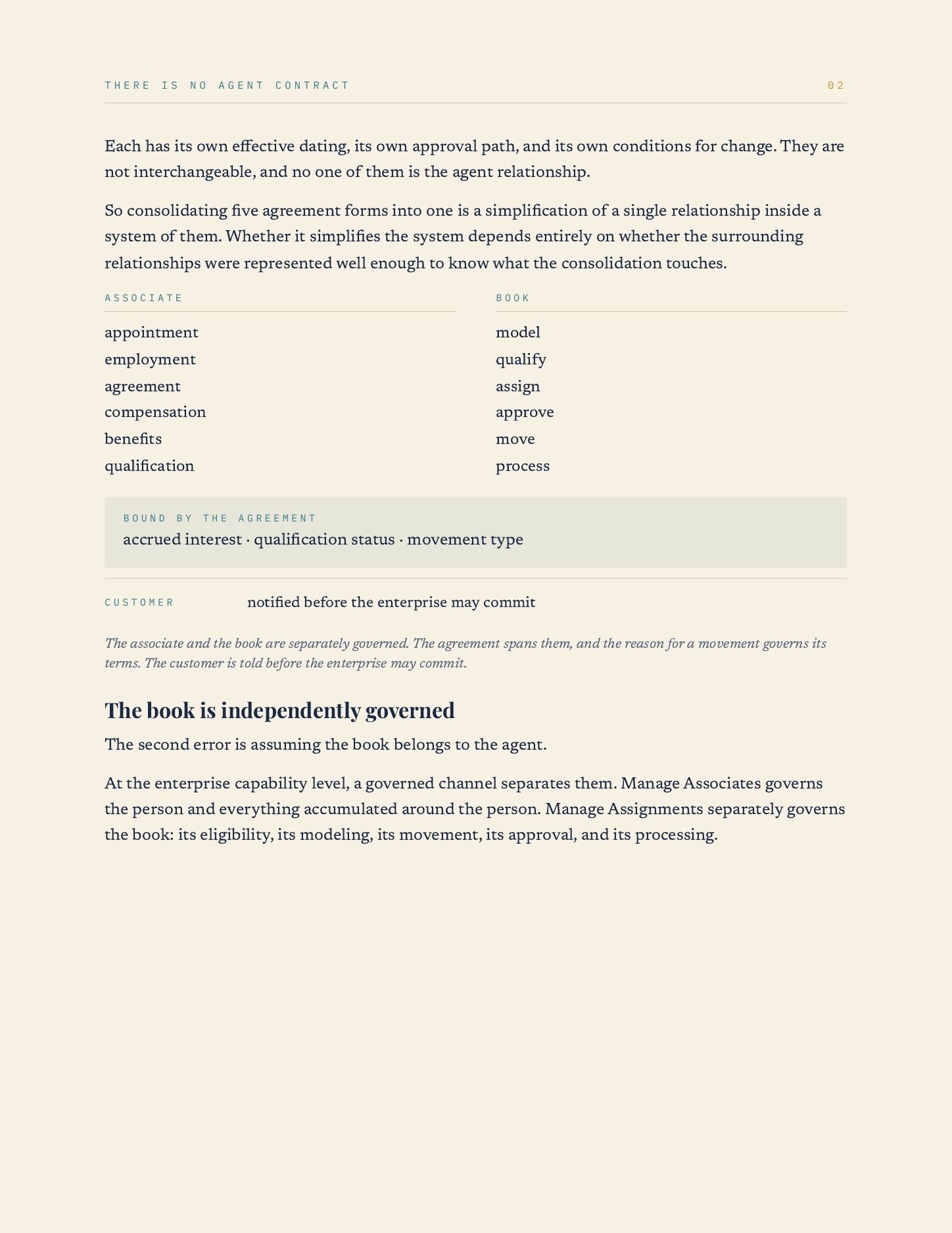
Each has its own effective dating, its own approval path, and its own conditions for change. They are not interchangeable, and no one of them is the agent relationship.
So consolidating five agreement forms into one is a simplification of a single relationship inside a system of them. Whether it simplifies the system depends entirely on whether the surrounding relationships were represented well enough to know what the consolidation touches.
The associate and the book are separately governed. The agreement spans them, and the reason for a movement governs its terms. The customer is told before the enterprise may commit.
The second error is assuming the book belongs to the agent.
At the enterprise capability level, a governed channel separates them. Manage Associates governs the person and everything accumulated around the person. Manage Assignments separately governs the book: its eligibility, its modeling, its movement, its approval, and its processing.
The book is its own governed object. It has its own eligibility rules, its own modeling, its own approval path, and its own execution. An agent can leave and the book persists, carrying an unresolved question: where does it go, and on what terms.
This is why a compensation change and a distribution change are the same event in a captive channel, and why they are almost never discussed as one.
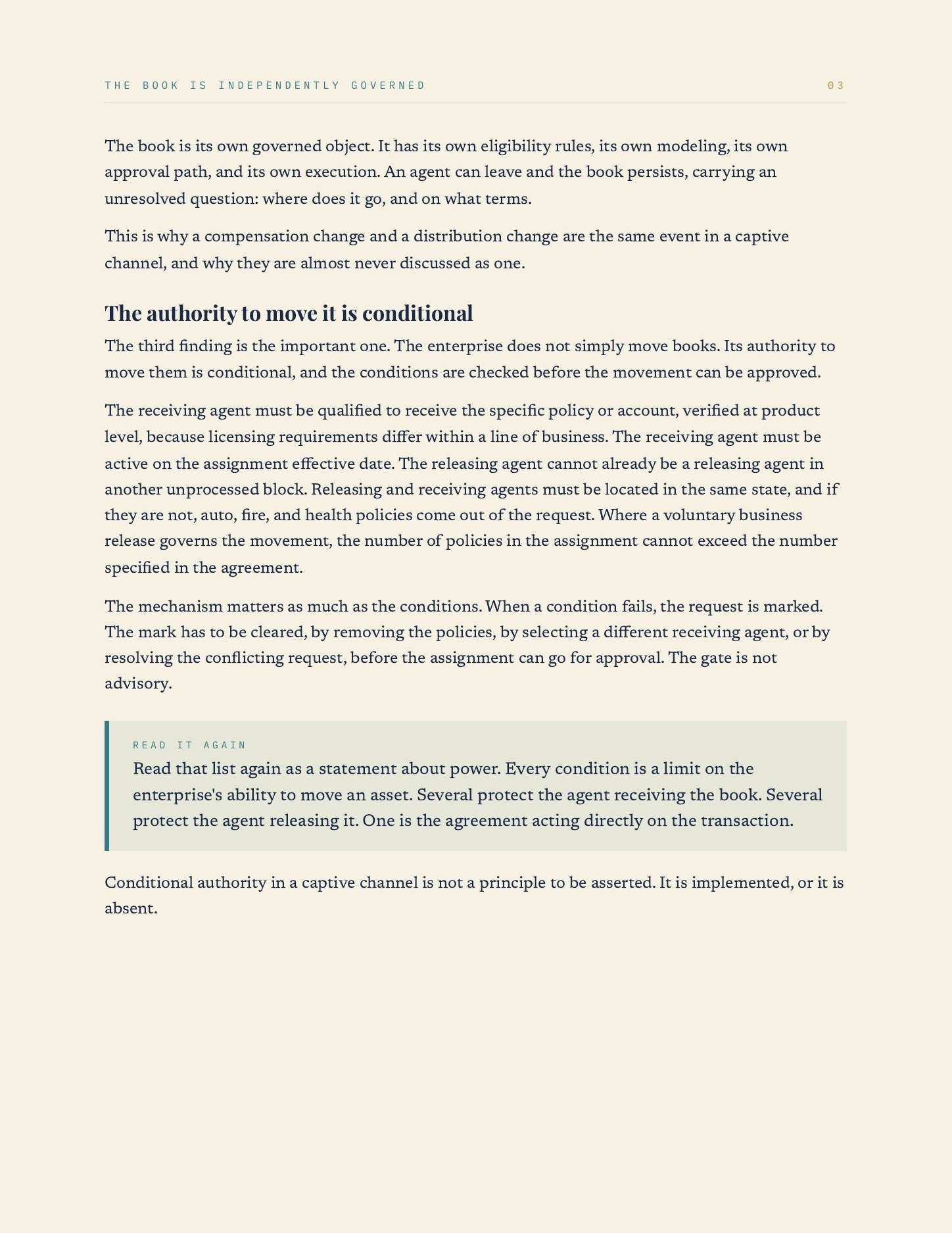
The third finding is the important one. The enterprise does not simply move books. Its authority to move them is conditional, and the conditions are checked before the movement can be approved.
The receiving agent must be qualified to receive the specific policy or account, verified at product level, because licensing requirements differ within a line of business. The receiving agent must be active on the assignment effective date. The releasing agent cannot already be a releasing agent in another unprocessed block. Releasing and receiving agents must be located in the same state, and if they are not, auto, fire, and health policies come out of the request. Where a voluntary business release governs the movement, the number of policies in the assignment cannot exceed the number specified in the agreement.
The mechanism matters as much as the conditions. When a condition fails, the request is marked. The mark has to be cleared, by removing the policies, by selecting a different receiving agent, or by resolving the conflicting request, before the assignment can go for approval. The gate is not advisory.
Read that list again as a statement about power. Every condition is a limit on the enterprise's ability to move an asset. Several protect the agent receiving the book. Several protect the agent releasing it. One is the agreement acting directly on the transaction.
Conditional authority in a captive channel is not a principle to be asserted. It is implemented, or it is absent.
The reason governs the terms.
The fourth finding is the one that changes how the current moment reads.
A governed channel does not merely record that a book moved. It types the reason, and the type determines the terms. Termination. Voluntary business release. Migration. Office book. Loss of bank authorization. Loss of securities license. Loss of state authorization. Amendment drop. Active to active.
Nine reasons. And where the releasing agent is an agent rather than an office, the effective date follows from the type. Discretion exists in one case out of the nine.
Sit with that. The enterprise's latitude over when a book moves is nearly absent, because the reason for the movement determines the timing, the eligibility rules, and the downstream compensation treatment. Losing a securities license and voluntarily releasing business are both reasons a book moves. They are not the same event, and a governed channel refuses to process them as though they were.
One of the nine is an amendment drop. An amendment to an agreement is already a governed reason a book moves, with its own typed treatment and its own effective dating.
That is worth stopping on. A contract amendment causing a book to move is already represented as a typed, governed event with its own treatment and its own effective dating. A carrier consolidating its agent agreements therefore has to know whether, where, and under what conditions the new agreement causes movement. The channel either answers that, or it does not.
What survives the move.
Two findings sit underneath all of this, different in kind from each other.
The first concerns the agent. Term pay, extended term pay, and life term pay are payable again each time an agent changes books. The accrued interest does not extinguish when the enterprise reassigns the object it accrued against. Alongside it sit deferred compensation, assignment of interest, and assignment to a living trust, and benefit eligibility spanning term pay, extended term pay, disability income, and survivor payment.
Those are not payroll attributes. An economic interest that survives transfer of the underlying asset, that can be assigned, and that can pass to a survivor is behaving like property. That is what makes a captive book a retirement asset rather than an income stream, and it is why changing the terms is not the same kind of act as changing a commission schedule.
The second concerns the customer, who has standing the discussion omits entirely. Before an assignment can go for approval, a call program must be selected and a letter must be selected, both validated. The customer is told the agent is changing before the enterprise may commit the change.
Three parties, not two.
The last finding is where this stops being about contracts.
A substantial part of a captive channel's architecture exists for no purpose other than detecting that reality has departed from the permitted state. An agent who has not made a decision on errors and omissions coverage. An office with no active associates. An agent whose certification has terminated. A candidate sitting in the same status for 60 days. An office closed while associations to it remain open.
That is not administrative housekeeping. It is how a captive channel is actually governed. The normal state largely runs itself. Management attention is consumed by deviation, and finding the deviation is itself an enterprise ability.
Which is where an AI layer belongs, and it is not where the conversation is putting it. The interesting proposition is not a copilot for every agent. It is continuous reasoning over the governed state of the channel: identifying where reality has left the permitted operating state, determining what intervention is required, and routing the exception to the authority capable of resolving it.
That is not a new architectural layer sitting on top of the channel. It is a class of performer evaluated against abilities the enterprise already has and has always had. Where those abilities are represented, the AI question becomes tractable. Where they are not, no amount of model capability supplies them, because the system does not know what it is looking at.
There is a limit on it, and the channel supplies that too.
Appeals consume more architecture than the performance measurement they contest. Filing, evidencing, routing, adjudicating, notifying, and applying the adjustment, plus the search and the access control that appeals require, spread across the network. In a channel where recognition and qualification carry economic consequence, contesting the enterprise's determinations is not an exception path. It is a substantial capability in its own right.
The inference follows. When an enterprise creates performance gates and attaches economic consequence to them, it creates a second order requirement for people to contest what it decides. And the conclusion: contestability has to be represented as an enterprise ability wherever a determination carries meaningful economic consequence, whoever or whatever makes it.
An automated system may detect, calculate, model, and recommend. Whether it may determine, and who may contest what it determines, against which evidence, and who owns the final commitment, are architectural questions. They do not answer themselves because the system is capable.
The question.
A captive agency channel governs two things that are easy to mistake for one. The associate, and the book.
The enterprise holds the authority to move the book. The agent's accrued interest and qualification status constrain that authority. The customer must be notified before it is exercised. And the reason for the movement governs its terms.
Those relationships coexist because the architecture states the conditions under which the enterprise may act. A transformation is consequential when it changes those conditions without restating them.
Consolidating the agreements does not simplify the channel. It removes one of the things that was holding it, and puts the weight on whatever representation of the channel the enterprise actually has.
So the question for anyone doing this now is not whether agents will accept it. It is what constrains the movement now, and which type is this.