 Carlson BCM
Read as text
AI is redesigning work. Where should the design begin?
Enterprise AI has made the workforce a design problem again. Skills platforms and workforce intelligence tools now decompose jobs into tasks and skills to decide which work to automate, which skills to build and when to hire. Workday’s Work Intelligence, introduced in October 2026 on a library of 75,000 skills, is built to do exactly that.
The premise is that jobs and tasks are the right starting objects for redesigning an enterprise. Jobs are how work is assigned today. Tasks are how it is performed today. AI is about to change both.
The question has been tested before. In the late 1990s, enterprise software first moved HR work from HR to the employee, and HR made its first claim on enterprise strategy. The design that worked did not begin with the existing organization of work. It began with what the enterprise needed to be able to do. It was the first enterprise application of Carlson BCM.
Is a representation of today’s workforce sufficient to govern the transformation of tomorrow’s enterprise?
HR wanted the top of the pyramid. The business never offered it.
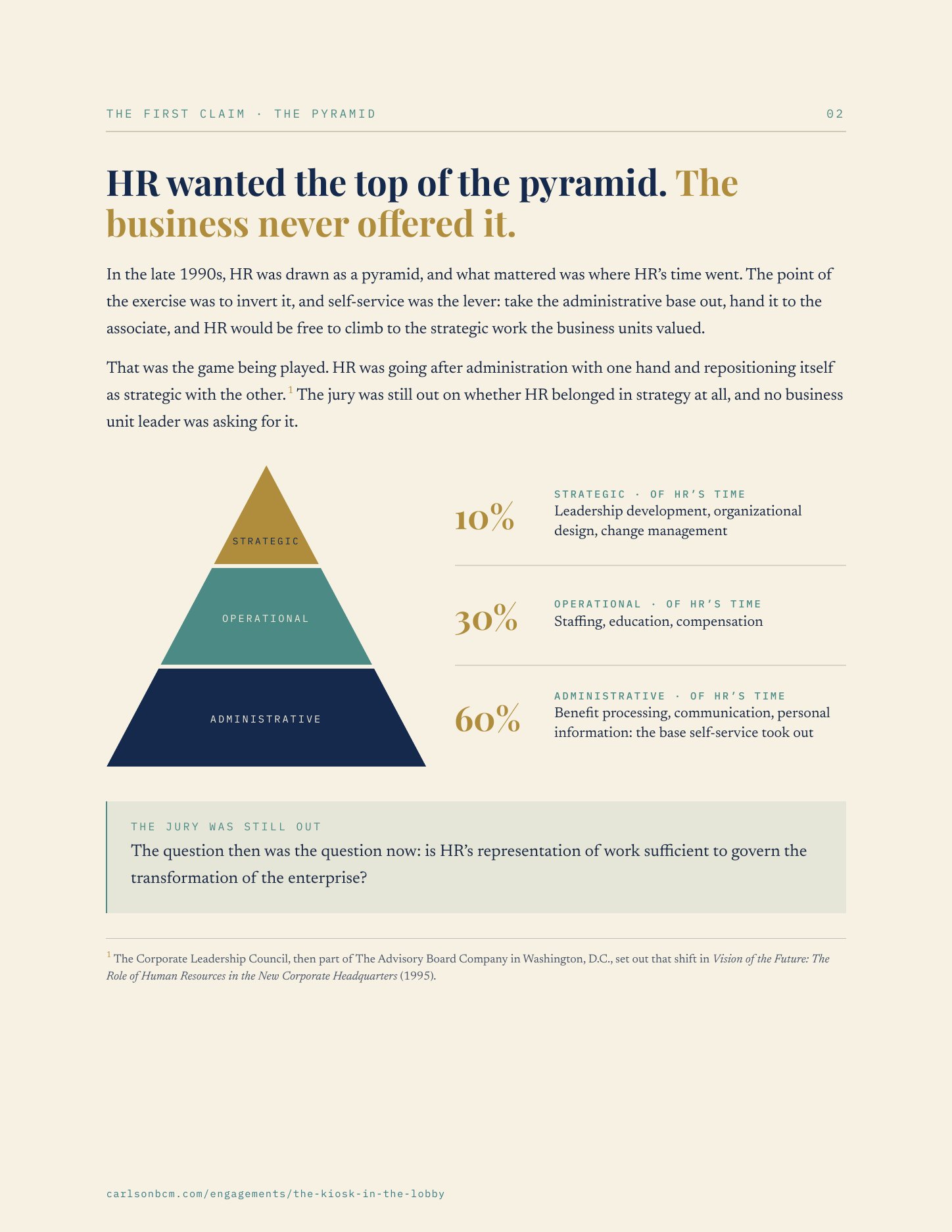
In the late 1990s, HR was drawn as a pyramid, and what mattered was where HR’s time went. The point of the exercise was to invert it, and self-service was the lever: take the administrative base out, hand it to the associate, and HR would be free to climb to the strategic work the business units valued.
That was the game being played. HR was going after administration with one hand and repositioning itself as strategic with the other. The jury was still out on whether HR belonged in strategy at all, and no business unit leader was asking for it.
Where HR’s time went: 10 percent strategic (leadership development, organizational design, change management), 30 percent operational (staffing, education, compensation), 60 percent administrative (benefit processing, communication, personal information), the base self-service took out. The Corporate Leadership Council, then part of The Advisory Board Company in Washington, D.C., set out that shift in Vision of the Future: The Role of Human Resources in the New Corporate Headquarters (1995).
The question then was the question now: is HR’s representation of work sufficient to govern the transformation of the enterprise?
An intranet on every desk, funded by HR administration.
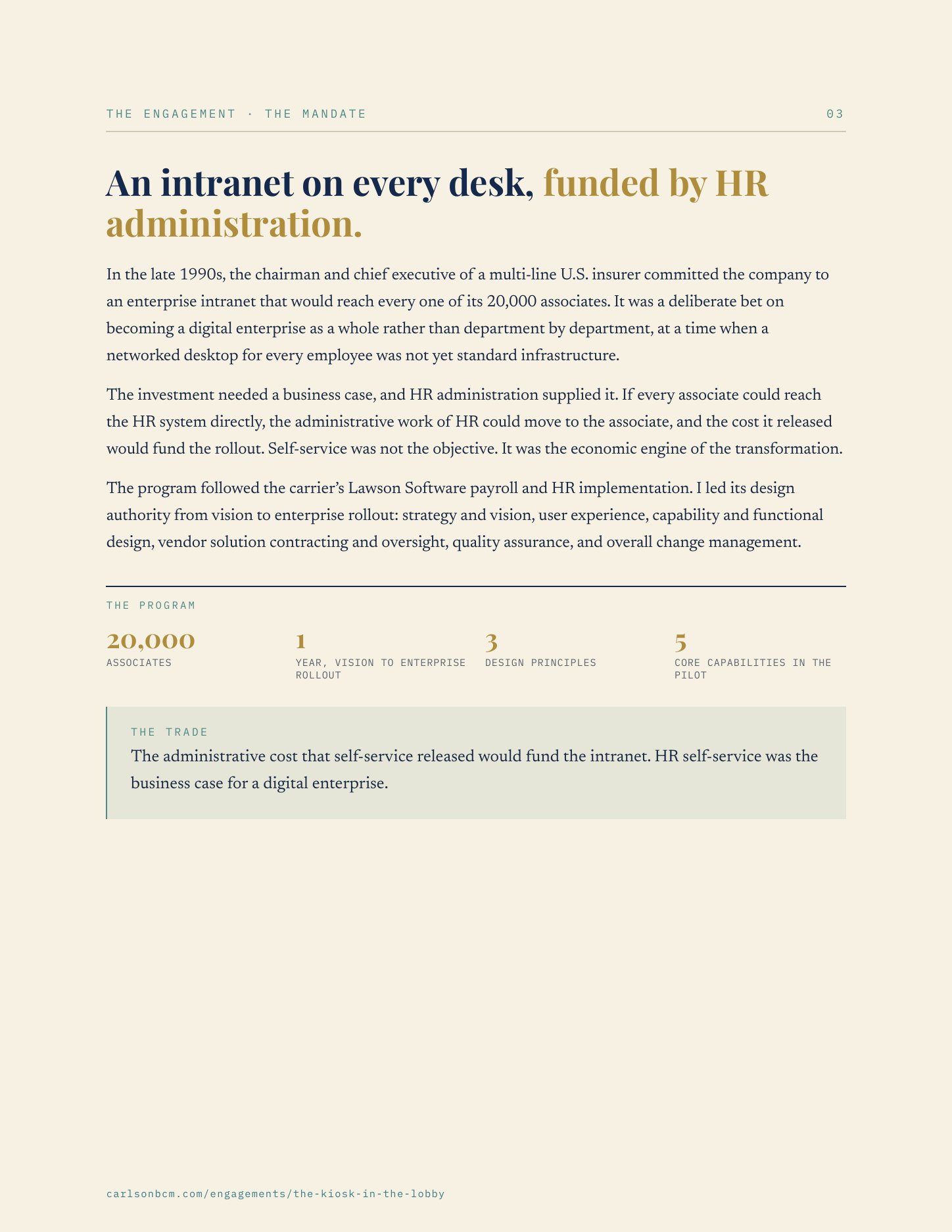
In the late 1990s, the chairman and chief executive of a multi-line U.S. insurer committed the company to an enterprise intranet that would reach every one of its 20,000 associates. It was a deliberate bet on becoming a digital enterprise as a whole rather than department by department, at a time when a networked desktop for every employee was not yet standard infrastructure.
The investment needed a business case, and HR administration supplied it. If every associate could reach the HR system directly, the administrative work of HR could move to the associate, and the cost it released would fund the rollout. Self-service was not the objective. It was the economic engine of the transformation.
The program followed the carrier’s Lawson Software payroll and HR implementation. I led its design authority from vision to enterprise rollout: strategy and vision, user experience, capability and functional design, vendor solution contracting and oversight, quality assurance, and overall change management.
The administrative cost that self-service released would fund the intranet. HR self-service was the business case for a digital enterprise.
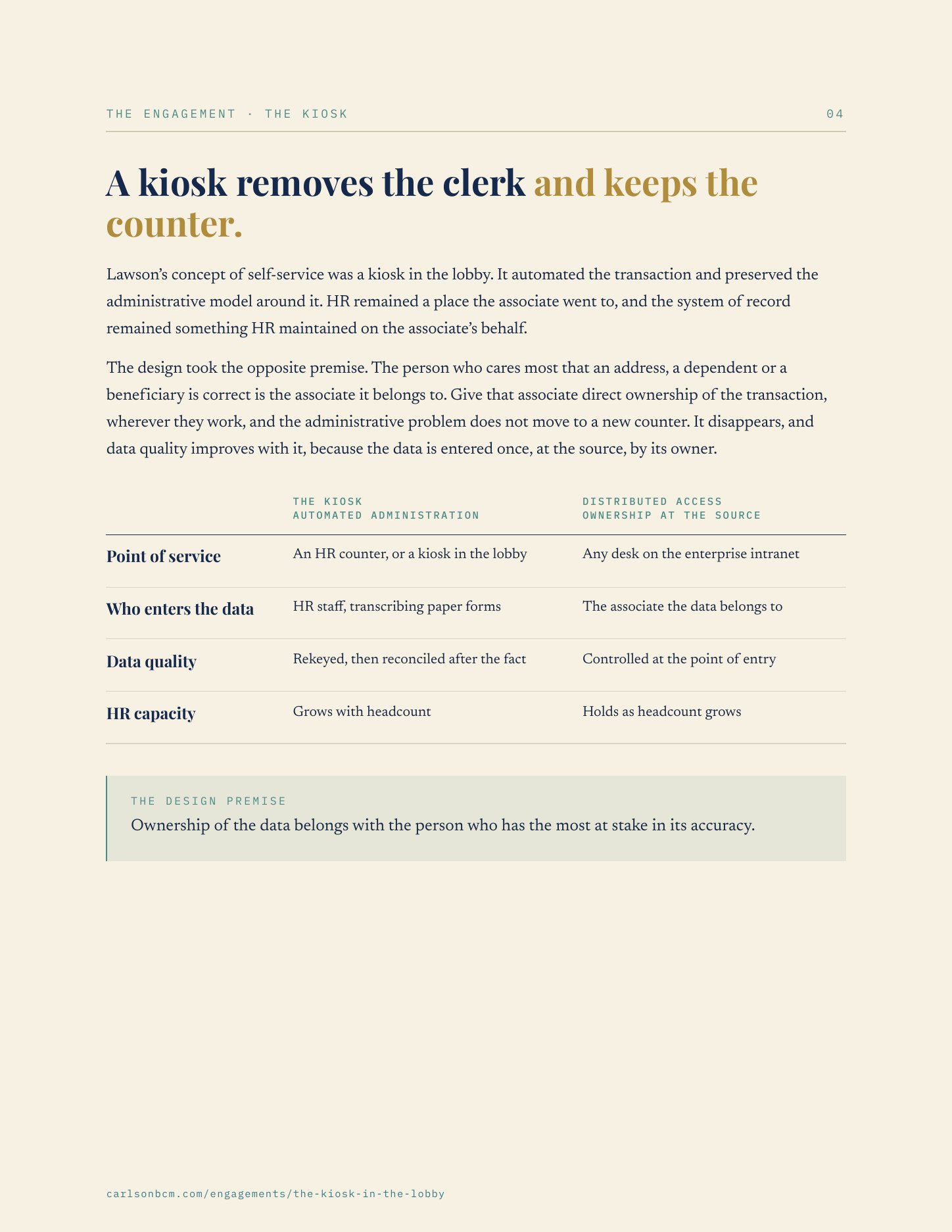
A kiosk removes the clerk and keeps the counter.
Lawson’s concept of self-service was a kiosk in the lobby. It automated the transaction and preserved the administrative model around it. HR remained a place the associate went to, and the system of record remained something HR maintained on the associate’s behalf.
The design took the opposite premise. The person who cares most that an address, a dependent or a beneficiary is correct is the associate it belongs to. Give that associate direct ownership of the transaction, wherever they work, and the administrative problem does not move to a new counter. It disappears, and data quality improves with it, because the data is entered once, at the source, by its owner.
Ownership of the data belongs with the person who has the most at stake in its accuracy.
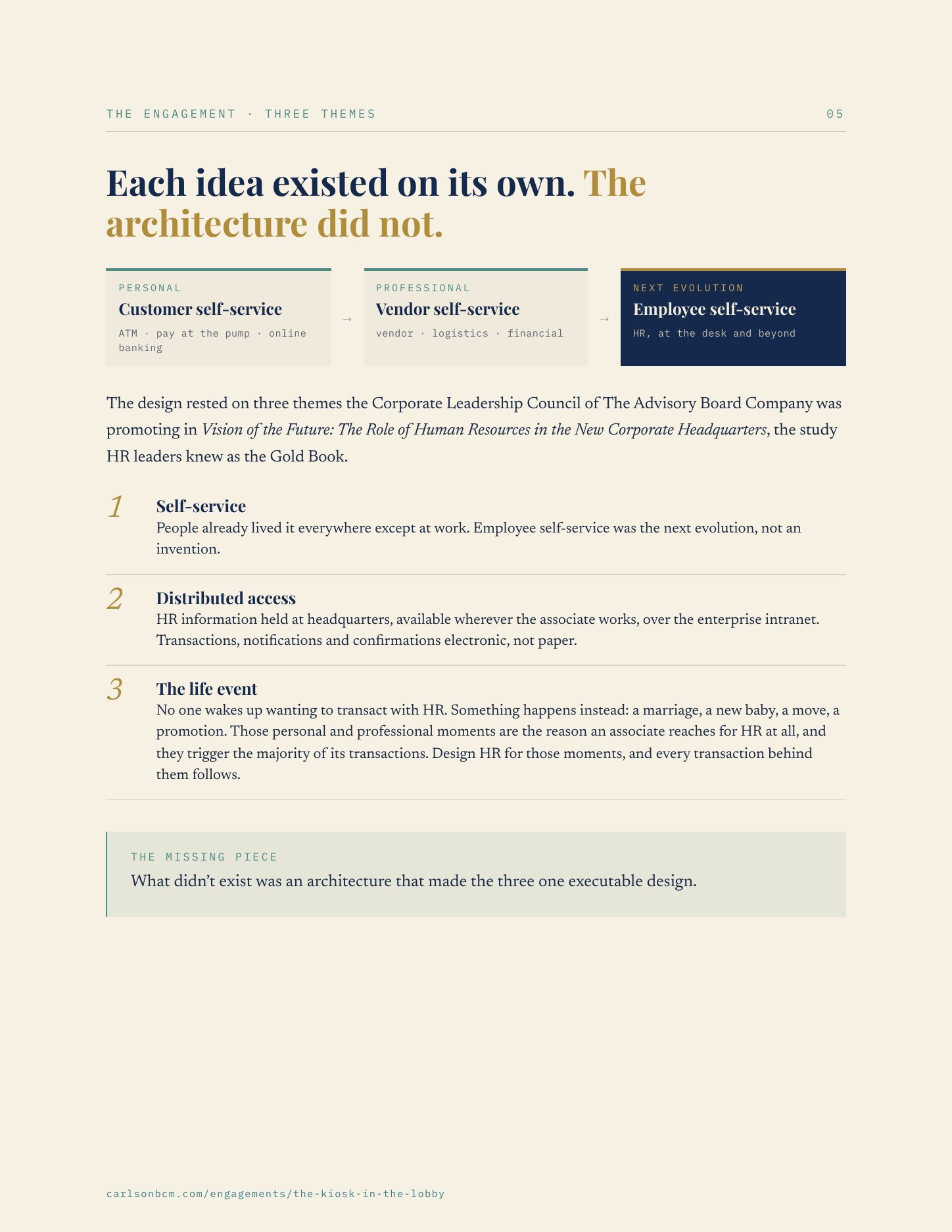
Each idea existed on its own. The architecture did not.
The design rested on three themes the Corporate Leadership Council of The Advisory Board Company was promoting in Vision of the Future: The Role of Human Resources in the New Corporate Headquarters, the study HR leaders knew as the Gold Book.
Self-service. People already lived it everywhere except at work. Employee self-service was the next evolution, not an invention.
Distributed access. HR information held at headquarters, available wherever the associate works, over the enterprise intranet. Transactions, notifications and confirmations electronic, not paper.
The life event. No one wakes up wanting to transact with HR. Something happens instead: a marriage, a new baby, a move, a promotion. Those personal and professional moments are the reason an associate reaches for HR at all, and they trigger the majority of its transactions. Design HR for those moments, and every transaction behind them follows.
What didn’t exist was an architecture that made the three one executable design.
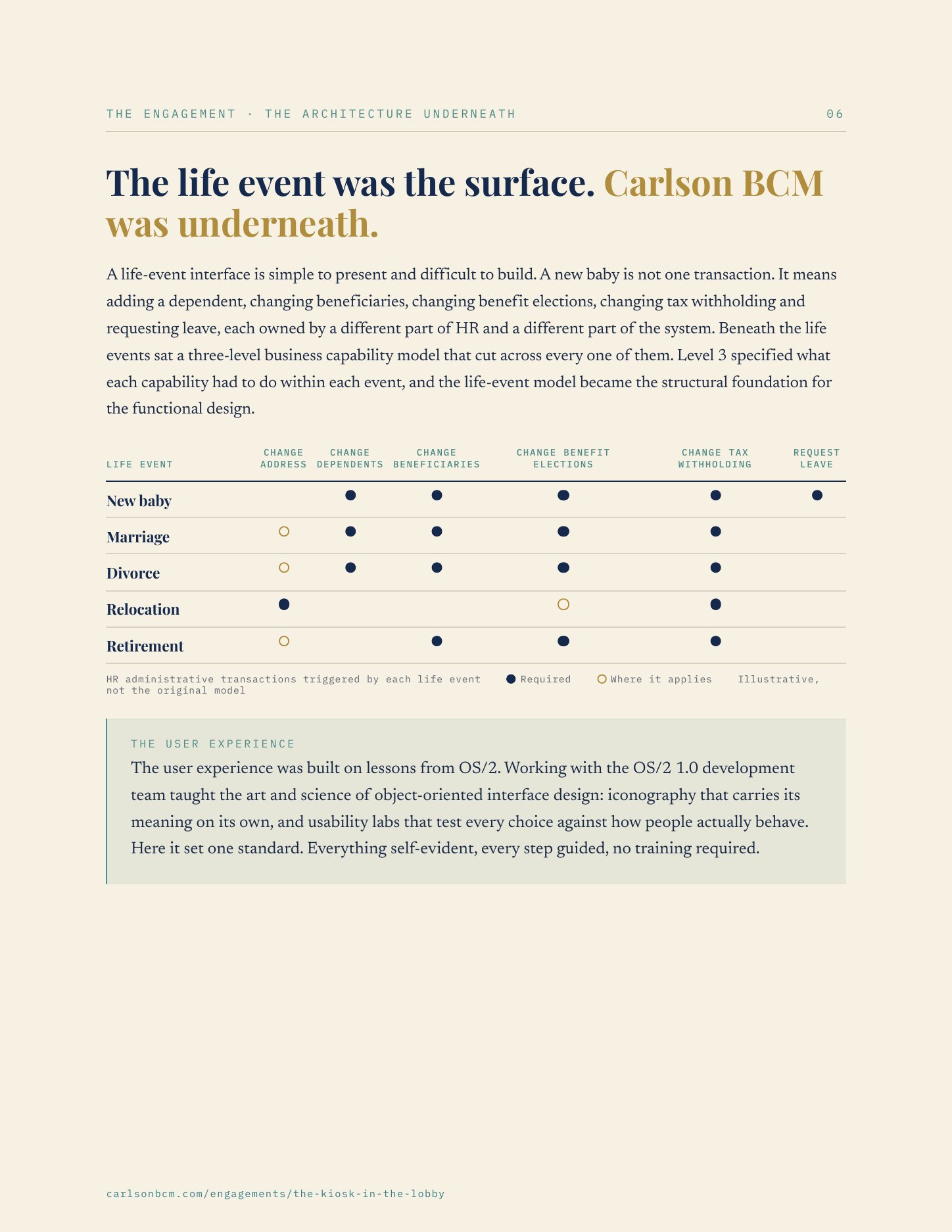
The life event was the surface. Carlson BCM was underneath.
A life-event interface is simple to present and difficult to build. A new baby is not one transaction. It means adding a dependent, changing beneficiaries, changing benefit elections, changing tax withholding and requesting leave, each owned by a different part of HR and a different part of the system. Beneath the life events sat a three-level business capability model that cut across every one of them. Level 3 specified what each capability had to do within each event, and the life-event model became the structural foundation for the functional design.
The user experience was built on lessons from OS/2. Working with the OS/2 1.0 development team taught the art and science of object-oriented interface design: iconography that carries its meaning on its own, and usability labs that test every choice against how people actually behave. Here it set one standard. Everything self-evident, every step guided, no training required.
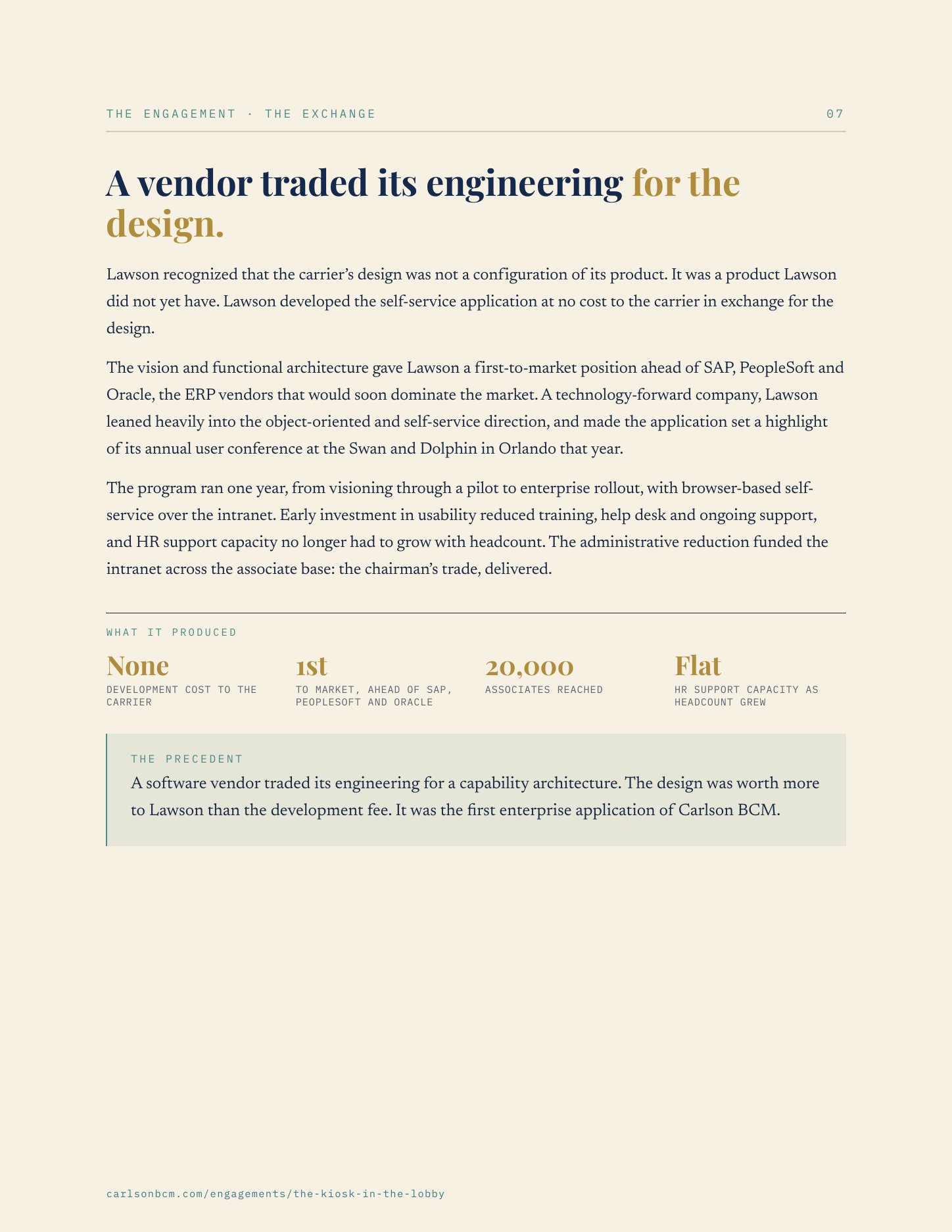
A vendor traded its engineering for the design.
Lawson recognized that the carrier’s design was not a configuration of its product. It was a product Lawson did not yet have. Lawson developed the self-service application at no cost to the carrier in exchange for the design.
The vision and functional architecture gave Lawson a first-to-market position ahead of SAP, PeopleSoft and Oracle, the ERP vendors that would soon dominate the market. A technology-forward company, Lawson leaned heavily into the object-oriented and self-service direction, and made the application set a highlight of its annual user conference at the Swan and Dolphin in Orlando that year.
The program ran one year, from visioning through a pilot to enterprise rollout, with browser-based self-service over the intranet. Early investment in usability reduced training, help desk and ongoing support, and HR support capacity no longer had to grow with headcount. The administrative reduction funded the intranet across the associate base: the chairman’s trade, delivered.
A software vendor traded its engineering for a capability architecture. The design was worth more to Lawson than the development fee. It was the first enterprise application of Carlson BCM.
The Carlson BCM perspective: HR’s second claim on enterprise strategy.
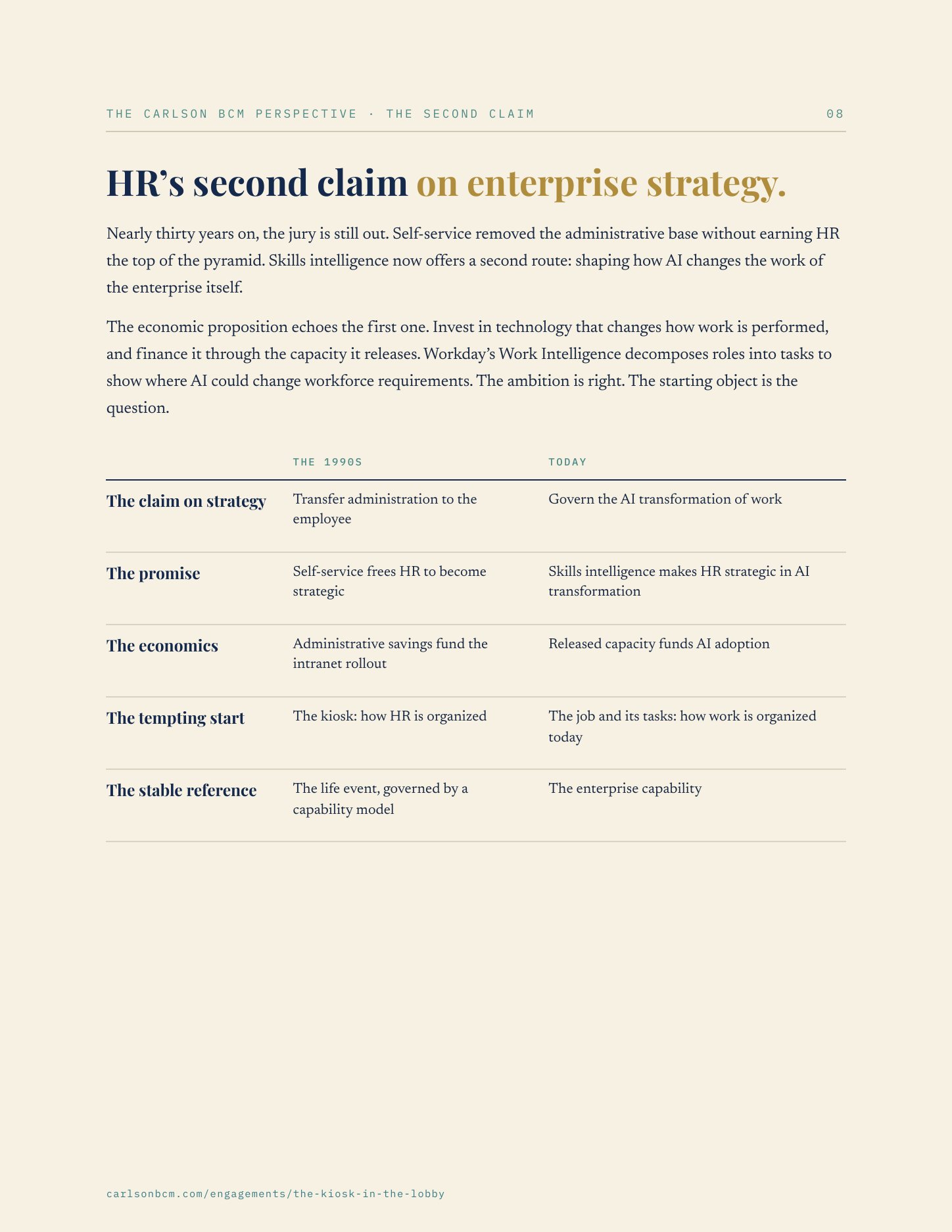
Nearly thirty years on, the jury is still out. Self-service removed the administrative base without earning HR the top of the pyramid. Skills intelligence now offers a second route: shaping how AI changes the work of the enterprise itself.
The economic proposition echoes the first one. Invest in technology that changes how work is performed, and finance it through the capacity it releases. Workday’s Work Intelligence decomposes roles into tasks to show where AI could change workforce requirements. The ambition is right. The starting object is the question.
Then and now. The claim on strategy: transfer administration to the employee; govern the AI transformation of work. The tempting start: the kiosk, how HR is organized; the job and its tasks, how work is organized today. The stable reference: the life event, governed by a capability model; the enterprise capability.
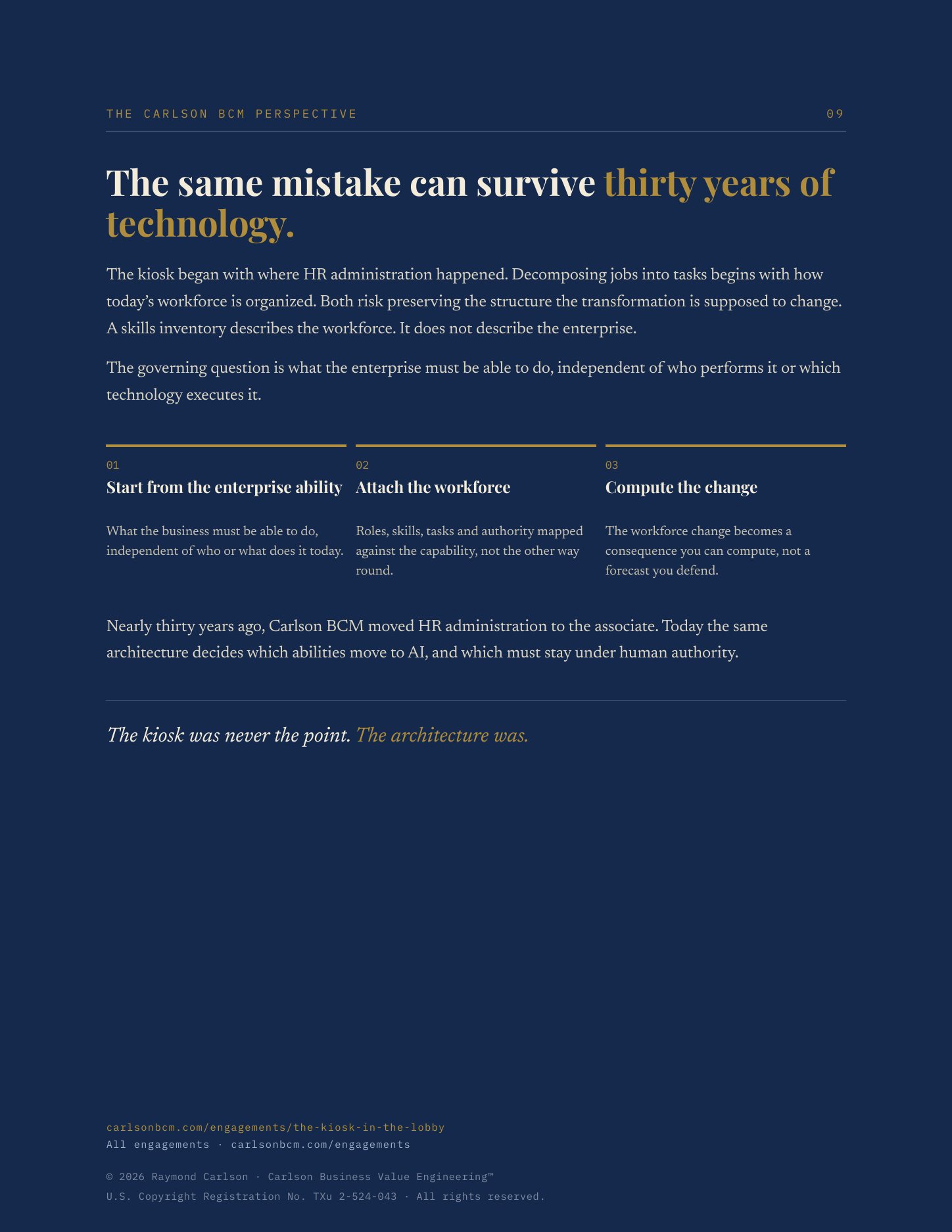
The same mistake can survive thirty years of technology.
The kiosk began with where HR administration happened. Decomposing jobs into tasks begins with how today’s workforce is organized. Both risk preserving the structure the transformation is supposed to change. A skills inventory describes the workforce. It does not describe the enterprise.
The governing question is what the enterprise must be able to do, independent of who performs it or which technology executes it. Start from the enterprise ability. Attach the workforce: roles, skills, tasks and authority mapped against the capability, not the other way round. Then compute the change, so the workforce change becomes a consequence you can compute, not a forecast you defend.
Nearly thirty years ago, Carlson BCM moved HR administration to the associate. Today the same architecture decides which abilities move to AI, and which must stay under human authority.
The kiosk was never the point. The architecture was.