 Carlson BCM

Read as text
A great analytical institution is known by its voice.
A reader recognizes it before the masthead: the cadence, the discipline, the weight of a judgment an entire organization stands behind. That voice is not decoration. It is the asset. And in the institution this work addressed, the regulated production of credit ratings and analytical content at global scale, that voice was carried by analysts whose time was consumed by the mechanics of production rather than the substance of judgment.
The conventional tools were already at work. Lean stripped low-value effort. Six Sigma attacked variance. The production flow got measurably tighter. But these methods operate on motion, the path work takes, and never define the thing the motion is exercising: the institution's ability to form, express, and govern an analytical opinion. Optimize the motion all you like. The opinion, the voice, the judgment, the regulatory discipline that protects it, remained unmodeled.
Carlson BCM modeled exactly that. Not the workflow around the analysis, but the analytical capability itself: what the institution could actually do, expressed as governed capability rather than process. The objective was never speed for its own sake. It was to preserve a recognizable institutional voice, to enforce the regulatory discipline that voice depends on, and to free analysts from repetition so they could do the work only they could do, form forward-looking, market-engaged judgment.
The aim, stated as plainly as it can be: to elevate the analyst, not to automate the analyst. That distinction governed every decision in the model. It is also the distinction that separates durable augmentation from the automation programs that fail.
Carlson BCM treated institutional analytical judgment itself as a governed operational object. There was, at the time, no common language for what that was.
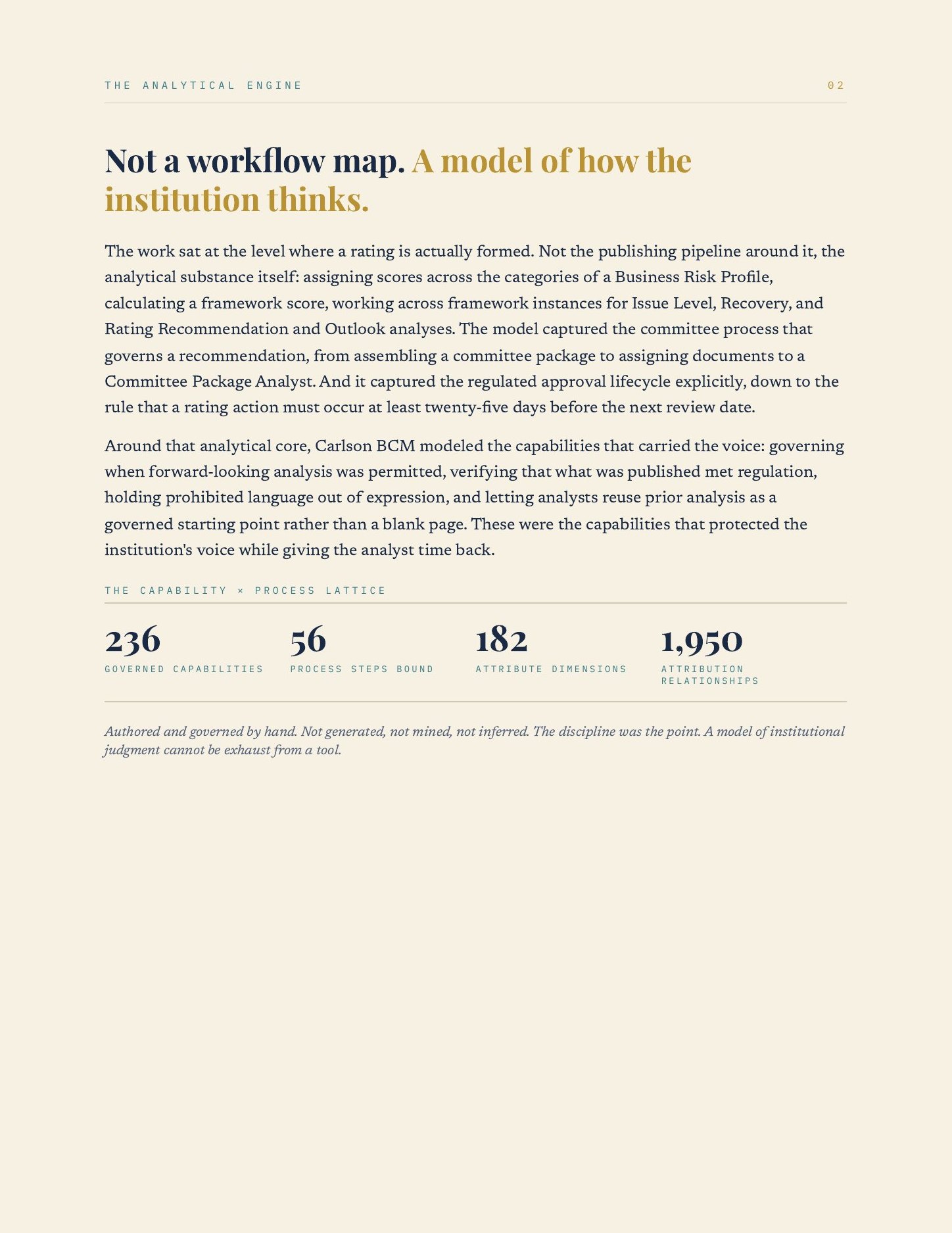
Not a workflow map. A model of how the institution thinks.
The work sat at the level where a rating is actually formed. Not the publishing pipeline around it, the analytical substance itself: assigning scores across the categories of a Business Risk Profile, calculating a framework score, working across framework instances for Issue Level, Recovery, and Rating Recommendation and Outlook analyses. The model captured the committee process that governs a recommendation, from assembling a committee package to assigning documents to a Committee Package Analyst. And it captured the regulated approval lifecycle explicitly, down to the rule that a rating action must occur at least twenty-five days before the next review date.
Around that analytical core, Carlson BCM modeled the capabilities that carried the voice: governing when forward-looking analysis was permitted, verifying that what was published met regulation, holding prohibited language out of expression, and letting analysts reuse prior analysis as a governed starting point rather than a blank page. These were the capabilities that protected the institution's voice while giving the analyst time back.
1,950
Authored and governed by hand. Not generated, not mined, not inferred. The discipline was the point. A model of institutional judgment cannot be exhaust from a tool.
Process methods decompose activity. Carlson BCM decomposed enterprise ability.
The Carlson BCM capability lattice bound 236 capabilities to 56 process steps across 182 attribute dimensions, with nearly 2,000 attribution relationships. Six Sigma optimized the motion of the work. Carlson BCM stabilized the operational object the work was exercising. Those are orthogonal: process methods decompose activity; Carlson BCM decomposed enterprise ability. The result is not a process map and not an org chart. It is a relational capability architecture, and because it was authored on governed enterprise meaning, every capability could be scored, for the business value it carried and for how intelligence should one day engage it.
The strategic intent was visible in the model itself. The capabilities that mattered most resolved to a small set of institutional intents, enhancing the analyst's voice and credibility, enabling forward-looking analysis, opening direct access between analyst and market. Those are not workflow mechanics. They are an institution declaring what its analytical voice is for. That layer, more than any process improvement, was the real object of the work.
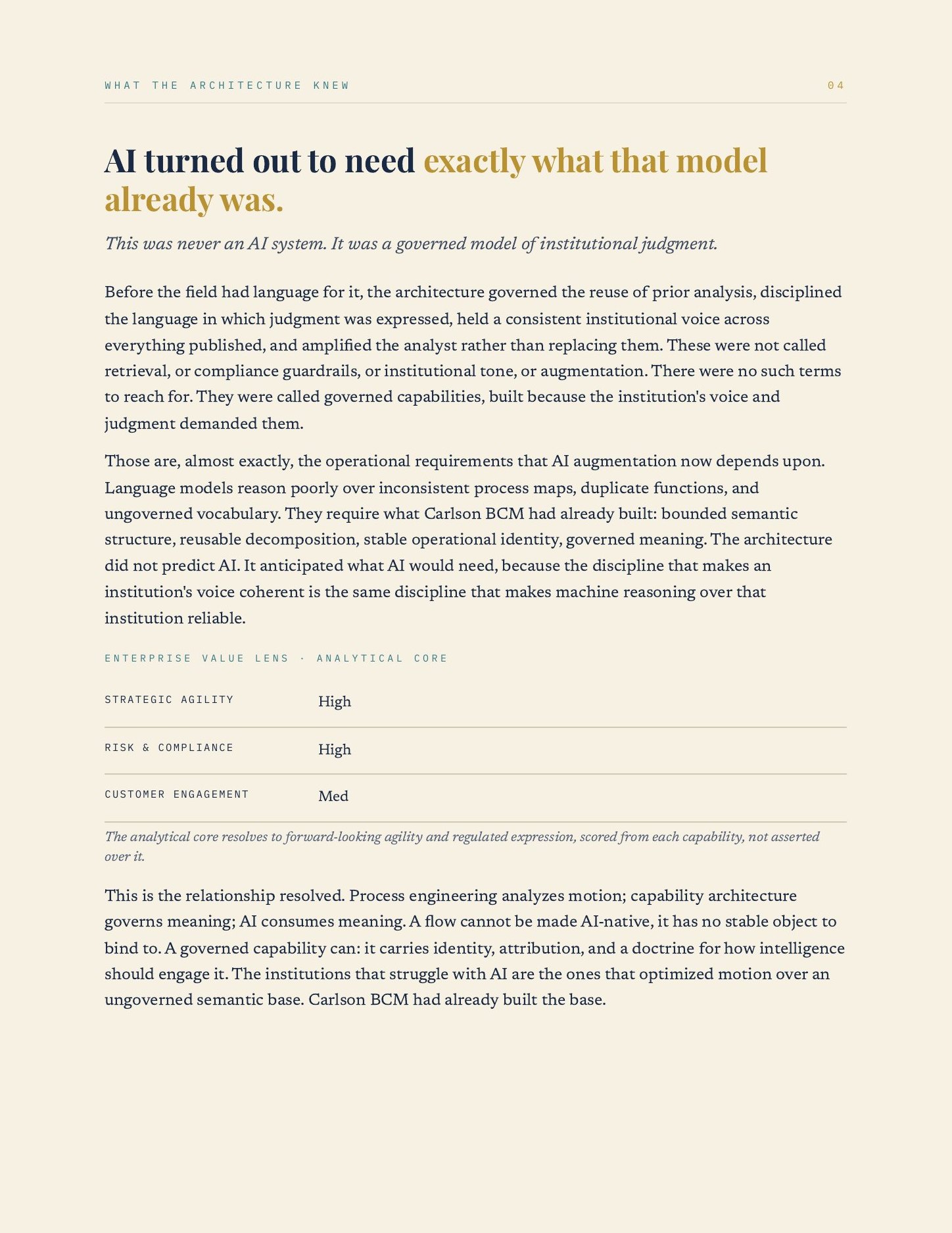
AI turned out to need exactly what that model already was.
This was never an AI system. It was a governed model of institutional judgment.
Before the field had language for it, the architecture governed the reuse of prior analysis, disciplined the language in which judgment was expressed, held a consistent institutional voice across everything published, and amplified the analyst rather than replacing them. These were not called retrieval, or compliance guardrails, or institutional tone, or augmentation. There were no such terms to reach for. They were called governed capabilities, built because the institution's voice and judgment demanded them.
Those are, almost exactly, the operational requirements that AI augmentation now depends upon. Language models reason poorly over inconsistent process maps, duplicate functions, and ungoverned vocabulary. They require what Carlson BCM had already built: bounded semantic structure, reusable decomposition, stable operational identity, governed meaning. The architecture did not predict AI. It anticipated what AI would need, because the discipline that makes an institution's voice coherent is the same discipline that makes machine reasoning over that institution reliable.
The analytical core resolves to forward-looking agility and regulated expression, scored from each capability, not asserted over it.
This is the relationship resolved. Process engineering analyzes motion; capability architecture governs meaning; AI consumes meaning. A flow cannot be made AI-native, it has no stable object to bind to. A governed capability can: it carries identity, attribution, and a doctrine for how intelligence should engage it. The institutions that struggle with AI are the ones that optimized motion over an ungoverned semantic base. Carlson BCM had already built the base.
AI will not reward the institutions with the most models. It will reward those with the most governed understanding of what they actually do.
Much of this work was developed before the field had language for governed analytical augmentation, inside one of the most demanding analytical institutions in the world. It is put forward now not because the technology finally caught up, but because the architecture was right before the technology existed. Carlson BCM is that model: forged in insurance, proven in capital-markets operations, and orthogonal to the methods it completes. The governed capability is the missing enterprise unit that operational improvement, and now AI, never had a name for. Carlson BCM gave it one.