 Carlson BCM
Read as text
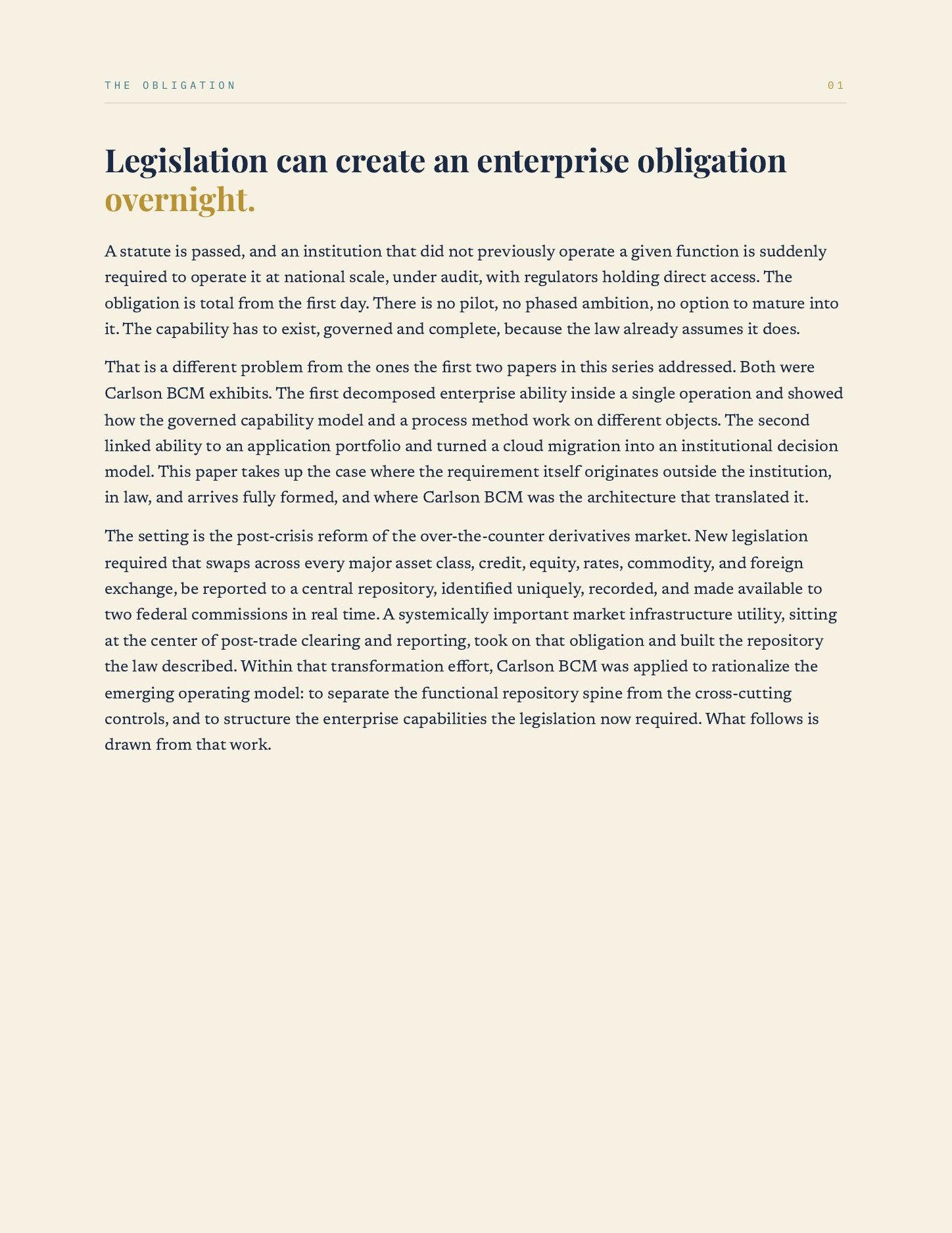
Legislation can create an enterprise obligation overnight.
A statute is passed, and an institution that did not previously operate a given function is suddenly required to operate it at national scale, under audit, with regulators holding direct access. The obligation is total from the first day. There is no pilot, no phased ambition, no option to mature into it. The capability has to exist, governed and complete, because the law already assumes it does.
That is a different problem from the ones the first two papers in this series addressed. Both were Carlson BCM exhibits. The first decomposed enterprise ability inside a single operation and showed how the governed capability model and a process method work on different objects. The second linked ability to an application portfolio and turned a cloud migration into an institutional decision model. This paper takes up the case where the requirement itself originates outside the institution, in law, and arrives fully formed, and where Carlson BCM was the architecture that translated it.
The setting is the post-crisis reform of the over-the-counter derivatives market. New legislation required that swaps across every major asset class, credit, equity, rates, commodity, and foreign exchange, be reported to a central repository, identified uniquely, recorded, and made available to two federal commissions in real time. A systemically important market infrastructure utility, sitting at the center of post-trade clearing and reporting, took on that obligation and built the repository the law described. Within that transformation effort, Carlson BCM was applied to rationalize the emerging operating model: to separate the functional repository spine from the cross-cutting controls, and to structure the enterprise capabilities the legislation now required. What follows is drawn from that work.
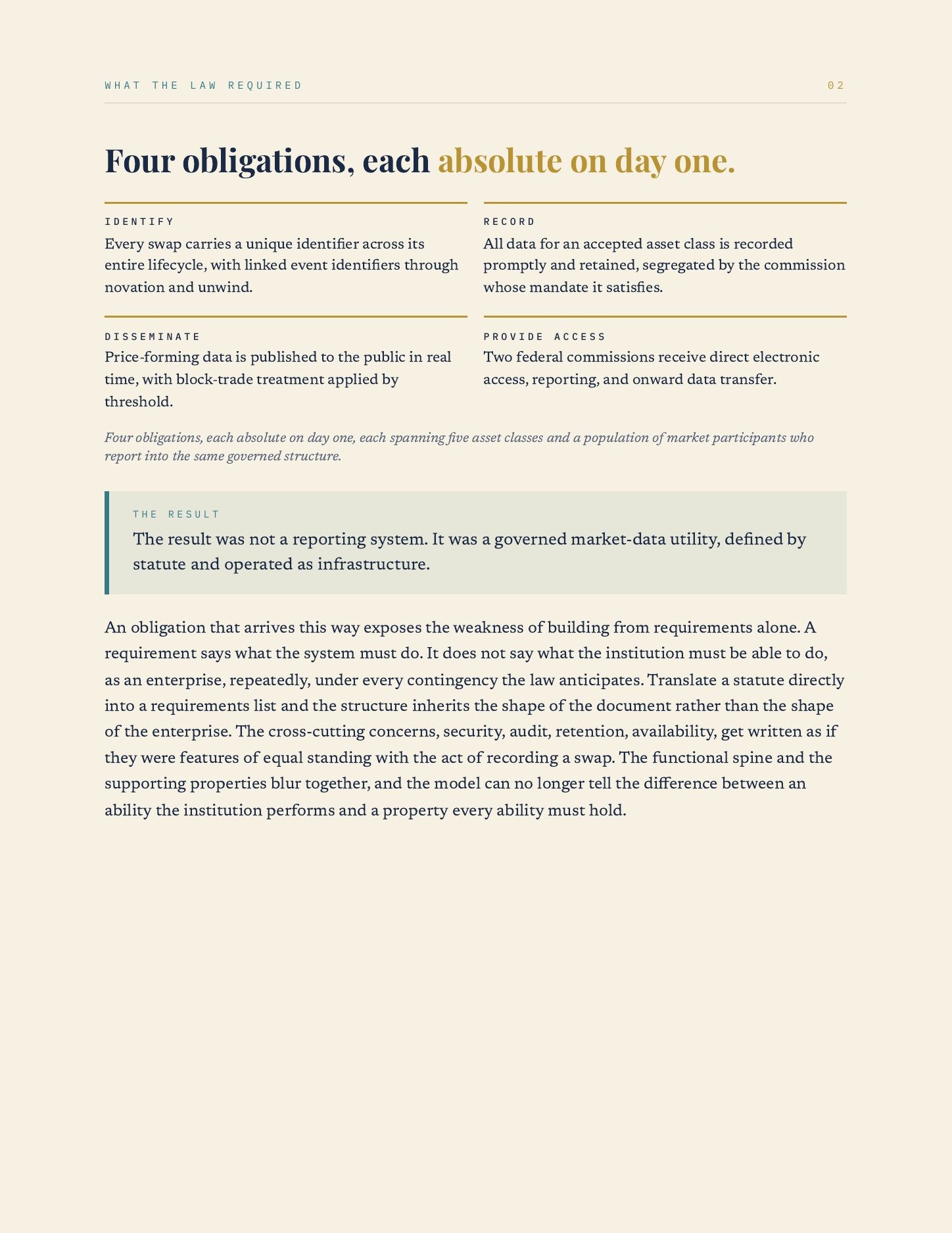
Four obligations, each absolute on day one.
Every swap carries a unique identifier across its entire lifecycle, with linked event identifiers through novation and unwind.
All data for an accepted asset class is recorded promptly and retained, segregated by the commission whose mandate it satisfies.
Price-forming data is published to the public in real time, with block-trade treatment applied by threshold.
Two federal commissions receive direct electronic access, reporting, and onward data transfer.
Four obligations, each absolute on day one, each spanning five asset classes and a population of market participants who report into the same governed structure.
The result was not a reporting system. It was a governed market-data utility, defined by statute and operated as infrastructure.
An obligation that arrives this way exposes the weakness of building from requirements alone. A requirement says what the system must do. It does not say what the institution must be able to do, as an enterprise, repeatedly, under every contingency the law anticipates. Translate a statute directly into a requirements list and the structure inherits the shape of the document rather than the shape of the enterprise. The cross-cutting concerns, security, audit, retention, availability, get written as if they were features of equal standing with the act of recording a swap. The functional spine and the supporting properties blur together, and the model can no longer tell the difference between an ability the institution performs and a property every ability must hold.
The governed capability model as the instrument of translation.
A capability model reads a statute differently. It does not ask what the system must do. It asks what the enterprise must be able to do, names each ability in governed grammar, and arranges those abilities into a value chain that reflects how the institution operates rather than how the law was drafted. The same grammar then separates the abilities the enterprise performs from the properties every ability must satisfy. That separation is the whole discipline.
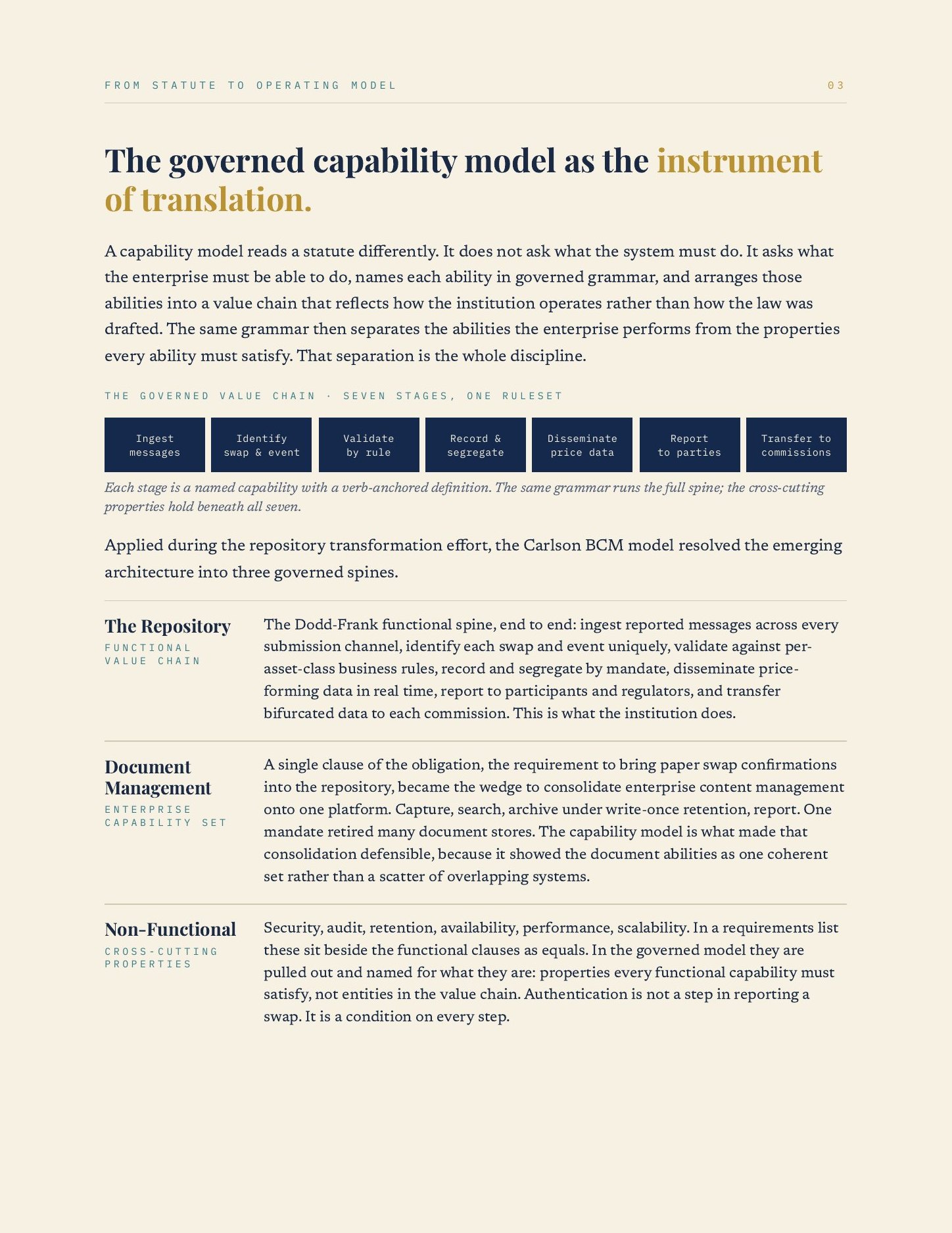
Each stage is a named capability with a verb-anchored definition. The same grammar runs the full spine; the cross-cutting properties hold beneath all seven.
Applied during the repository transformation effort, the Carlson BCM model resolved the emerging architecture into three governed spines.
The Dodd-Frank functional spine, end to end: ingest reported messages across every submission channel, identify each swap and event uniquely, validate against per-asset-class business rules, record and segregate by mandate, disseminate price-forming data in real time, report to participants and regulators, and transfer bifurcated data to each commission. This is what the institution does.
A single clause of the obligation, the requirement to bring paper swap confirmations into the repository, became the wedge to consolidate enterprise content management onto one platform. Capture, search, archive under write-once retention, report. One mandate retired many document stores. The capability model is what made that consolidation defensible, because it showed the document abilities as one coherent set rather than a scatter of overlapping systems.
Security, audit, retention, availability, performance, scalability. In a requirements list these sit beside the functional clauses as equals. In the governed model they are pulled out and named for what they are: properties every functional capability must satisfy, not entities in the value chain. Authentication is not a step in reporting a swap. It is a condition on every step.
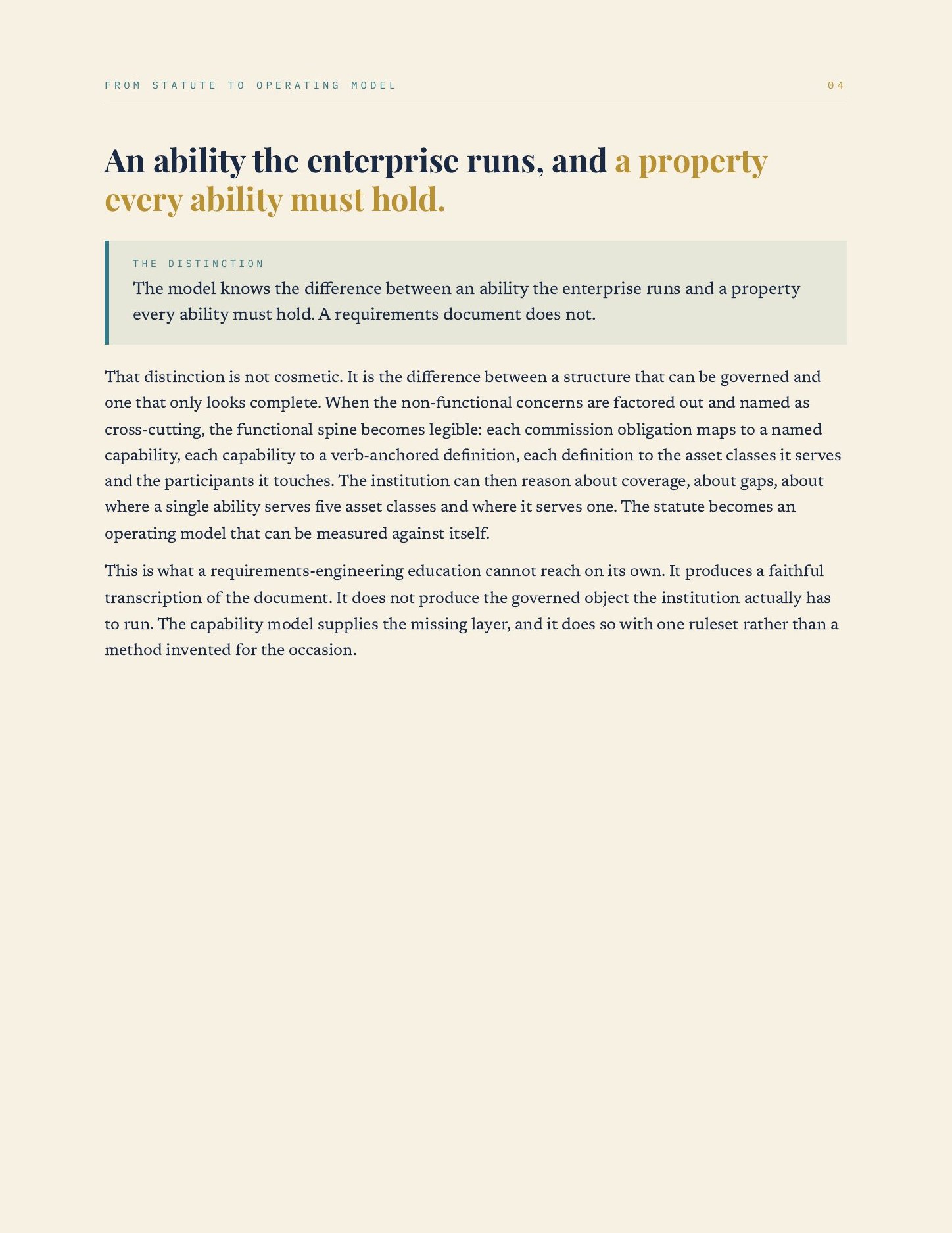
An ability the enterprise runs, and a property every ability must hold.
The model knows the difference between an ability the enterprise runs and a property every ability must hold. A requirements document does not.
That distinction is not cosmetic. It is the difference between a structure that can be governed and one that only looks complete. When the non-functional concerns are factored out and named as cross-cutting, the functional spine becomes legible: each commission obligation maps to a named capability, each capability to a verb-anchored definition, each definition to the asset classes it serves and the participants it touches. The institution can then reason about coverage, about gaps, about where a single ability serves five asset classes and where it serves one. The statute becomes an operating model that can be measured against itself.
This is what a requirements-engineering education cannot reach on its own. It produces a faithful transcription of the document. It does not produce the governed object the institution actually has to run. The capability model supplies the missing layer, and it does so with one ruleset rather than a method invented for the occasion.
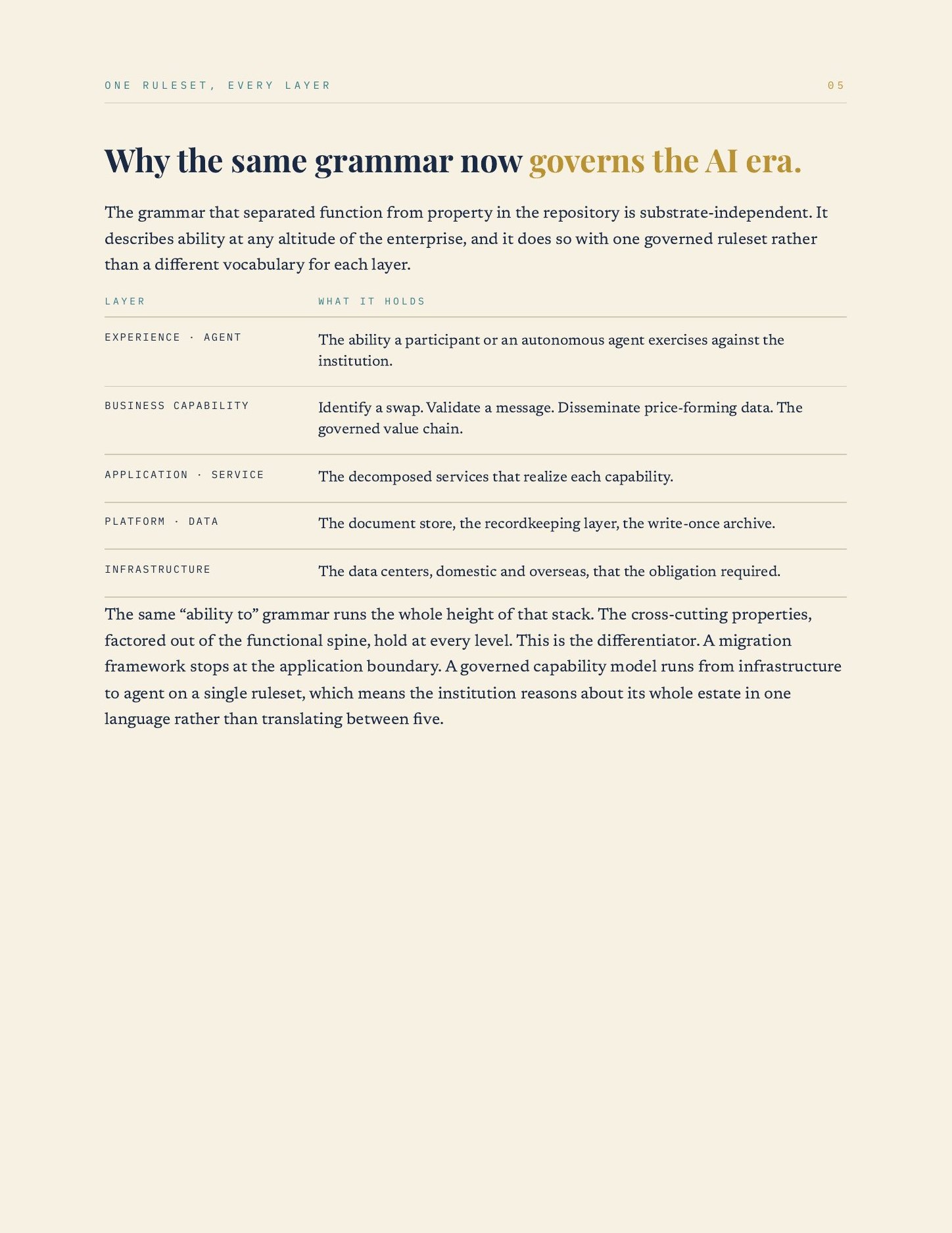
Why the same grammar now governs the AI era.
The grammar that separated function from property in the repository is substrate-independent. It describes ability at any altitude of the enterprise, and it does so with one governed ruleset rather than a different vocabulary for each layer.
The ability a participant or an autonomous agent exercises against the institution.
Identify a swap. Validate a message. Disseminate price-forming data. The governed value chain.
The decomposed services that realize each capability.
The document store, the recordkeeping layer, the write-once archive.
The data centers, domestic and overseas, that the obligation required.
The same “ability to” grammar runs the whole height of that stack. The cross-cutting properties, factored out of the functional spine, hold at every level. This is the differentiator. A migration framework stops at the application boundary. A governed capability model runs from infrastructure to agent on a single ruleset, which means the institution reasons about its whole estate in one language rather than translating between five.
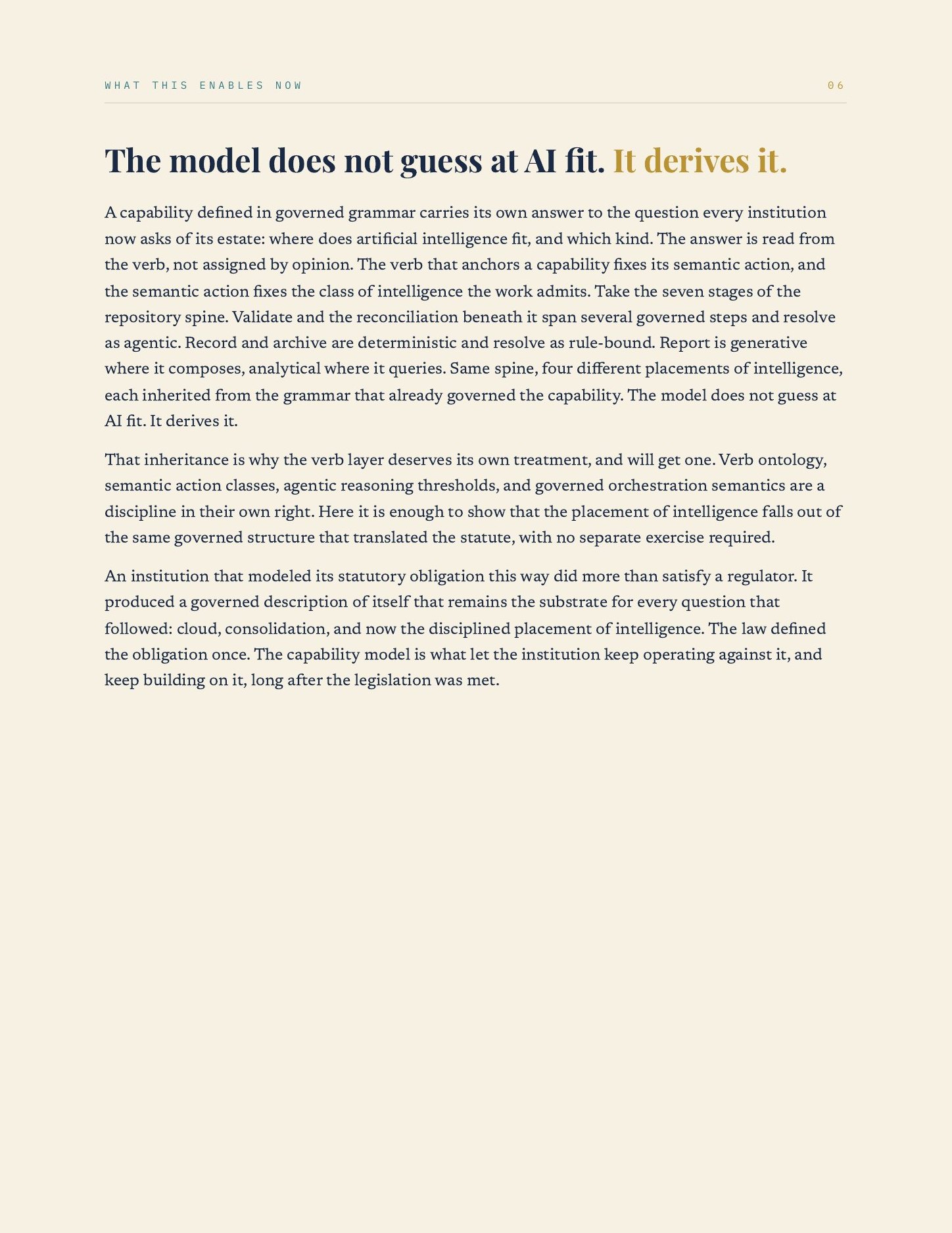
The model does not guess at AI fit. It derives it.
A capability defined in governed grammar carries its own answer to the question every institution now asks of its estate: where does artificial intelligence fit, and which kind. The answer is read from the verb, not assigned by opinion. The verb that anchors a capability fixes its semantic action, and the semantic action fixes the class of intelligence the work admits. Take the seven stages of the repository spine. Validate and the reconciliation beneath it span several governed steps and resolve as agentic. Record and archive are deterministic and resolve as rule-bound. Report is generative where it composes, analytical where it queries. Same spine, four different placements of intelligence, each inherited from the grammar that already governed the capability. The model does not guess at AI fit. It derives it.
That inheritance is why the verb layer deserves its own treatment, and will get one. Verb ontology, semantic action classes, agentic reasoning thresholds, and governed orchestration semantics are a discipline in their own right. Here it is enough to show that the placement of intelligence falls out of the same governed structure that translated the statute, with no separate exercise required.
An institution that modeled its statutory obligation this way did more than satisfy a regulator. It produced a governed description of itself that remains the substrate for every question that followed: cloud, consolidation, and now the disciplined placement of intelligence. The law defined the obligation once. The capability model is what let the institution keep operating against it, and keep building on it, long after the legislation was met.
Insurance proved the rigor. Capital markets proves the reach. The same governed ruleset, under law, at scale.