 Carlson BCM
Read as text
A sponsor asked for the day-two plan before it set the price.
A private equity sponsor set out to carve a workers' compensation claims administration business out of a large insurer's services subsidiary and build it into an independent company. The thesis was growth: a cost-effective administrator for employers of every size, reserve accuracy as the product, and over time an integrated benefits offering for the largest employers.
The facts on the ground were harder than the thesis. The business ran on twenty-three shared services, and nine of them would eventually have to stand on their own. The parent would carry the rest under a transitional services agreement. Between two and three hundred people sat across nine satellite offices, some in space that could not be shared after the close. The legacy claims platform ran on hardware whose support would end about a year after closing. And a technology vendor, introduced by the deal's originator, was already proposed as the replacement.
Most deal teams would have priced the business and handed the separation to whoever inherited it. This one did not. Before the price was set, the sponsor's lead asked what it would take to move off the legacy platform, and how quickly and efficiently it could be done. The financial model went to one firm. The operating question came to me.
Where does this business actually divide from its parent, who carries each piece on the first day, and what does it take to move each piece across the line?
One model, two axes, and the seam in plain sight.
The diligence ran on a pre-existing Carlson BCM asset of 17 value chains and 81 capabilities, in place within weeks rather than authored from a blank page. The model barely changed. What made this deal different arrived as a few added capabilities, among them the ability to manage a transitional services agreement and the ability to pay claims on a client's behalf, while ownership and timing went into attributes.
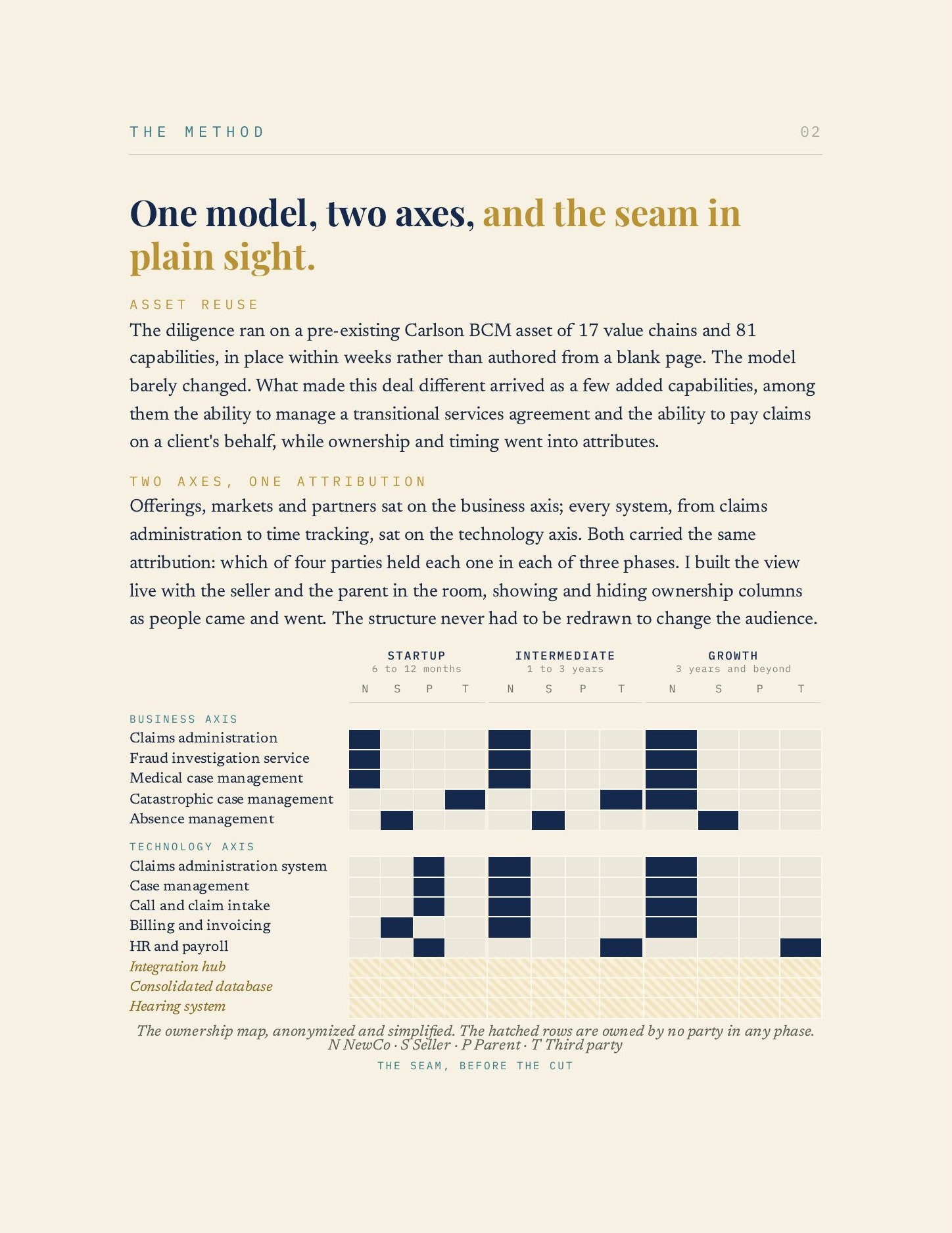
Offerings, markets and partners sat on the business axis; every system, from claims administration to time tracking, sat on the technology axis. Both carried the same attribution: which of four parties held each one in each of three phases. I built the view live with the seller and the parent in the room, showing and hiding ownership columns as people came and went. The structure never had to be redrawn to change the audience.
Claims administration Fraud investigation service Medical case management Catastrophic case management Absence management
Claims administration system Case management Call and claim intake Billing and invoicing HR and payroll Integration hub Consolidated database Hearing system
The ownership map, anonymized and simplified. The hatched rows are owned by no party in any phase.
N NewCo · S Seller · P Parent · T Third party
The deal never closed. The work paid anyway.
The rows that mattered most were the ones no column claimed: an integration hub, a consolidated database, a hearing system running in a desktop database. Shared assets that belonged to neither side, flagged by no inventory, surfaced by the model before anything was cut.
The vendor review ran against the same model. The proposed platform was strong at the work it was built for and dependent on exactly the layer no one owned. Its estimates covered roughly half the implementation effort. The sponsor received that as five named concerns before any commitment, rather than as a surprise six months after close.
The transaction did not proceed. The sponsor still came away with an operating plan, a phase-by-phase ownership map of the whole business, a platform verdict, and a method its own leadership wanted as the firm's diligence standard.
Deals close or they don't. The seam is there either way. The only question is whether it is seen before the price or after the cut.