 Carlson BCM
Read as text
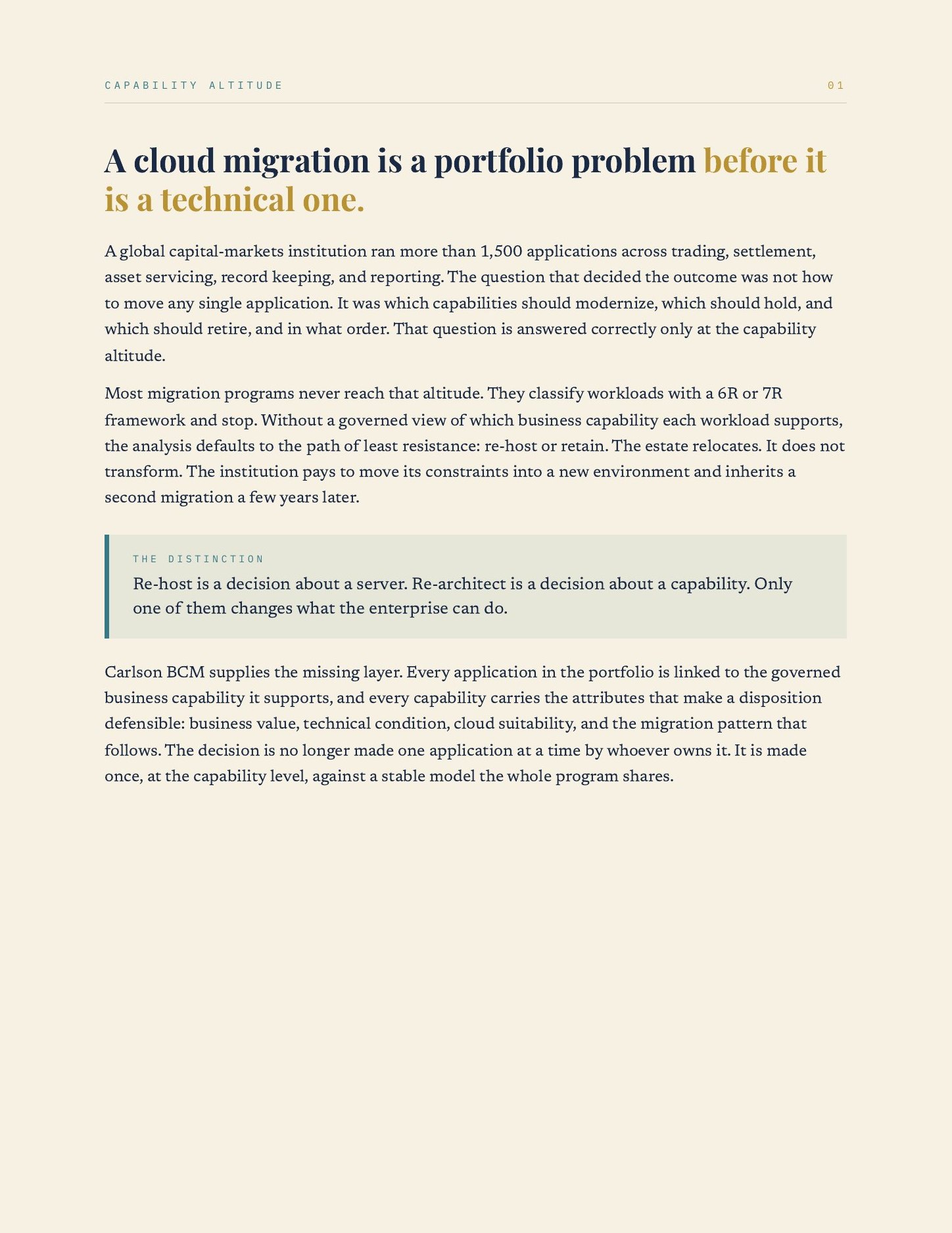
A cloud migration is a portfolio problem before it is a technical one.
A global capital-markets institution ran more than 1,500 applications across trading, settlement, asset servicing, record keeping, and reporting. The question that decided the outcome was not how to move any single application. It was which capabilities should modernize, which should hold, and which should retire, and in what order. That question is answered correctly only at the capability altitude.
Most migration programs never reach that altitude. They classify workloads with a 6R or 7R framework and stop. Without a governed view of which business capability each workload supports, the analysis defaults to the path of least resistance: re-host or retain. The estate relocates. It does not transform. The institution pays to move its constraints into a new environment and inherits a second migration a few years later.
Re-host is a decision about a server. Re-architect is a decision about a capability. Only one of them changes what the enterprise can do.
Carlson BCM supplies the missing layer. Every application in the portfolio is linked to the governed business capability it supports, and every capability carries the attributes that make a disposition defensible: business value, technical condition, cloud suitability, and the migration pattern that follows. The decision is no longer made one application at a time by whoever owns it. It is made once, at the capability level, against a stable model the whole program shares.
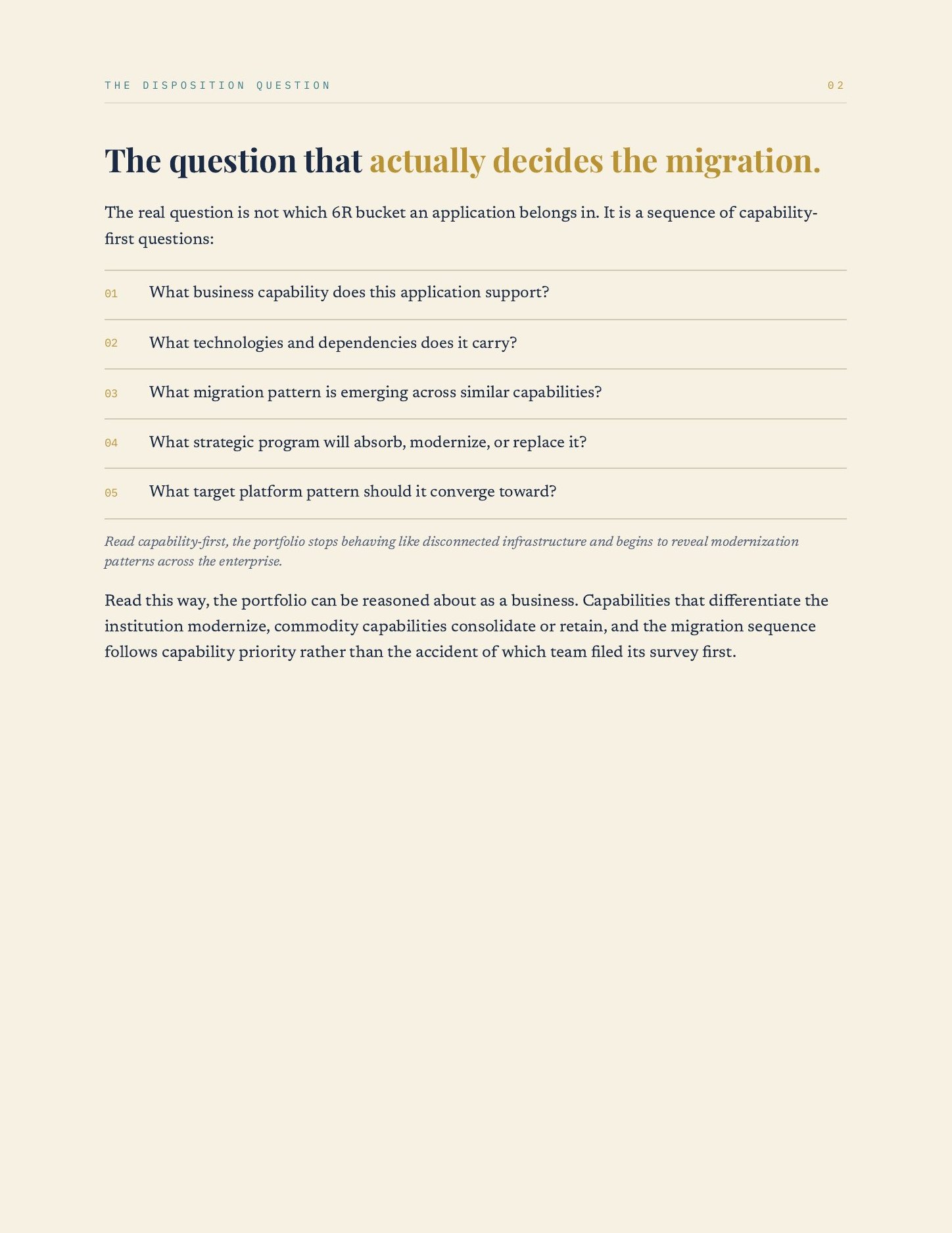
The question that actually decides the migration.
The real question is not which 6R bucket an application belongs in. It is a sequence of capability-first questions:
What business capability does this application support?
What technologies and dependencies does it carry?
What migration pattern is emerging across similar capabilities?
What strategic program will absorb, modernize, or replace it?
What target platform pattern should it converge toward?
Read capability-first, the portfolio stops behaving like disconnected infrastructure and begins to reveal modernization patterns across the enterprise.
Read this way, the portfolio can be reasoned about as a business. Capabilities that differentiate the institution modernize, commodity capabilities consolidate or retain, and the migration sequence follows capability priority rather than the accident of which team filed its survey first.
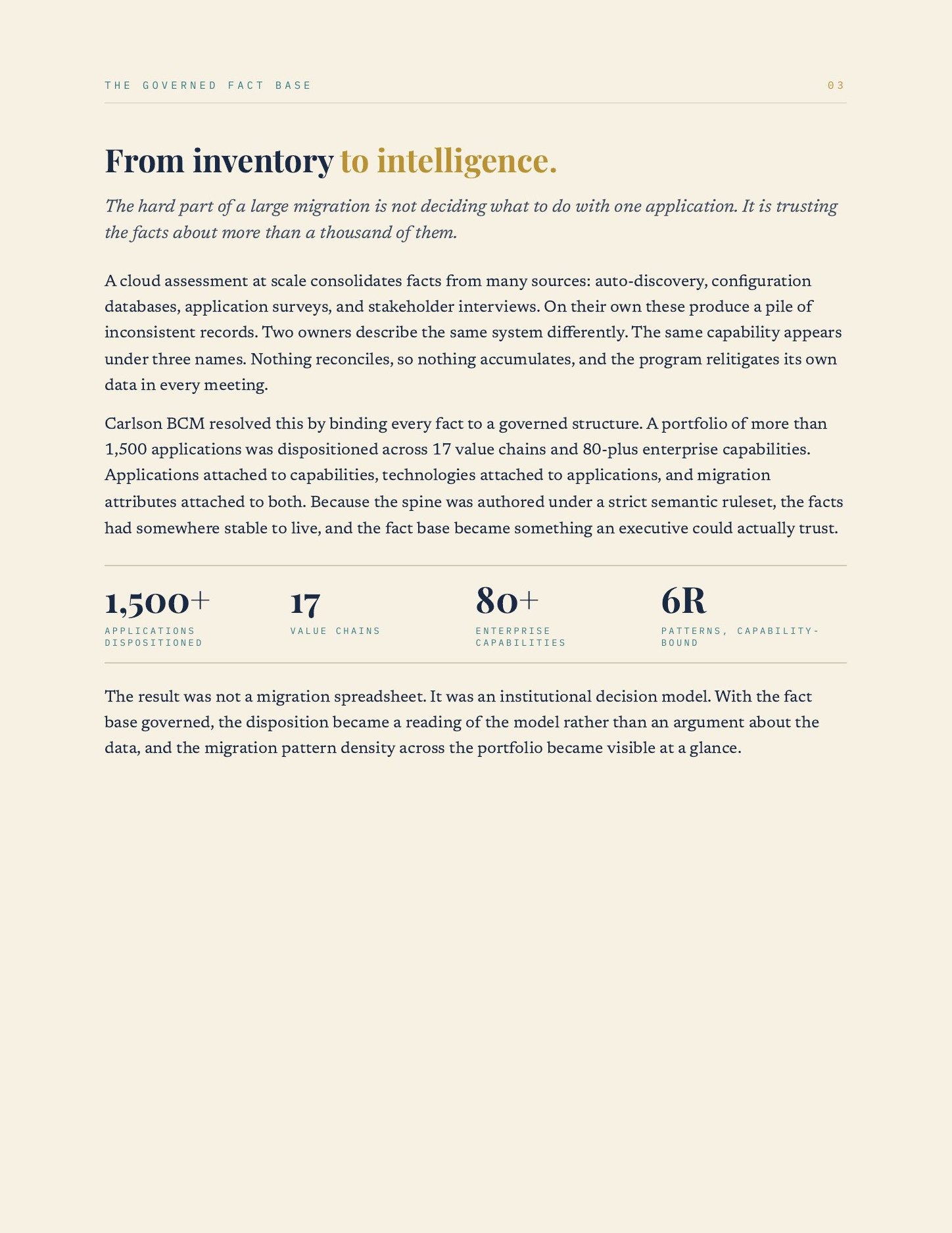
From inventory to intelligence.
The hard part of a large migration is not deciding what to do with one application. It is trusting the facts about more than a thousand of them.
A cloud assessment at scale consolidates facts from many sources: auto-discovery, configuration databases, application surveys, and stakeholder interviews. On their own these produce a pile of inconsistent records. Two owners describe the same system differently. The same capability appears under three names. Nothing reconciles, so nothing accumulates, and the program relitigates its own data in every meeting.
Carlson BCM resolved this by binding every fact to a governed structure. A portfolio of more than 1,500 applications was dispositioned across 17 BCM Level 1 capabilities and 80-plus enterprise capabilities beneath them. Applications attached to capabilities, technologies attached to applications, and migration attributes attached to both. Because the spine was authored under a strict semantic ruleset, the facts had somewhere stable to live, and the fact base became something an executive could actually trust.
1,500+
80+
6R
The result was not a migration spreadsheet. It was an institutional decision model. With the fact base governed, the disposition became a reading of the model rather than an argument about the data, and the migration pattern density across the portfolio became visible at a glance.
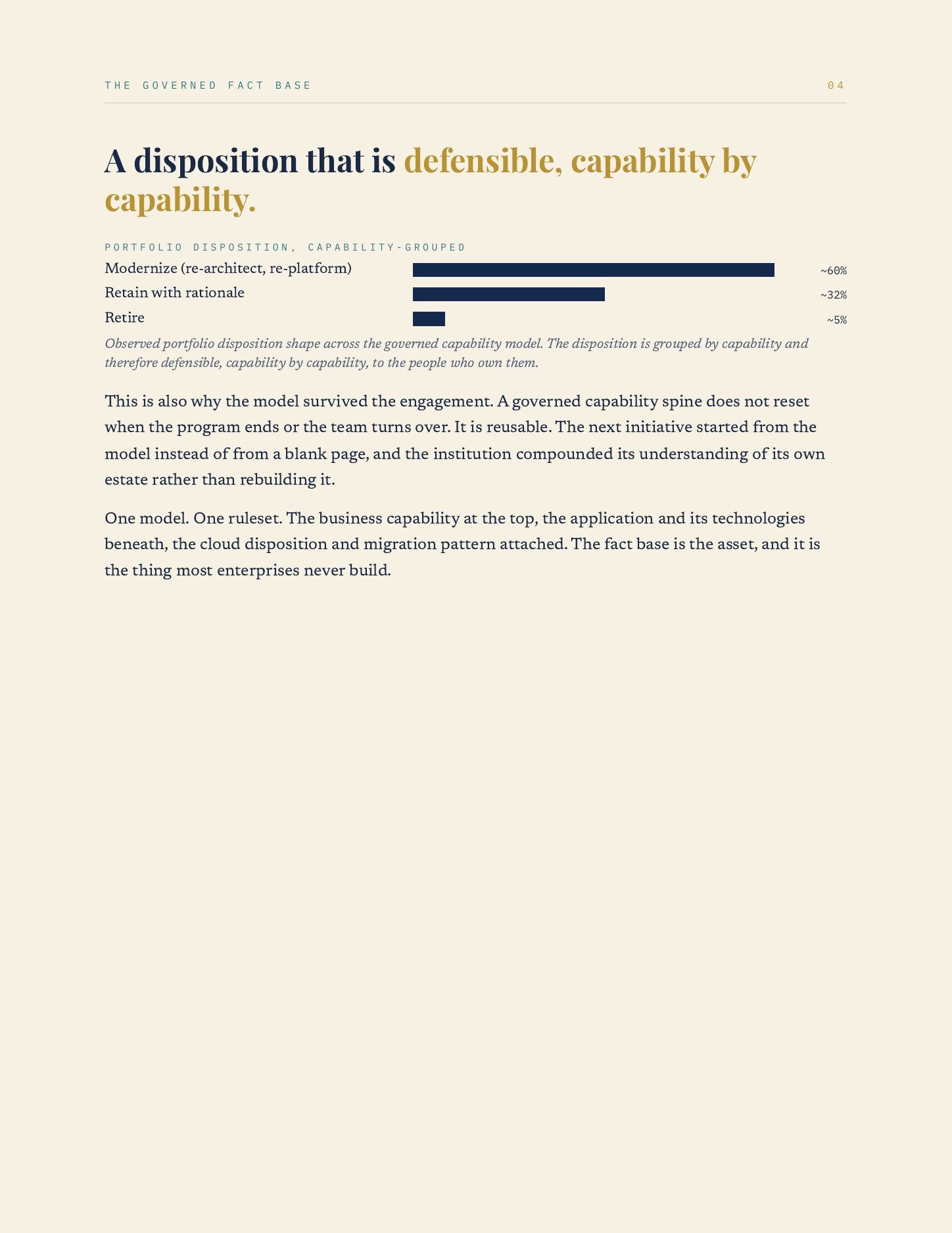
A disposition that is defensible, capability by capability.
Portfolio disposition by BCM Level 1: 1,511 applications dispositioned across 17 BCM Level 1 capabilities, 1,520 placements where an application served more than one. The disposition is grouped by capability and therefore defensible, capability by capability, to the people who own them.
This is also why the model survived the engagement. A governed capability spine does not reset when the program ends or the team turns over. It is reusable. The next initiative started from the model instead of from a blank page, and the institution compounded its understanding of its own estate rather than rebuilding it.
One model. One ruleset. The business capability at the top, the application and its technologies beneath, the cloud disposition and migration pattern attached. The fact base is the asset, and it is the thing most enterprises never build.
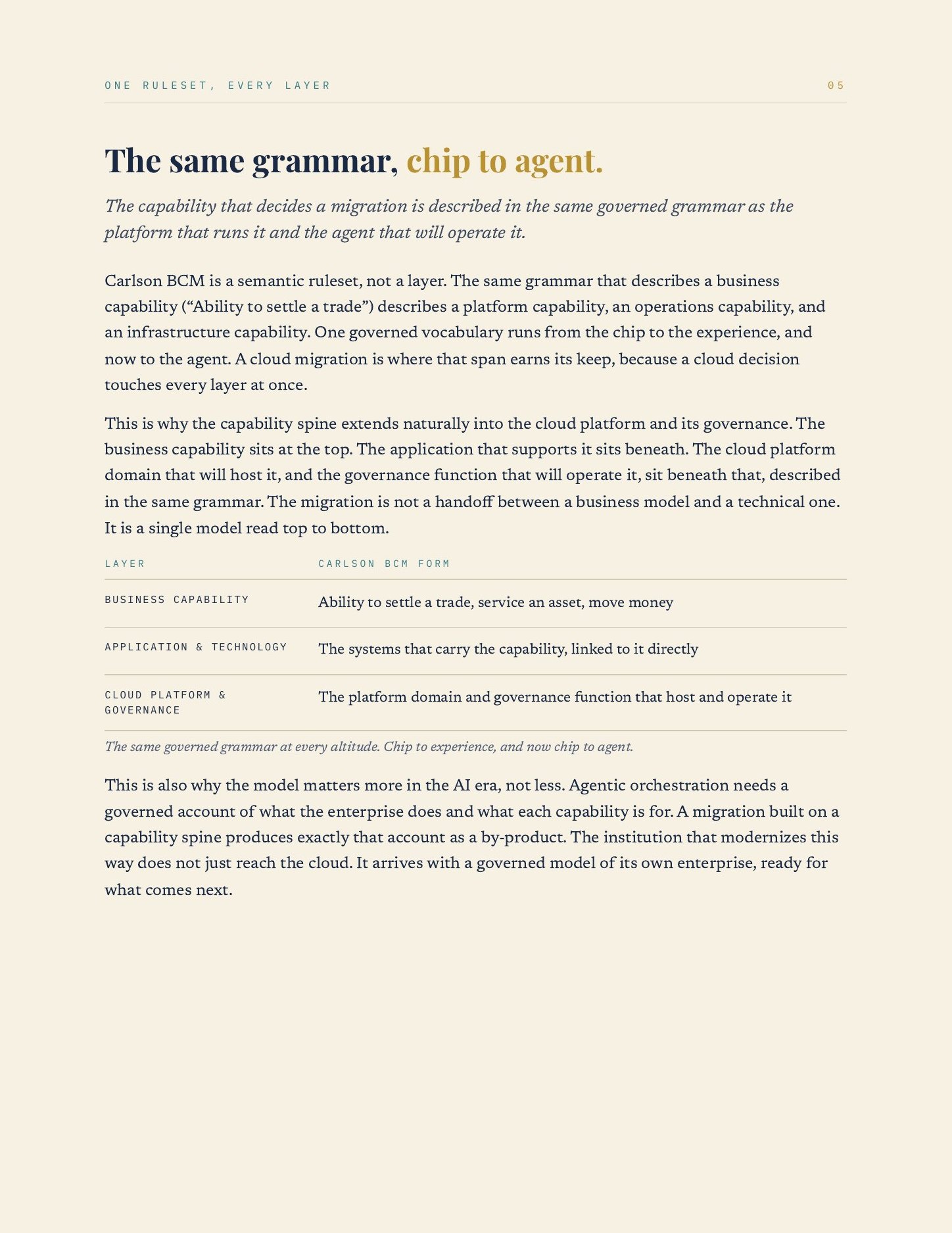
The same grammar, chip to agent.
The capability that decides a migration is described in the same governed grammar as the platform that runs it and the agent that will operate it.
Carlson BCM is a semantic ruleset, not a layer. The same grammar that describes a business capability (“Ability to settle a trade”) describes a platform capability, an operations capability, and an infrastructure capability. One governed vocabulary runs from the chip to the experience, and now to the agent. A cloud migration is where that span earns its keep, because a cloud decision touches every layer at once.
This is why the capability spine extends naturally into the cloud platform and its governance. The business capability sits at the top. The application that supports it sits beneath. The cloud platform domain that will host it, and the governance function that will operate it, sit beneath that, described in the same grammar. The migration is not a handoff between a business model and a technical one. It is a single model read top to bottom.
Ability to settle a trade, service an asset, move money
The systems that carry the capability, linked to it directly
The platform domain and governance function that host and operate it
The same governed grammar at every altitude. Chip to experience, and now chip to agent.
This is also why the model matters more in the AI era, not less. Agentic orchestration needs a governed account of what the enterprise does and what each capability is for. A migration built on a capability spine produces exactly that account as a by-product. The institution that modernizes this way does not just reach the cloud. It arrives with a governed model of its own enterprise, ready for what comes next.
The advantage will not belong to the institution that moves the most workloads. It will belong to the one that understands, in governed terms, what those workloads are for.
Carlson BCM for Cloud is one of six Core Methods of Carlson Business Value Engineering. It applies the same authored capability grammar that governs the enterprise to the decision of how that enterprise should move to the cloud.