 Carlson BCM

Read as text
Nobody buys an underwriting transformation to go faster. They buy it because there is a book they cannot move.
The group had been taking its US carrier apart for years. Marine went into the commercial specialty arm. The commercial property and casualty business followed. The high net worth personal lines business was sold for $365M. Roughly $2.2B of older business was moved into runoff.
Every piece that could be isolated was isolated and disposed of. What remained was the US commercial middle market book: mid corporate property and casualty, small business, programs, agribusiness, and the entertainment franchise. It stayed.
A book that cannot be read as one thing cannot be priced as one thing, steered as one thing, or sold as one thing. That is a strategy problem before it is ever a systems problem.
I co-led it for four years. My team was the business design authority.
A €130M program across its full life. I ran a 25-person consulting team from inception through engineering.
Every business capability, and every functional capability beneath it, was harmonized into one common enterprise capability model. From that model my team rendered a common target operating model: common process, common user experience, common class-structure engineering.
One specification, governed across every product and coverage in the book, every operational area, and every application in the landscape.
Working sessions ran out of New York, where operational leadership sat and where subject matter experts came in from across the US. London held the policy book of record, where bind, booking, and reporting ran. The West Coast was the US carrier and the book itself. Munich held program leadership and engineering.
Design decisions were not handed to engineering as documents. My team carried them into build and remained accountable there.
Mid-market is a different economic problem than large corporate.
The group already owned the middle market book. What it did not own was an operating model that could serve that market at the economics the market demands.
Absorbs bespoke placement. Complex structures are individually designed, negotiated, and serviced by concentrated expert teams. The cost of a one-off is carried by the premium.
Margin depends on repeatability across many comparable risks, and on changing a product without launching another program to do it. The buyer would later describe the book as more than 30,000 accounts, at an average middle-market account size of $170K.
A product that requires separate design, build, and approval every time it appears is not a product platform. It is a succession of programs.
The redundancy was in the specification, not in the scope.
Property was specified separately as high protected risk, as base, as middle market, as a non-bordereaux program, as agribusiness, and as engineering. So were general liability, inland marine, and crime. Seven product families, each carrying its own statement of the same underlying business ability, each maintained separately, each rebuilt whenever anything changed.
Seven product families is real complexity. Specifying the same ability seven times over is not. My team did not treat it as a requirements problem. I authored one governed capability model. Roles, products and coverages, locations, and system specifics were separated from the statement of ability and carried as relational attributes. What remained could be authored once and reused wherever that ability occurred.
The risk model was engineered to the same standard. A single commercial submission could carry up to 800 insured locations. Data was gathered on every one of them, and risk assessment, underwriting, and pricing all operated at the level of the individual insured location.
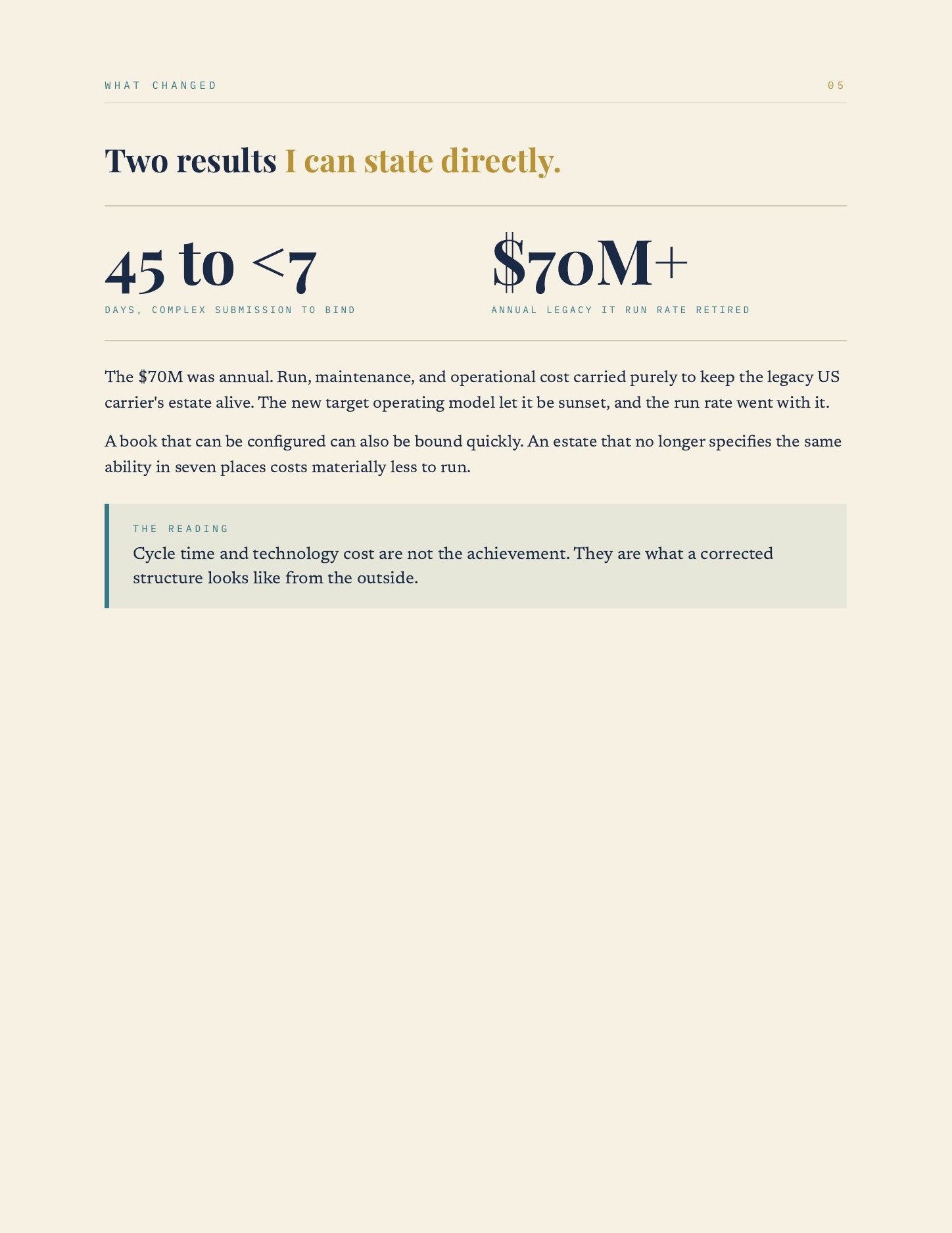
Two results I can state directly.
The $70M was annual. Run, maintenance, and operational cost carried purely to keep the legacy US carrier's estate alive. The new target operating model let it be sunset, and the run rate went with it.
A book that can be configured can also be bound quickly. An estate that no longer specifies the same ability in seven places costs materially less to run.
Cycle time and technology cost are not the achievement. They are what a corrected structure looks like from the outside.
A buyer later priced its own read of it.
Another carrier acquired the US middle market and entertainment businesses. $450M in cash for franchise value, roughly $2B of loss reserves assumed, $1.7B of gross premium written in the prior year, about 500 people, $1.4B of total transaction value.
In the investor presentation filed with the acquisition, the buyer stated that a multiyear underwriting and operational transformation program launched under the prior owner had reshaped the book and improved performance, and listed a scalable platform for middle market business among the assets it was acquiring.
The buyer then drew a line. The loss portfolio transfer covers losses occurring on or after January 1, 2016. Everything written before that stayed with the seller.
The buyer took the book the transformed operating model wrote, and left the one written before it.
The enterprise has to be defined once. Everything else renders from it.
Carriers still buy transformation as a collection of requirements, workflows, applications, and now AI use cases. Each one specifies the enterprise again, in its own vocabulary, for its own scope, and none of them agrees with the last. The program runs. The spend lands. The book still cannot be read as one thing, and so it still cannot be priced, steered, or sold as one.
The alternative is not another framework. It is one common business capability architecture, authored once and governed, from which the target operating model, process design, user experience, class structures, and now the placement of AI all render in common.
Author the ability once and the book becomes configurable: a product is a change to attributes rather than a new specification. Steerable: every account is measured against the same definition. Separable: the enterprise can be cut along something real.
The transformation worked because the enterprise stopped rebuilding the same ability every time the context changed.