 Carlson BCM
Read as text
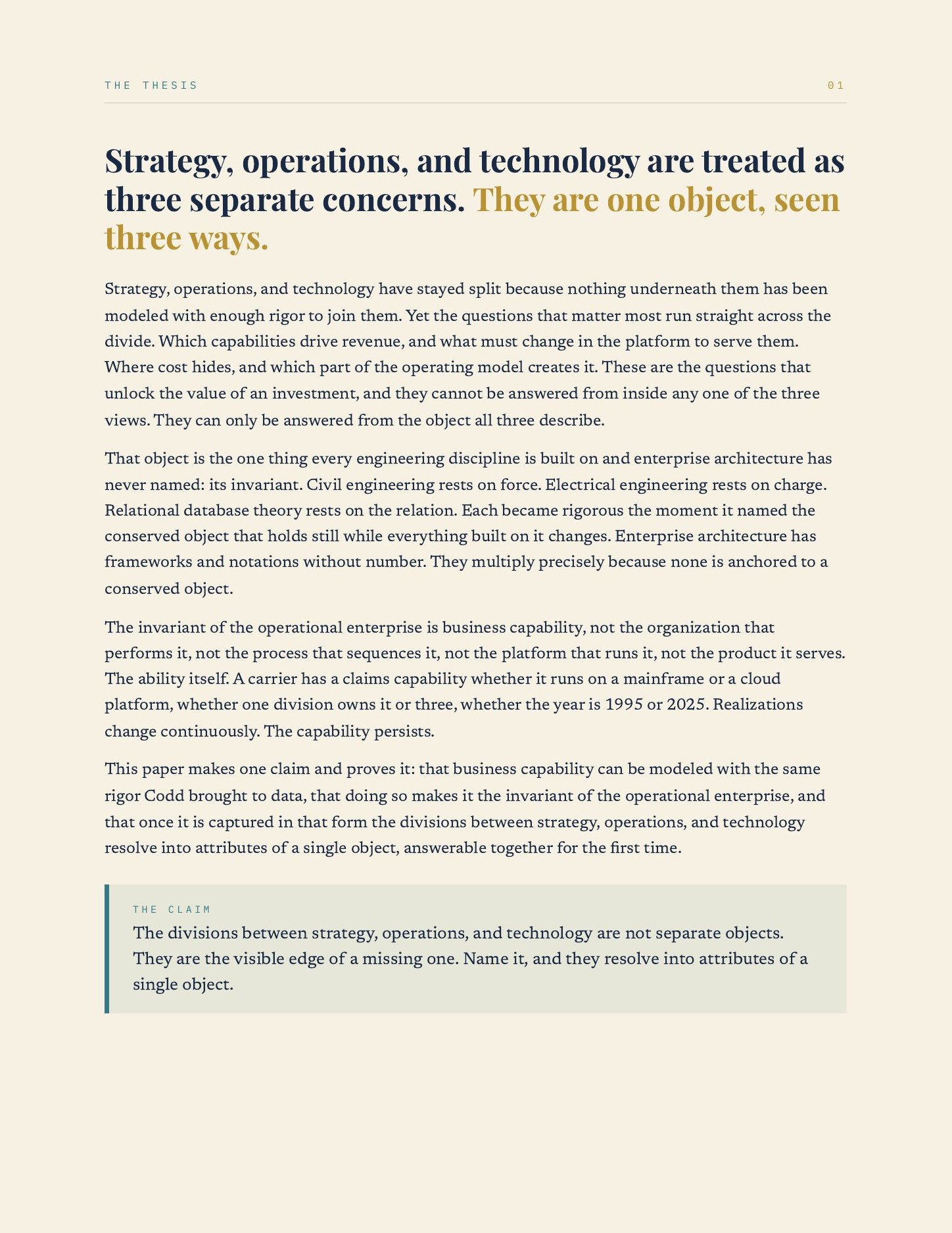
Strategy, operations, and technology are treated as three separate concerns. They are one object, seen three ways.
Strategy, operations, and technology have stayed split because nothing underneath them has been modeled with enough rigor to join them. Yet the questions that matter most run straight across the divide. Which capabilities drive revenue, and what must change in the platform to serve them. Where cost hides, and which part of the operating model creates it. These are the questions that unlock the value of an investment, and they cannot be answered from inside any one of the three views. They can only be answered from the object all three describe.
That object is the one thing every engineering discipline is built on and enterprise architecture has never named: its invariant. Civil engineering rests on force. Electrical engineering rests on charge. Relational database theory rests on the relation. Each became rigorous the moment it named the conserved object that holds still while everything built on it changes. Enterprise architecture has frameworks and notations without number. They multiply precisely because none is anchored to a conserved object.
The invariant of the operational enterprise is business capability, not the organization that performs it, not the process that sequences it, not the platform that runs it, not the product it serves. The ability itself. A carrier has a claims capability whether it runs on a mainframe or a cloud platform, whether one division owns it or three, whether the year is 1995 or 2025. Realizations change continuously. The capability persists.
This paper makes one claim and proves it: that business capability can be modeled with the same rigor Codd brought to data, that doing so makes it the invariant of the operational enterprise, and that once it is captured in that form the divisions between strategy, operations, and technology resolve into attributes of a single object, answerable together for the first time.
The divisions between strategy, operations, and technology are not separate objects. They are the visible edge of a missing one. Name it, and they resolve into attributes of a single object.
The enterprise already reveres one invariant. It is data. The reverence is right, and it is not the whole picture.
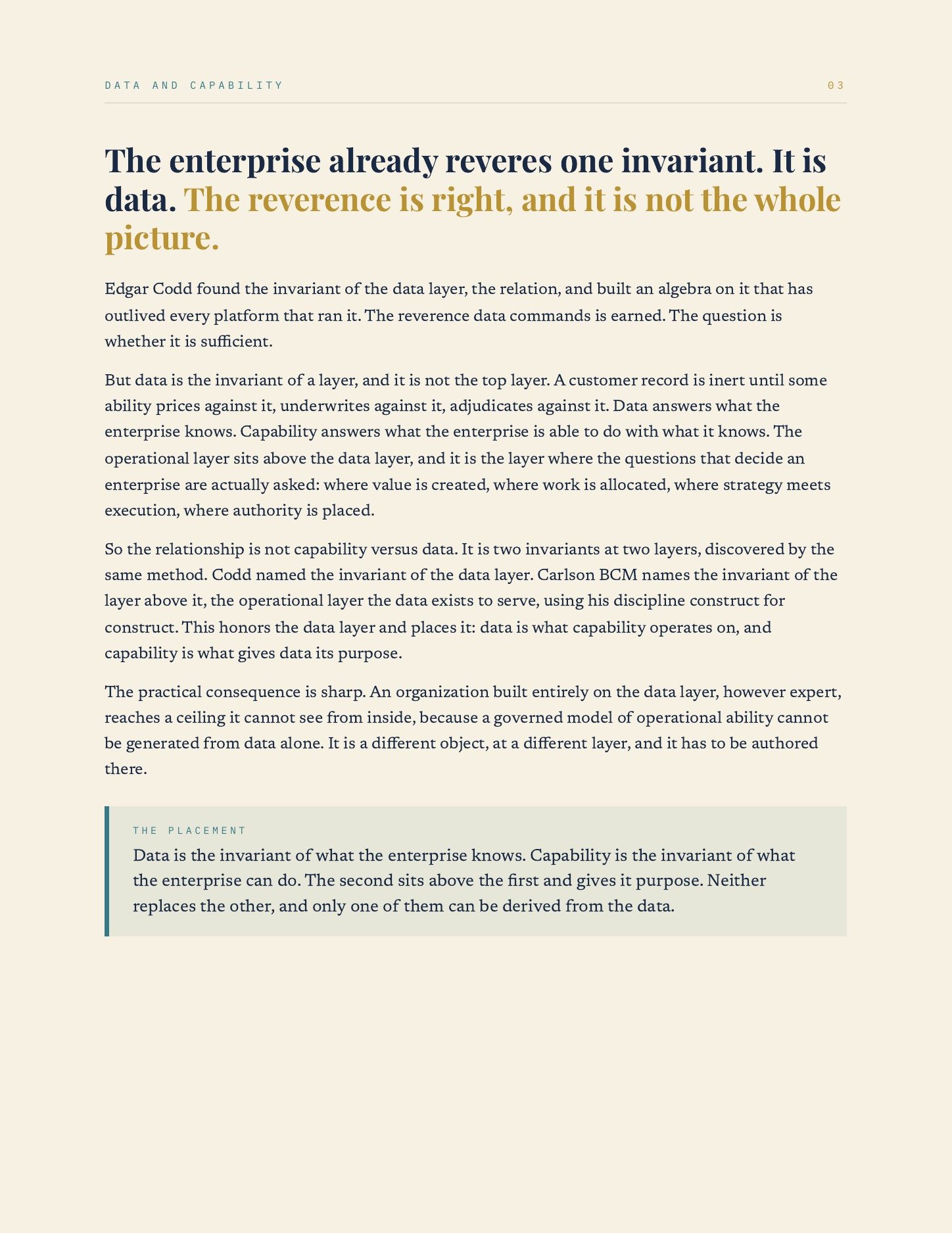
Edgar Codd found the invariant of the data layer, the relation, and built an algebra on it that has outlived every platform that ran it. The reverence data commands is earned. The question is whether it is sufficient.
But data is the invariant of a layer, and it is not the top layer. A customer record is inert until some ability prices against it, underwrites against it, adjudicates against it. Data answers what the enterprise knows. Capability answers what the enterprise is able to do with what it knows. The operational layer sits above the data layer, and it is the layer where the questions that decide an enterprise are actually asked: where value is created, where work is allocated, where strategy meets execution, where authority is placed.
So the relationship is not capability versus data. It is two invariants at two layers, discovered by the same method. Codd named the invariant of the data layer. Carlson BCM names the invariant of the layer above it, the operational layer the data exists to serve, using his discipline construct for construct. This honors the data layer and places it: data is what capability operates on, and capability is what gives data its purpose.
The practical consequence is sharp. An organization built entirely on the data layer, however expert, reaches a ceiling it cannot see from inside, because a governed model of operational ability cannot be generated from data alone. It is a different object, at a different layer, and it has to be authored there.
Data is the invariant of what the enterprise knows. Capability is the invariant of what the enterprise can do. The second sits above the first and gives it purpose. Neither replaces the other, and only one of them can be derived from the data.
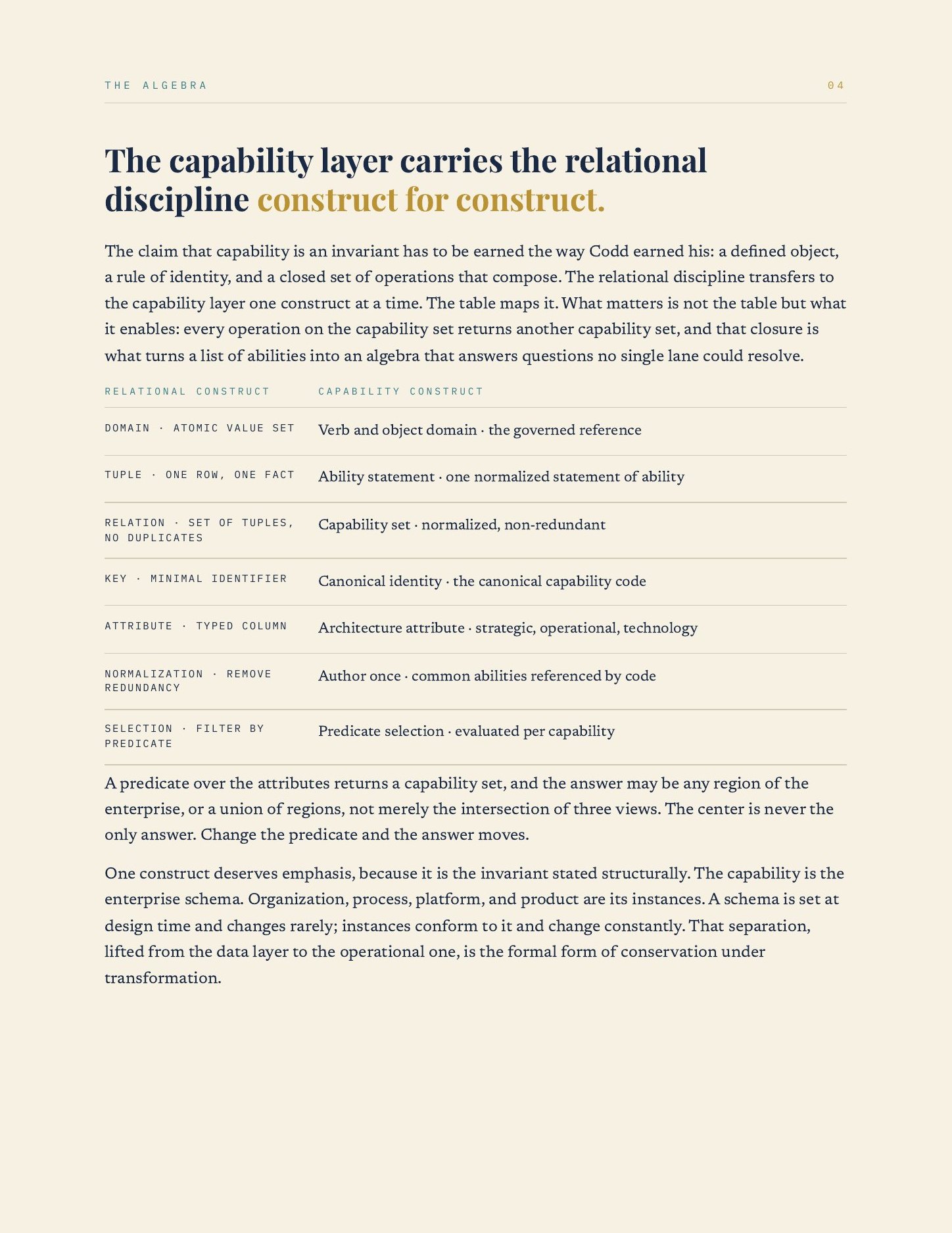
The capability layer carries the relational discipline construct for construct.
The claim that capability is an invariant has to be earned the way Codd earned his: a defined object, a rule of identity, and a closed set of operations that compose. The relational discipline transfers to the capability layer one construct at a time. The table maps it. What matters is not the table but what it enables: every operation on the capability set returns another capability set, and that closure is what turns a list of abilities into an algebra that answers questions no single lane could resolve.
A predicate over the attributes returns a capability set, and the answer may be any region of the enterprise, or a union of regions, not merely the intersection of three views. The center is never the only answer. Change the predicate and the answer moves.
One construct deserves emphasis, because it is the invariant stated structurally. The capability is the enterprise schema. Organization, process, platform, and product are its instances. A schema is set at design time and changes rarely; instances conform to it and change constantly. That separation, lifted from the data layer to the operational one, is the formal form of conservation under transformation.
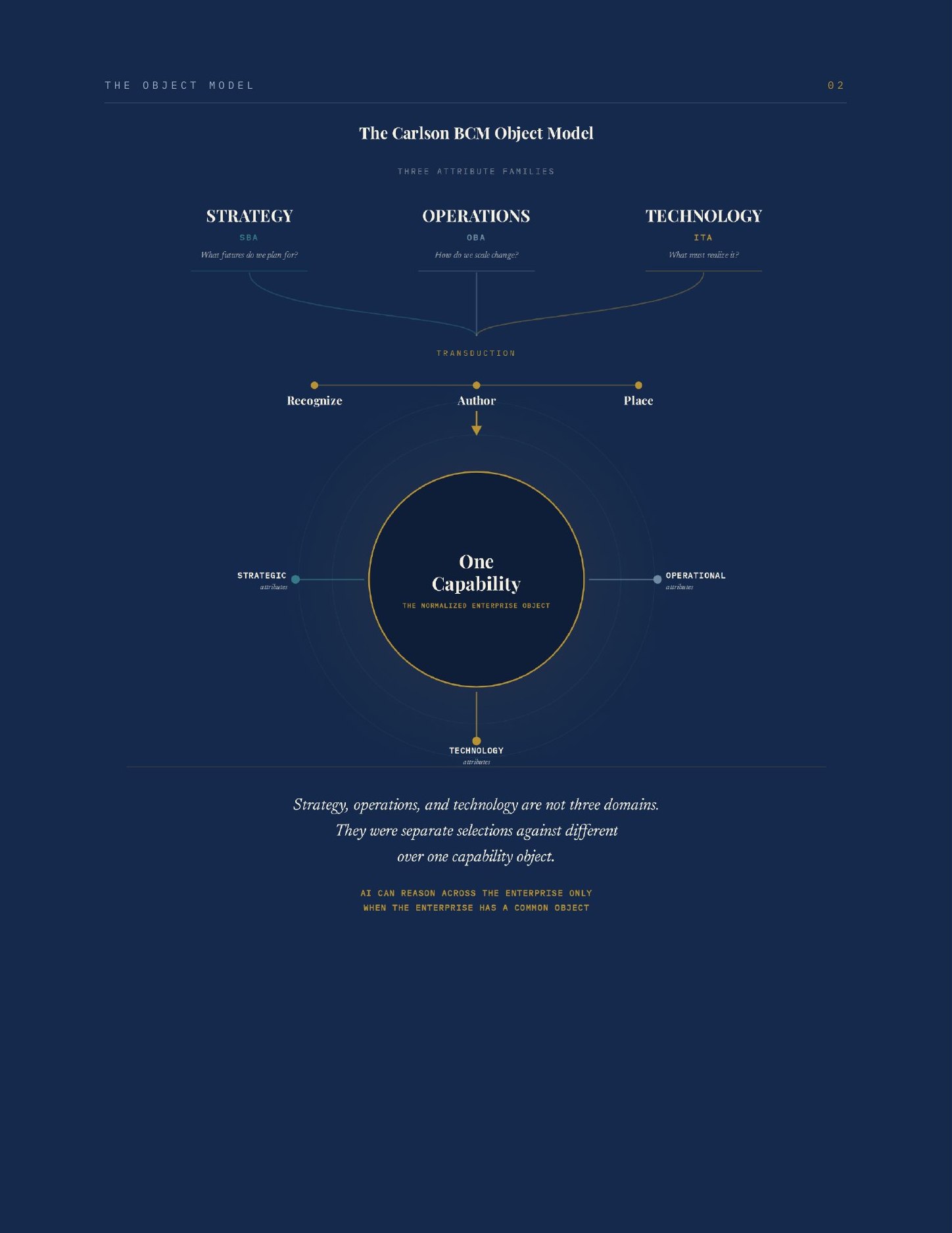
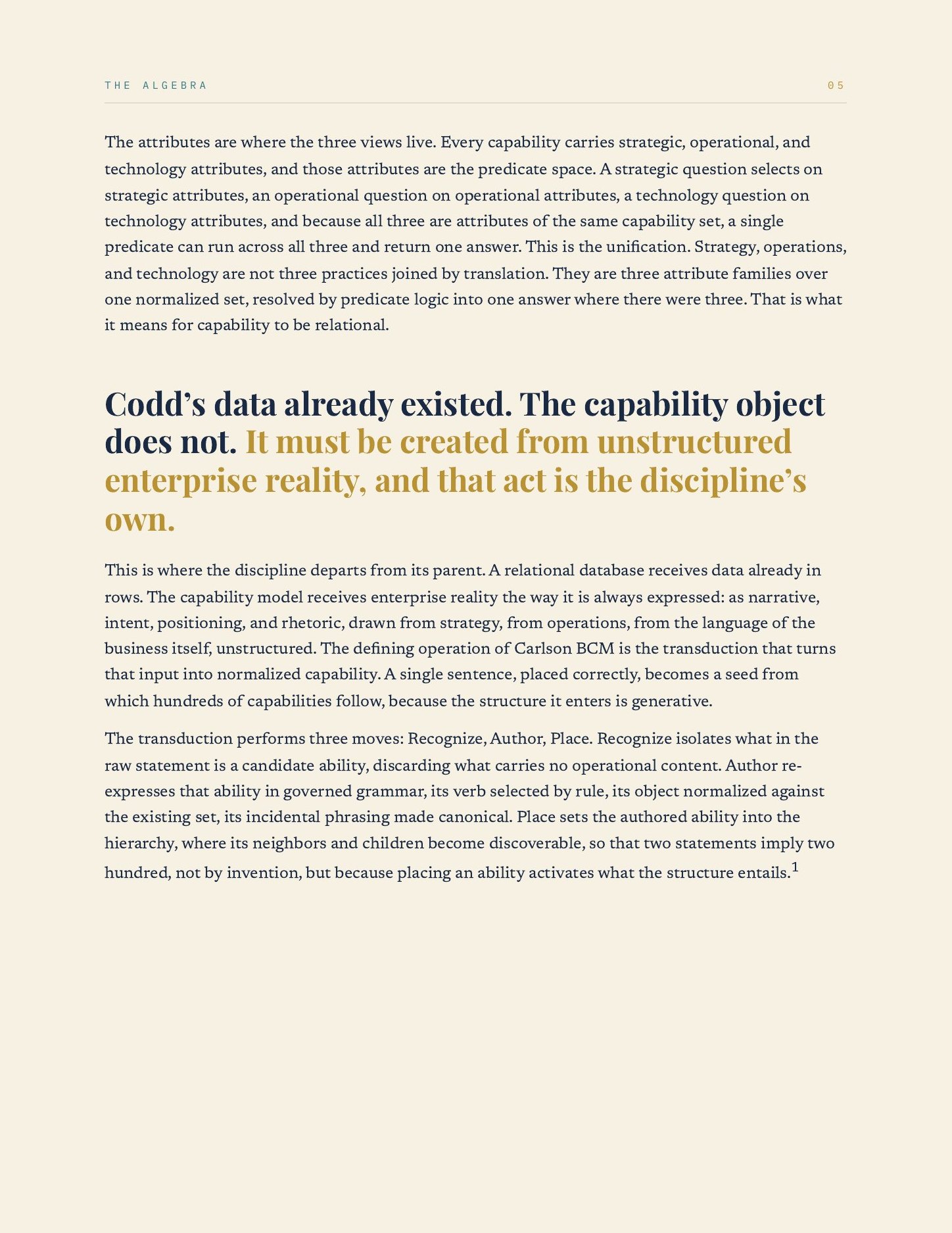
The attributes are where the three views live. Every capability carries strategic, operational, and technology attributes, and those attributes are the predicate space. A strategic question selects on strategic attributes, an operational question on operational attributes, a technology question on technology attributes, and because all three are attributes of the same capability set, a single predicate can run across all three and return one answer. This is the unification. Strategy, operations, and technology are not three practices joined by translation. They are three attribute families over one normalized set, resolved by predicate logic into one answer where there were three. That is what it means for capability to be relational.
Codd’s data already existed. The capability object does not. It must be created from unstructured enterprise reality, and that act is the discipline’s own.
This is where the discipline departs from its parent. A relational database receives data already in rows. The capability model receives enterprise reality the way it is always expressed: as narrative, intent, positioning, and rhetoric, drawn from strategy, from operations, from the language of the business itself, unstructured. The defining operation of Carlson BCM is the transduction that turns that input into normalized capability. A single sentence, placed correctly, becomes a seed from which hundreds of capabilities follow, because the structure it enters is generative.
The transduction performs three moves: Recognize, Author, Place. Recognize isolates what in the raw statement is a candidate ability, discarding what carries no operational content. Author re-expresses that ability in governed grammar, its verb selected by rule, its object normalized against the existing set, its incidental phrasing made canonical. Place sets the authored ability into the hierarchy, where its neighbors and children become discoverable, so that two statements imply two hundred, not by invention, but because placing an ability activates what the structure entails. 1
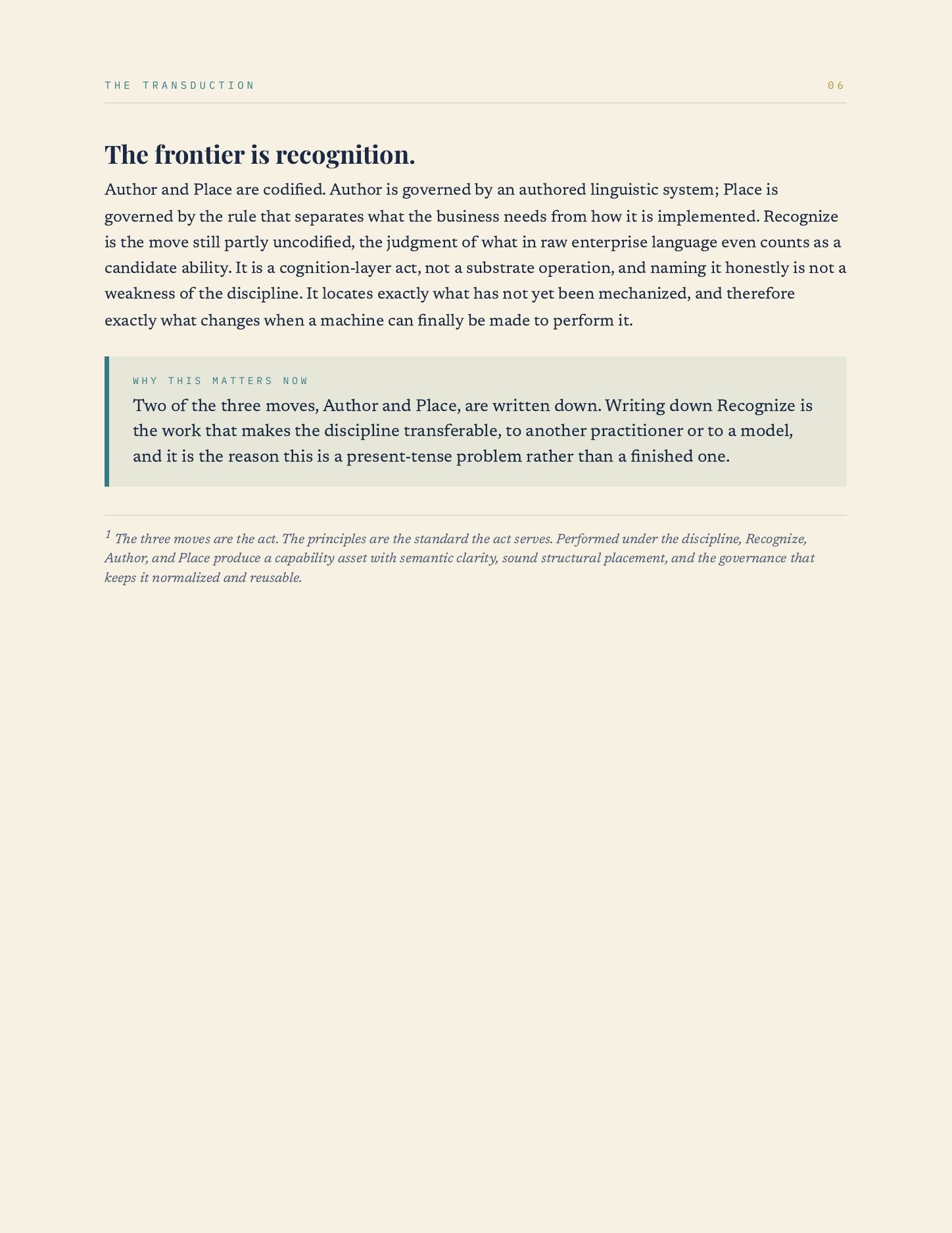
The frontier is recognition.
Author and Place are codified. Author is governed by an authored linguistic system; Place is governed by the rule that separates what the business needs from how it is implemented. Recognize is the move still partly uncodified, the judgment of what in raw enterprise language even counts as a candidate ability. It is a cognition-layer act, not a substrate operation, and naming it honestly is not a weakness of the discipline. It locates exactly what has not yet been mechanized, and therefore exactly what changes when a machine can finally be made to perform it.
Two of the three moves, Author and Place, are written down. Writing down Recognize is the work that makes the discipline transferable, to another practitioner or to a model, and it is the reason this is a present-tense problem rather than a finished one.
1 The three moves are the act. The principles are the standard the act serves. Performed under the discipline, Recognize,
Author, and Place produce a capability asset with semantic clarity, sound structural placement, and the governance that keeps it normalized and reusable.
Name the invariant, and the questions that cross the divisions become answerable in a single move.
Once capability is captured in invariant form, the divisions stop being walls and become attributes. A question can run from strategy through operations to technology in one selection: which capabilities drive the most value; what supports them; and what must change in the platform to realize them. These are the questions that unlock the value of an investment, and they were never answerable from inside one view.
The present moment makes this urgent rather than elegant. The enterprise is generating software faster than ever, through low-code, no-code, and AI-generated build. But speed against no invariant does not reduce complexity, it multiplies it. Every generated solution not expressed against a shared capability object is another single-use artifact. Generating them faster only industrializes the production of debt. AI accelerates building. Without an invariant to build against, what it accelerates is proliferation.
The capability invariant is the precondition. It turns AI-accelerated building from a faster way to make point solutions into a way to build against something reusable. The enterprise that names its invariant can reason across its own divisions and build without multiplying debt. The one that does not will generate its own fragmentation at machine speed.
Capability is the invariant of the operational enterprise. Model it with the rigor data has long enjoyed, and strategy, operations, and technology resolve into one object: answerable together, buildable against, and reusable without multiplying debt.