 Carlson BCM
I
Strategic
What futures do we need to plan for?
Revenue growth, cost efficiency, customer experience, risk and compliance, and strategic agility.
An authored, registered, and fully relational corpus of enterprise ability. The asset beneath the practice.
Every capability in the library is authored under the same principles and attributed across strategy, operations, and technology. Where the experts who ran the work gave judgment, it is preserved with its provenance. Where they were silent, values are reasoned or derived under explicit rules, and every gap is recorded as a finding rather than left blank.
Insurance is the deepest shelf and the quintessential domain. The others follow the same rules, so a capability authored in one can be read, compared, and joined against any other.
New business, underwriting, rating and pricing, binding and issuance, small commercial, renewals, and mid-term change.
Life, annuity, and group benefits: new business, enrollment, worksite, policy administration, billing, and claims.
Analytical judgment, market infrastructure, regulatory reporting, trading, settlement, asset servicing, and record keeping.
The customer, agent, and broker experience across journeys, channels, enablers, and the metrics that govern them.
Data platforms, networks, observability, and IT operations, chip to experience.
The abilities every enterprise shares, authored once and referenced wherever they occur.
An illustration from commercial property and casualty. The business capability states what the enterprise must be able to do; the functional capabilities beneath it state how that need is met.
Strategy, operations, and technology are not three models reconciled in meetings. They are three families of attributes on the same capability.
What futures do we need to plan for?
Revenue growth, cost efficiency, customer experience, risk and compliance, and strategic agility.
How do we drive, scale, and accelerate change?
Products and coverages, channels, markets, geographies, roles and accountability, and the workforce that performs the work.
What is the resulting impact on the technology architecture?
Applications, data, platforms, and AI-native architecture, including which class of intelligence each capability admits.
The Library is held in a fully relational database, operational in PostgreSQL, under a governed schema of thirty-six conceptual entities across the three architecture domains. It is owned, documented, and registered, and it travels intact from one engagement to the next.
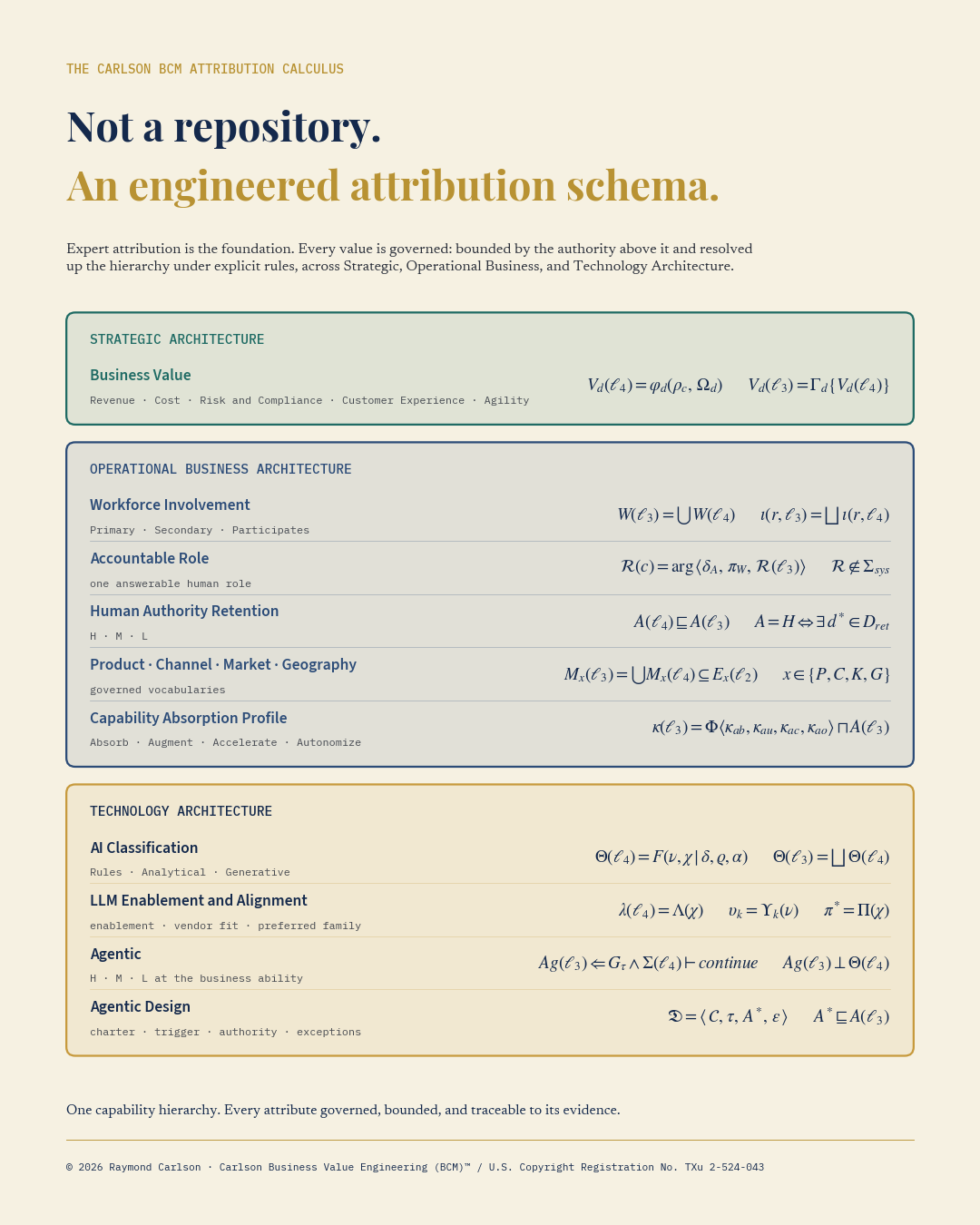
Every attribution is a relational selection against the same capability identities, so a question asked in any lane is answered against one governed corpus.
Every judgment records its source: expert, reasoned, or derived. Findings are first-class objects. What the rules cannot settle is recorded, never guessed.
Platform-independent by design. The corpus deploys by API into whatever the enterprise runs: service management such as ServiceNow, enterprise architecture tools such as LeanIX, operational platforms such as Palantir, and the LLM and agentic platforms now arriving. It also renders to Excel on demand, in a format that never drifts.
No study is commissioned to assemble what the corpus already holds, and the underlying judgments remain available for examination.
The corpus is brought to each engagement as a starting point measured in weeks rather than months, extended where an enterprise genuinely differs, and governed as it changes. Every extension makes the asset more complete. It is registered under U.S. Copyright Registration No. TXu 2-524-043.
Repositories store answers. A calculus produces them.