 Carlson BCM
Of 250 business capabilities
High for cost efficiency
80
The population a cost program would look at first.
McKinsey states the rule. Carlson BCM shows where it applies.
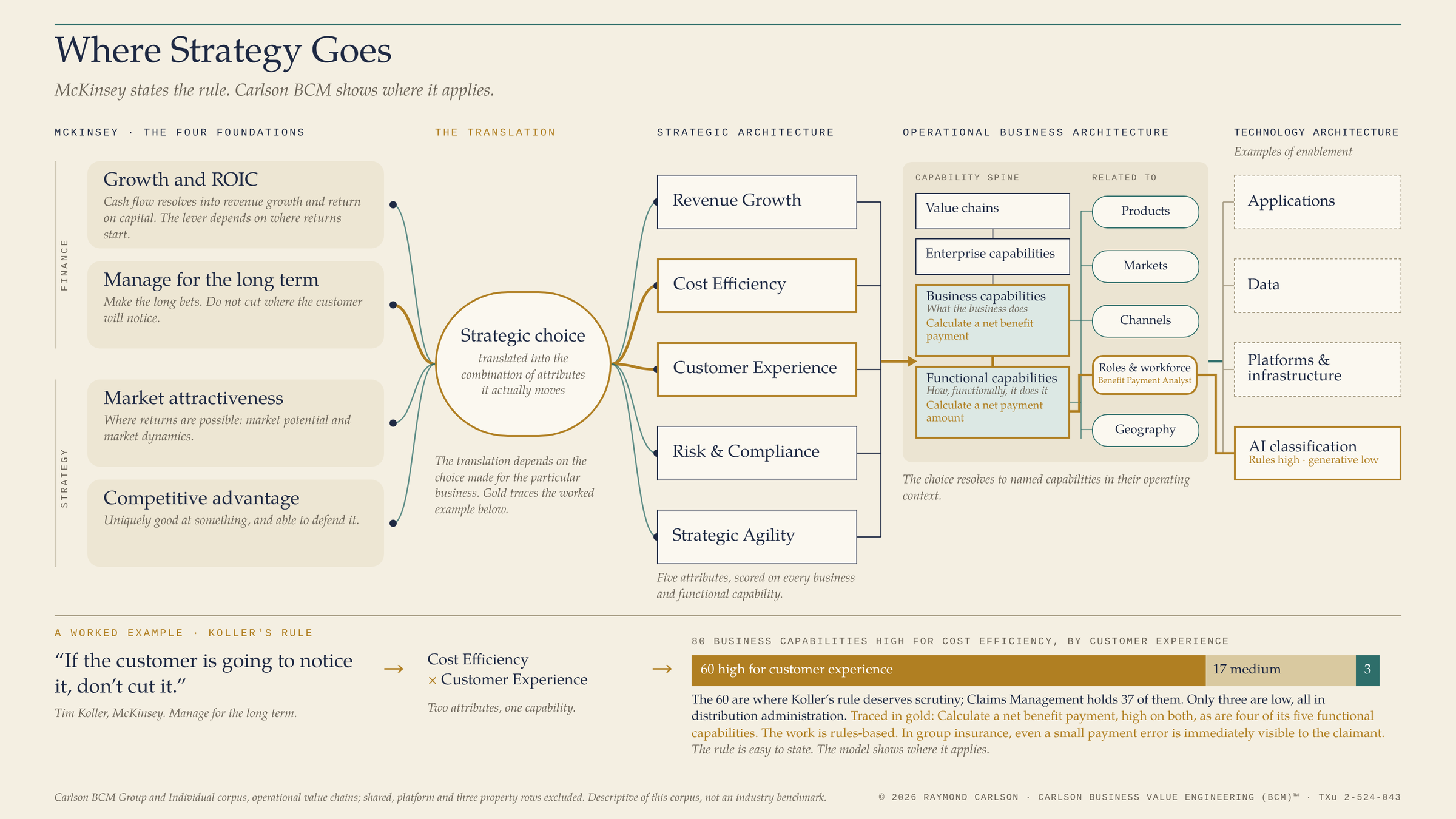
The population a cost program would look at first.
These are where Koller’s rule deserves scrutiny.
Benefits, offsets, overpayments and settlements. Work that moves the customer’s money.
All in distribution administration. A cost priority does not, by itself, identify a safe pool.
Tim Koller states the rule plainly: if you are going to cut costs and the customer is going to notice, do not do it. Carlson BCM translates the rule into two strategic attributes, Cost Efficiency and Customer Experience, and follows one business capability that scores high on both.
Four of its five functional capabilities also score high on both: identifying an applicable payment deduction, calculating a garnishment amount, calculating an overpayment recovery amount and calculating the net payment amount. The rule holds as the work decomposes. The accountable role is the Benefit Payment Analyst. The technology the work calls for is rules, not generative intelligence.
In group insurance, even a small payment error is immediately visible to the claimant. When the work moves the customer’s money, the customer notices.
Derived from the Carlson BCM insurance corpus · Group and Individual
Download the plateThe population is the 250 business capabilities that run a group and individual insurance operation, from product and distribution through new business, policy, billing and claims. Shared and platform categories are excluded, as are three property rows that sit outside the disability model.
Every business capability carries five strategic attributes, each scored high, medium or low. Koller’s rule translates into two of them. The finding crosses Cost Efficiency high with Customer Experience, then counts the result by value chain.
The example is one member of that population, traced from its strategic attributes to its functional capabilities, its accountable role and its AI classification. Every object on the trace is an object in the model. The findings describe this corpus. They are not an industry benchmark.
Strategy does not become executable because the enterprise agrees with it. It becomes executable when the choice can be resolved to the abilities, operating context and technology that have to change.
All insights