 Carlson BCM
Of 2,427 functional capabilities
Can be automated
67%
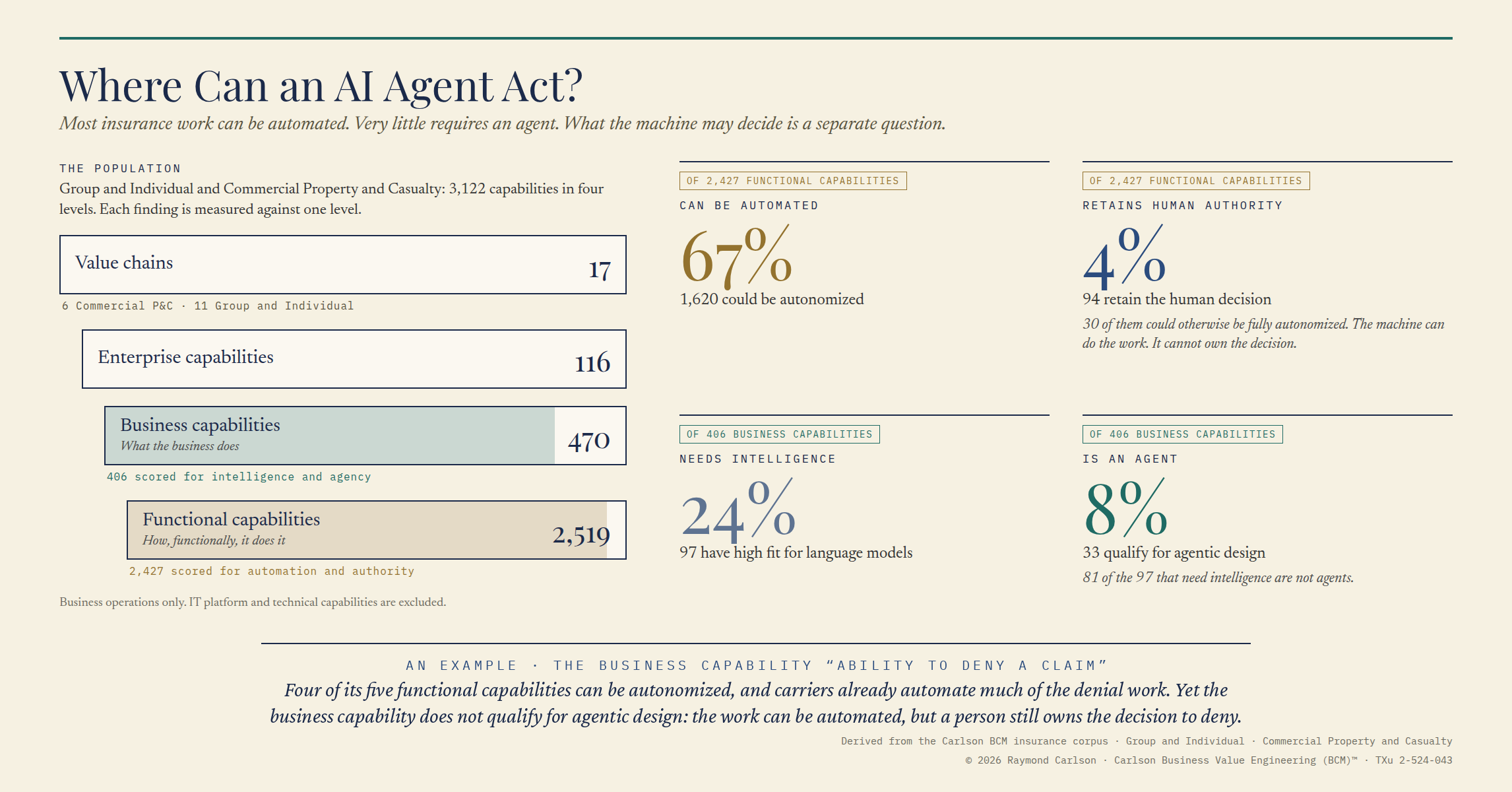
1,620 could be autonomized. Most insurance work can be automated.
Most insurance work can be automated. Very little requires an agent. What the machine may decide is a separate question.
1,620 could be autonomized. Most insurance work can be automated.
97 have high fit for language models.
33 qualify for agentic design. 81 of the 97 that need intelligence are not agents. A model that can read and reason is not a worker that can hold a goal and act on it.
94 retain the human decision. 30 of them could otherwise be fully autonomized. The machine can do the work. It cannot own the decision.
Four of its five functional capabilities can be autonomized, and carriers already automate much of the denial work. Yet the business capability does not qualify for agentic design: the work can be automated, but a person still owns the decision to deny. A denial shifts the loss to the insured, and the carrier answers for it.
Where that ownership has shrunk to a signature on denials reviewed in seconds, it has drawn class actions and new state law requiring a qualified professional to make the decision.
Derived from the Carlson BCM insurance corpus · Group and Individual · Commercial Property and Casualty
Download the plateThe population is 3,122 business operations capabilities across 17 value chains, 6 in Commercial Property and Casualty and 11 in Group and Individual: 116 enterprise capabilities, 470 business capabilities and 2,519 functional capabilities. IT platform and technical capabilities are excluded.
Business capabilities describe what the business does. Functional capabilities describe how, functionally, it does it. Automation and authority are properties of the work, so they are measured on the 2,427 functional capabilities scored for both. Intelligence and agency are properties of what the business does, so they are measured on the 406 business capabilities scored for both.
Every finding states its own denominator, and no comparison mixes the two levels.
The question is not what an agent can do. It is what the enterprise has authorized it to do.
All insights