 Carlson BCM
The Network Didn’t Own the Show
Any episode plays on any channel. Any capability should play for any provider.
Built to play anywhere.
NBC aired Seinfeld. It did not own it. The federal financial interest and syndication rules, in force from 1970 to 1995, kept networks from owning the shows they broadcast, so the show belonged to its producer, Castle Rock, and to Jerry Seinfeld and Larry David.
Ownership explains who got paid. It does not explain why the show kept paying. Part of the answer is how it was built.
Larry David’s rule for the writers was “no hugging, no learning.” Characters did not grow. Nothing carried from one week to the next. Every episode stood on its own. That made the show unusually portable. Any episode could play on any channel, in any order, for any audience: broadcast syndication, cable, home video and, in 2019, a worldwide streaming deal with Netflix reported at more than $500 million.
Seinfeld was owned, and it was built in a form that could travel. An enterprise should hold its own work the same way.
Independence. Any capability, any provider.
An enterprise distributes its work the way a studio distributes a show. Strategy firms design it. Outsourcers operate it. Systems integrators and platforms implement it. AI agents now perform it. Each is a channel.
Most enterprises let each channel write its own episode. The strategy firm defines the business in its framework. The outsourcer defines it in its process maps. The integrator defines it in its configuration. The AI vendor defines it in its prompts. Every engagement produces a new script for the same business, and none of them belongs to the enterprise in a form it can take to the next channel.
Carlson BCM writes the business once, in the enterprise’s own terms. Business capabilities state what the enterprise must be able to do. Functional capabilities state how those abilities work. Each is independently defined, without reference to the role, provider or technology that performs it. The ability to evaluate a submission does not belong to the underwriter, the outsourcing provider, the underwriting platform or the AI model that performs it. Its definition belongs to the enterprise.
That independence is what lets a capability play on any channel. The strategy firm designs against it. The outsourcer operates against it. The integrator implements against it. The AI agent performs against it. The episode does not change when the network does.
Independent does not mean frozen. The definition changes when the business changes. It changes in one place, under the enterprise’s control, and every channel plays the new version.
Convergence. One cast, many storylines.
Independence made Seinfeld portable. Convergence made it great. Most episodes ran parallel storylines that developed on their own until the last act, when they collided in a single ending. They could collide because they shared one cast. The same four characters carried every storyline, and the writers governed how the threads related within one episode.
Carlson BCM is built the same way. Capabilities are the cast. Lines of business, with their products and coverages, are the storylines. Each line has its own rules, regulators, participants and authority, and those legitimate differences are made explicit. But every line runs on the same independently defined capabilities, related within one governed enterprise model. That shared cast is what lets the storylines converge on one customer, one policy, one claim.
Without it, each line, provider and platform recasts the business in its own terms, and the enterprise gets six sitcoms, each written by a different network.
The Carlson BCM Commercial P&C corpus shows the cast at work. Across six commercial lines, Business Auto, Crime, Entertainment, General Liability, Inland Marine and Property, 599 functional capabilities carry the work. Of those, 454 serve four or more lines. And 159 serve all six. Only six serve a single line. Any two lines share, on average, 62 percent of the capabilities either one uses.
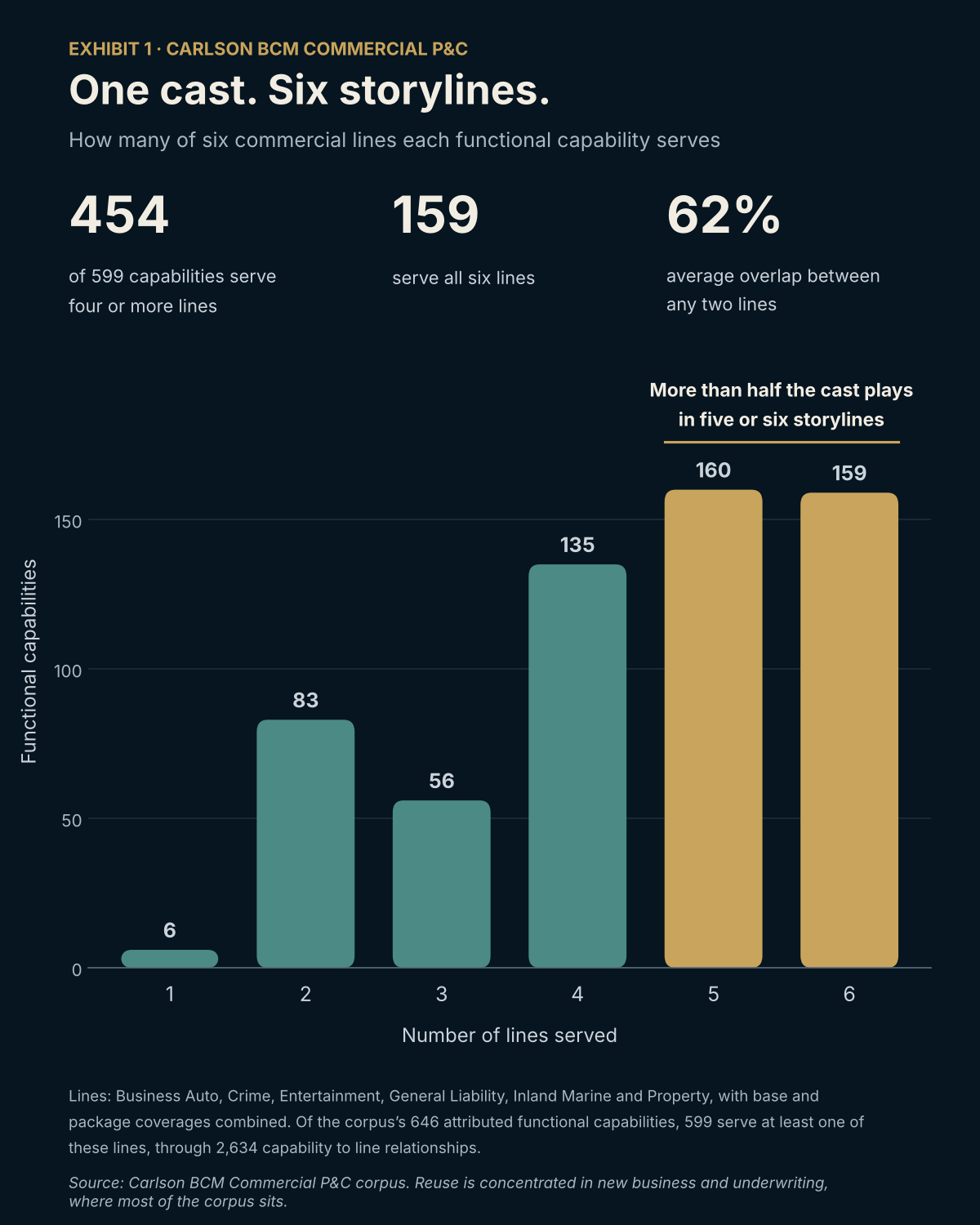
If each line authored every capability it uses, the enterprise would maintain 2,634 functional specifications. Carlson BCM maintains 599, with their relationships to each line explicitly governed. That is 2,035 potential rewrites, avoided without giving up a single line of business or its legitimate differences. One script, not 2,634.
The show outlived the network.
Seinfeld ended in 1998. Twenty-one years later, a streaming business that did not exist when the scripts were written paid more than half a billion dollars to play them. The network that first aired the show had no claim on that deal. The format, the channel and the audience had all changed. The episodes had not.
That is the test for an enterprise’s business architecture. Platforms will be replaced. Outsourcing contracts will end. Consulting firms will rotate. AI models will be superseded every year. If the definition of the business lives in their scripts, it leaves with them. If it lives in a governed capability architecture the enterprise owns, every one of them is just another channel.
The rules that kept NBC from owning Seinfeld were repealed in 1995, and networks moved to own the shows they aired. The enterprise faces the same drift without any rule change at all. Every configuration, process map and prompt that defines the work in a provider’s terms makes that provider a little more the network that owns the show. No regulation will stop that. Only the enterprise can.
Own the episodes. Let any network air them.