 Carlson BCM
The Chains We Forged
An enterprise is visited by three spirits, and learns what it has been forgetting.
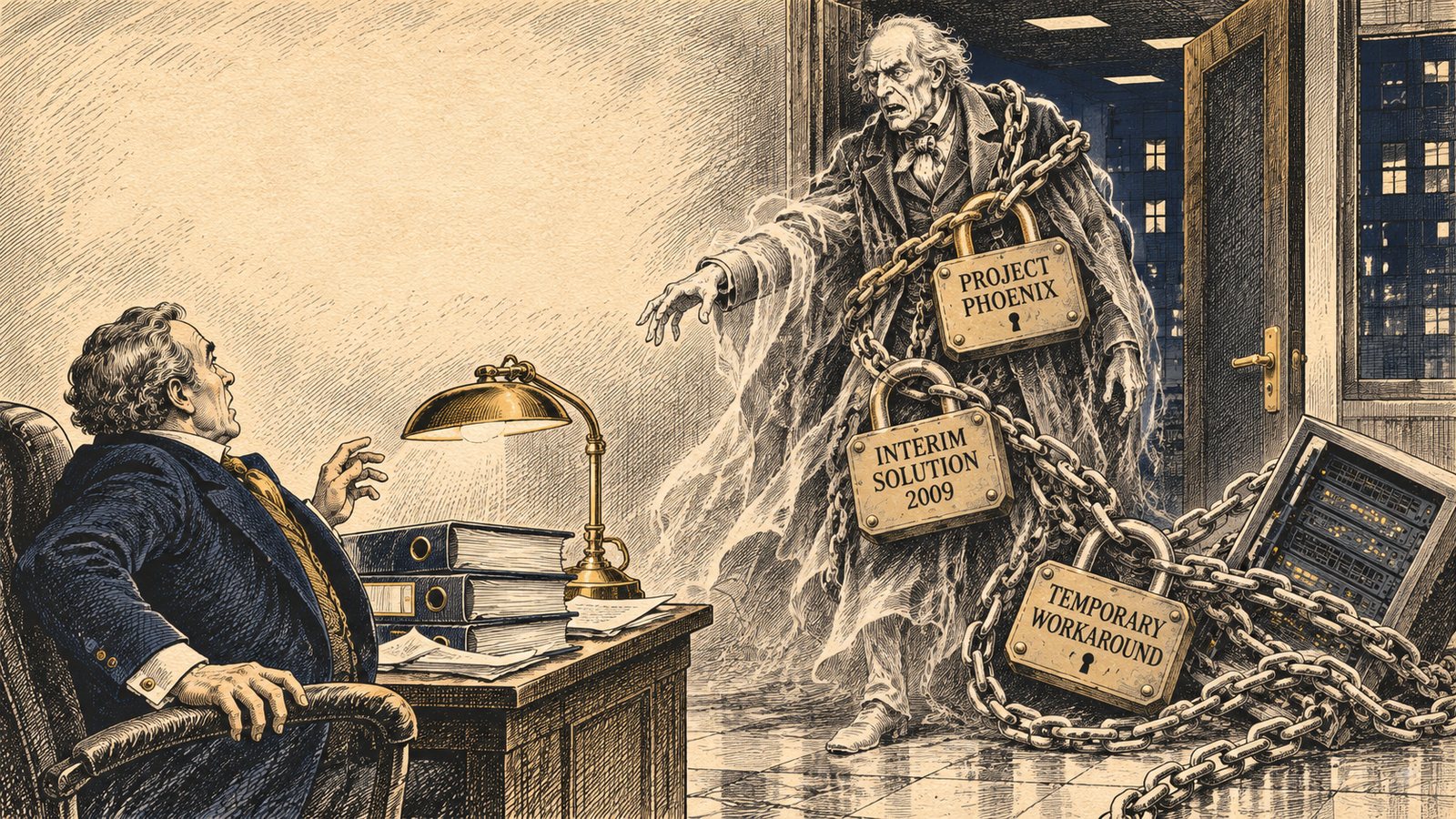
“I wear the chain I forged in life.”
Marley’s Ghost
Marley was dead, to begin with. He had run the firm for nineteen years, and in that time he had launched three transformations, retired two chief information officers and commissioned more binders than the basement could hold. When he died, the firm sent flowers, renamed a conference room after him and kept every one of his systems running, because no one was entirely sure what would stop if they didn’t.
Ebenezer Scrooge had inherited all of it. He sat in his office on Christmas Eve, long after the floor had emptied, reading a budget line that annoyed him.
“Four hundred thousand dollars,” he said to no one, “to keep running a system nobody can explain.”
Outside his door, Bob Cratchit was still at his desk, closing out the quarter by hand, as he did every quarter, because the reconciliation never quite reconciled and he was the only one who knew where it went wrong.
“Cratchit. You’ll want tomorrow off, I suppose.”
“If it’s convenient, sir.”
“It is never convenient. Be in early the day after.”
The building’s heating clicked off at nine. At ten, the lights on Scrooge’s floor flickered, and he heard it coming down the corridor before he saw it: a dragging, metallic sound, like a server rack being pulled across marble.
Marley came through the closed door. He was grey and translucent and wrapped from neck to ankle in chain, and every link had a padlock, and every padlock had a name stamped into it. Project Horizon. Project Phoenix. Project One. Interim Solution, 2009. Temporary Workaround, Do Not Remove.
“Jacob,” said Scrooge. “You look terrible.”
“I wear the chain I forged in life,” said Marley. “I made it link by link. Every shortcut I approved. Every program I abandoned halfway. Every vendor I let decide what the firm was, because it was easier than deciding myself.”
“But you were always a good man of business, Jacob.”
“Business! I invested in systems. I never once asked what the firm could actually do. And now I drag every one of them behind me, and so will you. Yours is longer than mine already, Ebenezer. You’ve just added the AI ones.”
He rattled the chains, and somewhere below them a fix installed in the summer gave way under the evening’s load, and every screen on the floor went dark.
“You will be visited by three spirits,” said Marley, fading. “Listen to them. Every budget I approved became a link.”
The First of the Three Spirits
The first spirit arrived at one o’clock, carrying a lantern and a lanyard from a consulting firm that no longer existed.
“I am the Ghost of Transformation Past,” it said. “Come.”
They stood in the same building, thirty years younger. The carpet was brown. In the corner office sat Old Fezziwig, the head of operations, with his feet on the desk, answering questions from a line of young analysts.
“Who can approve a payment to a new supplier?” one asked.
“Anyone but the person who set the supplier up,” said Fezziwig, “and here’s why.” And he explained, in three minutes and without notes, how the firm worked: what it could do, who was allowed to do it and what broke if you got it wrong.
“He knew everything,” said Scrooge.
“He knew everything,” the spirit agreed, “and he wrote none of it down, because no one asked him to.”
The scene dissolved. Fezziwig’s retirement party. Cake, a speech, a clock. Then the next morning: a team of consultants in fresh suits, arriving with fresh binders, interviewing forty people to discover what Fezziwig had known.
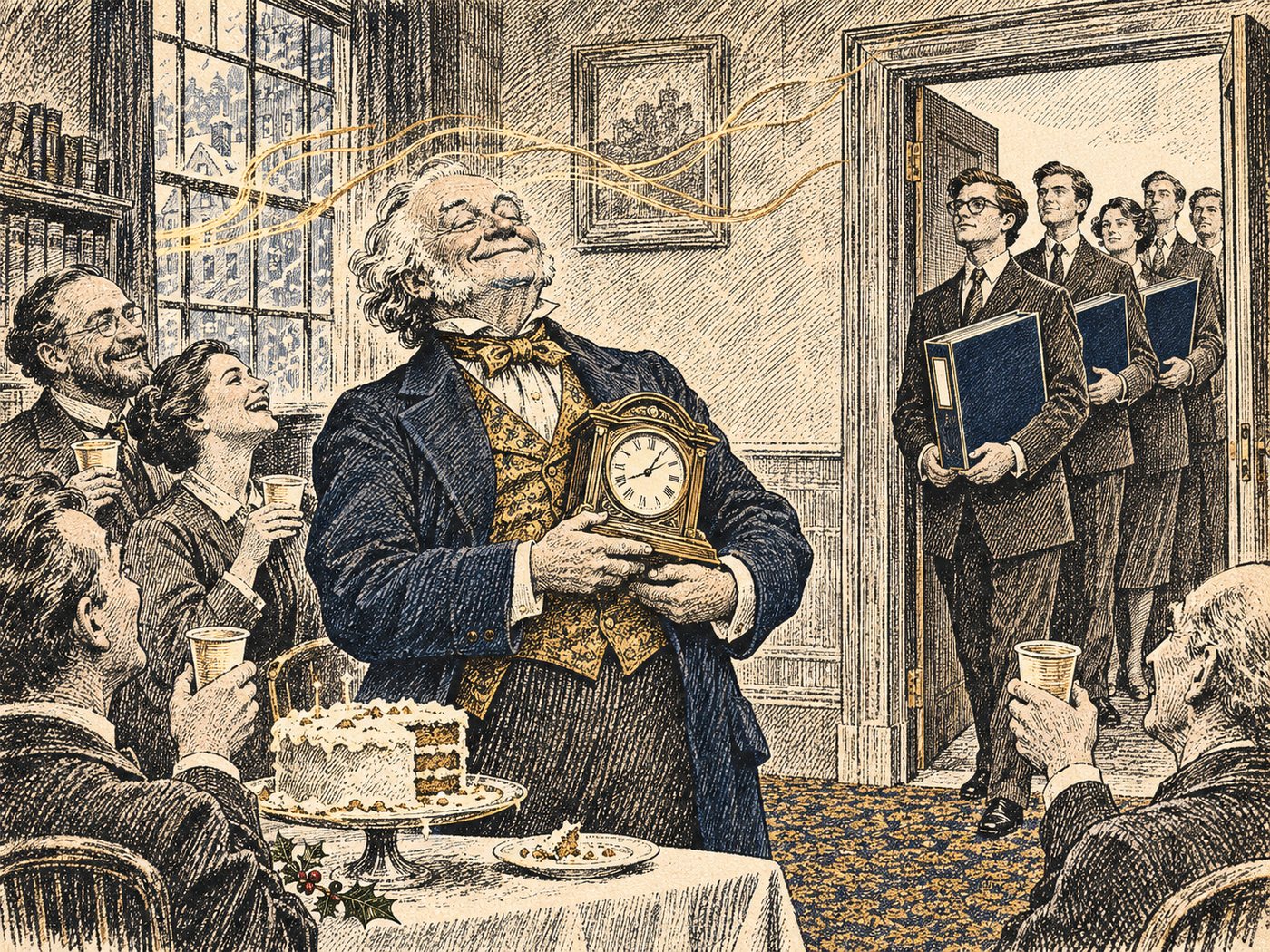
The scene dissolved again. Ten years later. Different consultants, different binders, the same forty questions.
Again. Again.
“They keep rediscovering the same firm,” said Scrooge.
“Three times,” said the spirit. “At great expense. And each time, when the program ended, the knowledge walked out the door with the people who held it. The systems stayed. The understanding left.”
The Second of the Three Spirits
The second spirit was enormous and cheerful and sat on a throne of glowing dashboards.
“I am the Ghost of Transformation Present,” it boomed. “Look how much you have!”
Scrooge looked. Cloud platforms. Automation pilots. Fourteen AI initiatives, each with a sponsor and a slide deck. A data lake. A second data lake, because the first one had been built by a different division. An AI initiative whose only purpose was to explain the results of another AI initiative.
“Impressive,” said Scrooge, a little proud.
“Isn’t it? Now ask it a question.”
“If our core platform failed tomorrow, what would it cost us?”
The dashboards glowed. None of them could answer.
“Which of these AI pilots is returning any value?”
The dashboards glowed more brightly. Still none of them could answer.
“Every one of them was justified on its own,” said the spirit kindly. “Not one of them can tell you what it is worth. You have more technology than any executive in this firm’s history, Ebenezer, and less idea what it is all for.”
Then the spirit showed him a small kitchen on Christmas Eve. A table set for six, one chair empty. Propped against the empty plate was a paper star, cut out by a child.
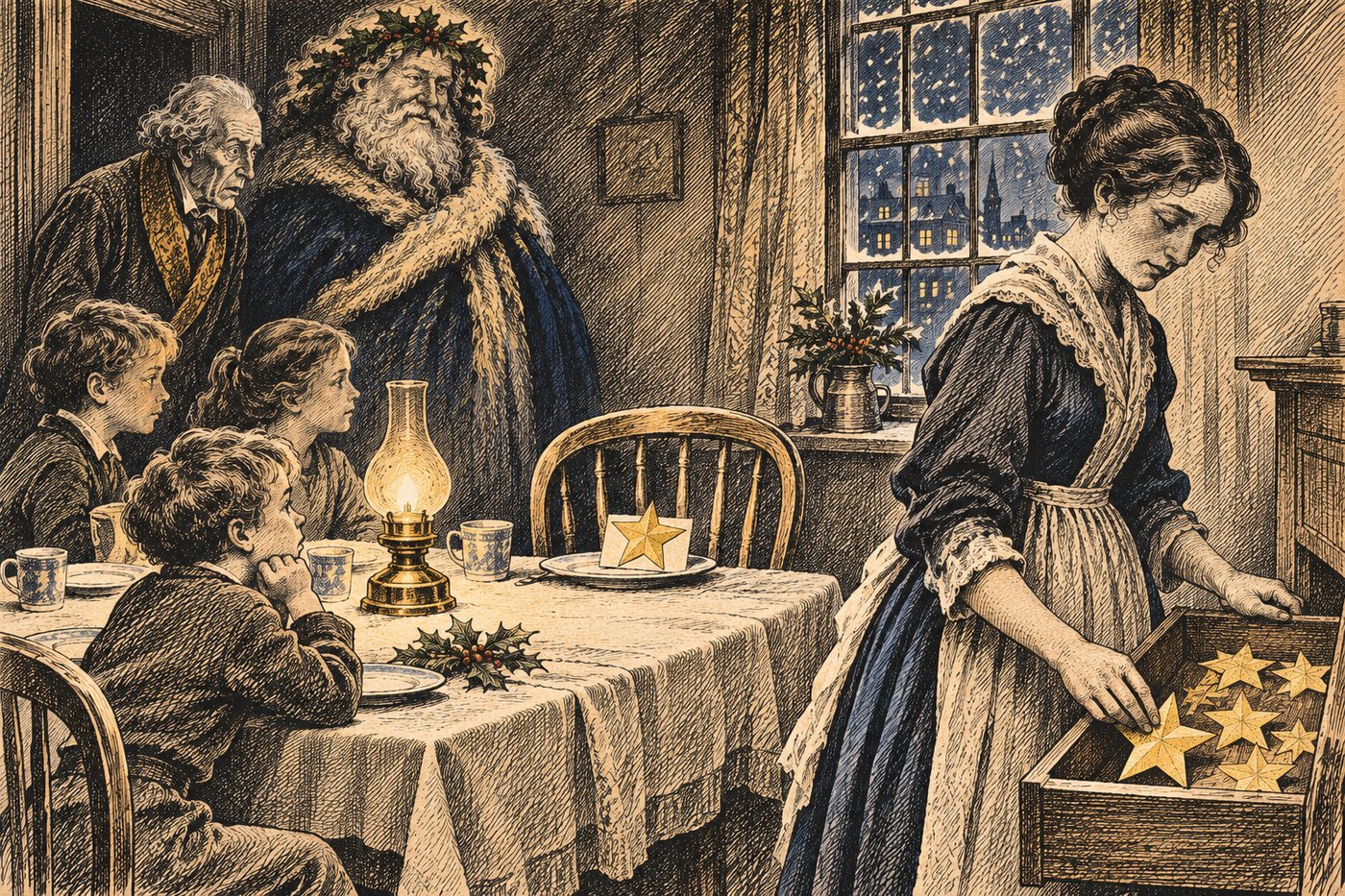
“Is Father coming?” asked the smallest Cratchit.
“Not tonight,” said Mrs. Cratchit. “The quarter.”
“He said that last year.”
“He’ll be home in the morning,” she said, and put the star in a drawer with the others.
Scrooge counted them. There were seven.
“Seven Christmas Eves at that desk,” said the spirit, “because he is the only one who knows why the numbers don’t agree. You pay him for what he knows. His children pay for it too.”
“And if he leaves?”
“Then the quarter doesn’t close,” said the spirit, “and no one will know why.”
The Last of the Spirits
The third spirit did not speak.
It was tall and dark and hooded, and where a face should have been there was only the faint blue glow of a status light.
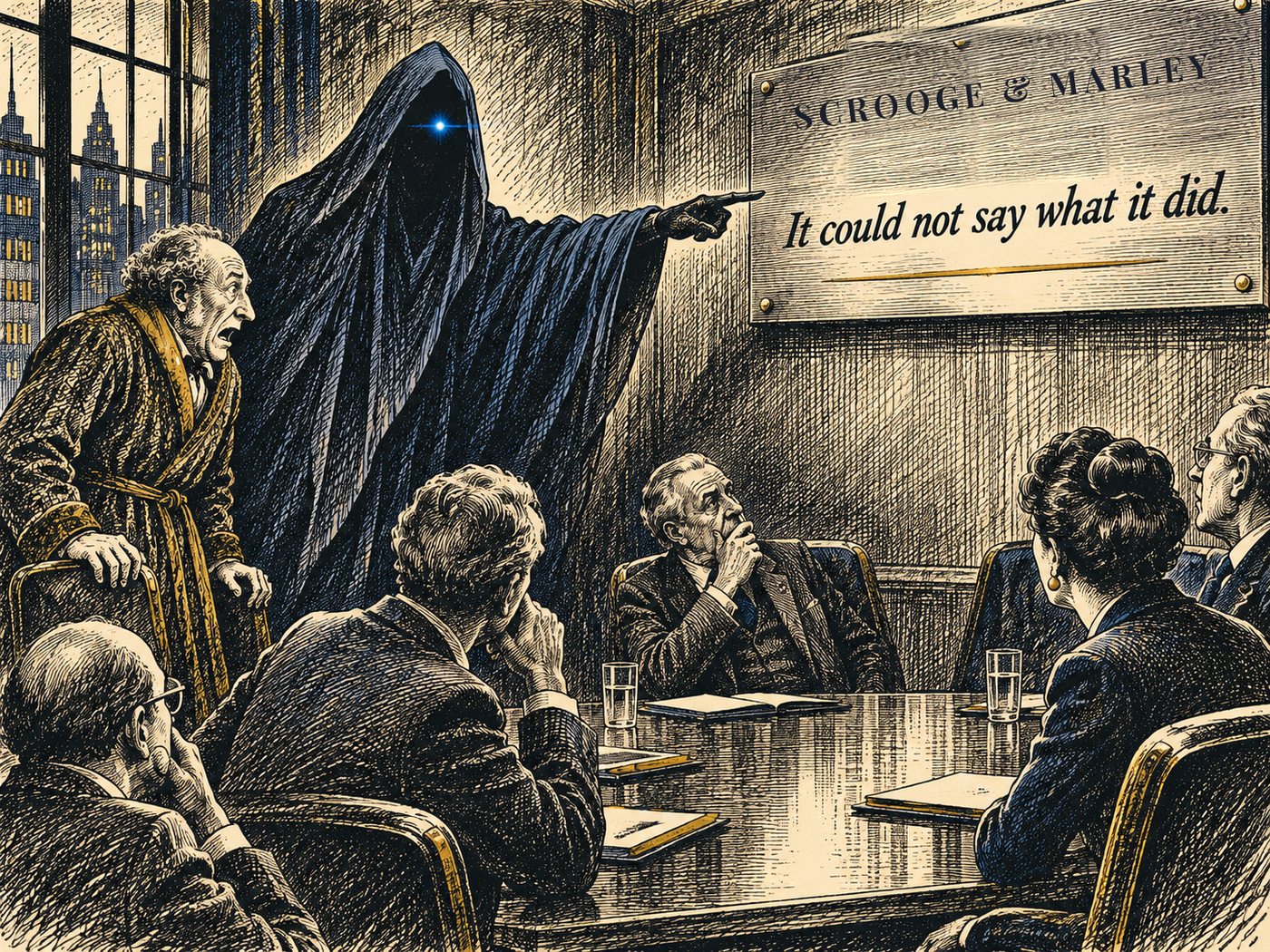
It took Scrooge to a boardroom some years ahead. The directors sat in silence. On the screen was a single decision: a payment approved, a commitment made, a customer refused. No person had made it. An agent had, at 3:14 in the morning.
“Who authorized this?” the chair asked.
The chief technology officer looked at the chief operating officer. The chief operating officer looked at the chief financial officer. The chief financial officer looked at the screen.
“The agent was within its technical permissions,” someone offered.
“That isn’t what I asked. Whose authority did it act under?”
No one answered. No one could. There was nowhere to look it up.
Scrooge turned to the spirit. “Tell me this is only what may be. Tell me it can be changed.”
The spirit said nothing. It raised one hand and pointed.
At the far end of the room hung the firm’s name in brushed steel, the same name that hung over Scrooge’s door. Beneath it, someone had added a line, the way a stonemason finishes a grave:
It could not say what it did.
The End of It
Scrooge woke on his office floor, wrapped in a server cable, with grey light coming through the blinds. He ran to the window and threw it open. A boy was walking a dog in the street below.
“You there! What day is it?”
“It’s Christmas, mister.”
“Christmas! I haven’t missed it!”
He called Cratchit at home. Cratchit answered on the first ring, in the voice of a man who expects bad news.
“Bob. Take the week. Take two.”
“Sir, if I’m not there, the quarter won’t close.”
“Then we will write down how it closes,” said Scrooge, “and keep it, so that no one at this firm ever again spends Christmas Eve as the only person who knows.”
There was a pause on the line, and behind it, a child asking who it was.
“Merry Christmas, Mr. Scrooge.”
“Merry Christmas, Bob.”
He hung up and stood for a long while at the window, thinking of Marley’s chains, and of Fezziwig’s clock, and of the silent figure pointing at a name in steel.
Scrooge was better than his word. From that Christmas on, the firm kept what it knew, and it transformed with the confidence of an enterprise that understood itself. And it was always said of him that he knew what his firm could do, if any executive alive possessed the knowledge.
✦ ✦ ✦
The enterprise had finally stopped forgetting what it was.
Carlson BCM Insights is published weekly on LinkedIn. Each edition carries the week’s insight.