
Carlson BCM
Insight · September 30, 2026

Six Insurance Value Chains. Six Different AI Strategies.

The mistake is asking what AI can do to insurance. The answer changes with the part of the enterprise you are trying to change.
Three transformation patternsProtect retained judgmentIndustrializeRedesign the work
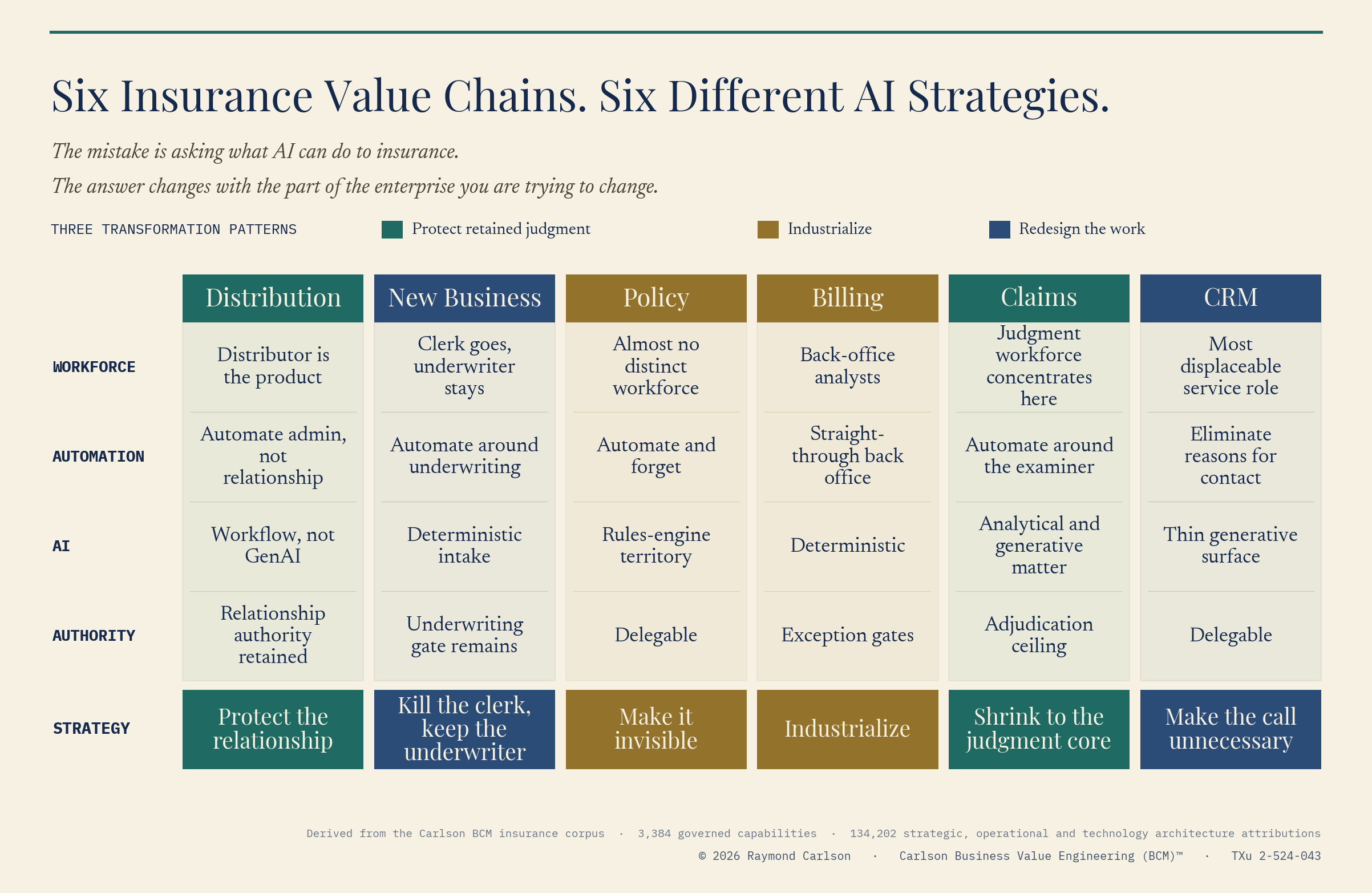
Six insurance value chains, six AI strategies: Distribution, protect the relationship; New Business, kill the clerk, keep the underwriter; Policy, make it invisible; Billing, industrialize; Claims, shrink to the judgment core; CRM, make the call unnecessary.

DistributionProtect retained judgment

Workforce
Distributor is the product
Automation
Automate admin, not relationship
AI
Workflow, not GenAI
Authority
Relationship authority retained
Protect the relationship

New BusinessRedesign the work

Workforce
Clerk goes, underwriter stays
Automation
Automate around underwriting
AI
Deterministic intake
Authority
Underwriting gate remains
Kill the clerk, keep the underwriter

PolicyIndustrialize

Workforce
Almost no distinct workforce
Automation
Automate and forget
AI
Rules-engine territory
Authority
Delegable
Make it invisible

BillingIndustrialize

Workforce
Back-office analysts
Automation
Straight-through back office
AI
Deterministic
Authority
Exception gates
Industrialize

ClaimsProtect retained judgment

Workforce
Judgment workforce concentrates here
Automation
Automate around the examiner
AI
Analytical and generative matter
Authority
Adjudication ceiling
Shrink to the judgment core

CRMRedesign the work

Workforce
Most displaceable service role
Automation
Eliminate reasons for contact
AI
Thin generative surface
Authority
Delegable
Make the call unnecessary

Derived from the Carlson BCM insurance corpus · 3,384 governed capabilities · 134,202 strategic, operational and technology architecture attributions

Download the plate
How it was derived

Four properties, read across every capability in the value chain.

Each value chain was read across four governed properties of every capability in it: the workforce that performs the work, how far the work can be absorbed or automated, the class of intelligence the work admits, and where human authority must be retained.

The pattern a value chain shows across those four properties sets its strategy. Where retained judgment concentrates, the strategy protects it. Where the work is deterministic and authority is delegable, the strategy industrializes it. Where a role is displaceable, the strategy redesigns the work so the role is no longer needed.

All insights